Artisan vs. Monaco: Which fits your team?
Artisan ships an autonomous AI BDR with customer proof today. Monaco is a well-funded, well-led public beta. Here's how to choose in 2026.

Key Takeaways
- Artisan's Ava is a shipping autonomous AI BDR: she finds leads, enriches them, runs multichannel campaigns, handles replies, and books meetings, with over 90% of Artisan customers running her autonomously.
- Monaco is Sam Blond's AI-native revenue engine, backed by a $50M Series B led by Benchmark in May 2026 and over $85M total, but it's in public beta with undisclosed pricing and a short track record.
- Artisan has named, quotable customers: SaaStr, SumUp, CookUnity, Quora, Raise. Raise sourced over $700K of annual recurring revenue (ARR) in six months with Ava, a 20x return.
- Artisan's core platform is usage-based with no platform fee and a free trial; Monaco's pricing is a gated, undisclosed flat fee during beta.
- Artisan is SOC 2 Type II compliant with single sign-on (SSO), SAML, and role-based access on Enterprise plans, plus a forward-deployed strategist and dedicated customer success manager (CSM).
- Both are real bets on autonomous outbound. The split is maturity: proof and scale today versus promise and pedigree.
Both aim to put an AI in charge of outbound. Artisan ships Ava, an autonomous AI business development representative (BDR) with named customers, published proof points, and thousands of live deployments today. Monaco is a well-funded, well-led AI-native revenue engine in public beta, still early and still gated. If you need results now, this is the deciding difference.
Artisan vs. Monaco at a glance
Monaco is one of the more credible new entrants. The honest question is whether you're buying results now or backing an early product.
Your situation | Better fit |
You need an autonomous AI BDR producing pipeline this quarter | Artisan |
You're comfortable running a public beta and want to bet on a specific founder's vision | Monaco |
You want named customers, published proof points, and a track record before you commit | Artisan |
You have time to co-develop with an early-stage product and shape its roadmap | Monaco |
You need SOC 2 Type II, SSO, and governance for an enterprise rollout today | Artisan |
You want transparent, usage-based pricing you can start on with a free trial | Artisan |
Who is Monaco and why does it attract attention?
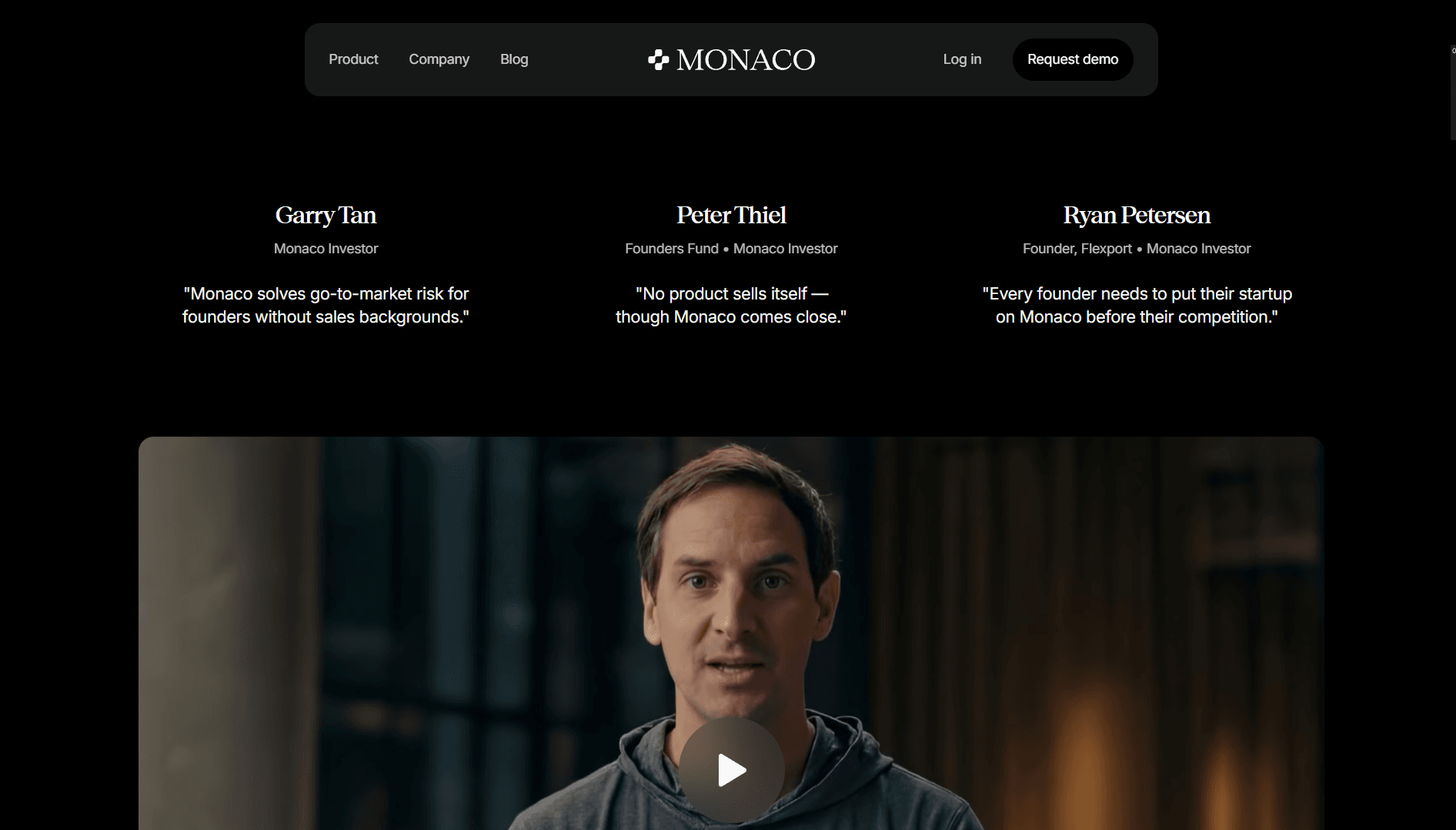
Monaco earns its buzz honestly. It's led by Sam Blond, a widely respected go-to-market (GTM) operator, and it's pitched as an AI-native revenue engine rather than a bolt-on assistant. In May 2026 it raised a $50M Series B led by Benchmark, bringing total funding past $85M. This is serious capital and serious backing, and it signals investors believe the category is heading toward AI that runs the motion rather than just augmenting reps. On thesis, Monaco and Artisan agree. For the wider field, see the best AI GTM platforms.
But maturity is the whole story here. Monaco is in public beta. Its pricing is gated and undisclosed, an unspecified flat fee, so you can't evaluate cost without a sales conversation, and beta pricing rarely reflects what a product will charge at scale. There's no meaningful published customer proof yet, because the product is young. None of this is a knock on the team; it's simply where an early-stage product sits. If you like backing a strong founder early and you can absorb the risk of a beta, Monaco is a reasonable bet. If you need pipeline this quarter, a public beta is a hard thing to stake a number on.
What does Artisan ship today?
Artisan's Ava is a fully deployed autonomous AI BDR, not a beta. She owns the BDR job end to end: she finds best-fit leads across a database of over 400M contacts with natural language processing (NLP) search, ideal customer profile (ICP) filters, and intent signals; enriches and prioritizes them with waterfall email and phone data that charges only on success; launches personalized multichannel campaigns across email, social outreach, and dialer call steps; tests dozens of message variations and shifts volume to what converts; handles every reply by qualifying, answering objections from a knowledge base, and chasing follow-ups; and books meetings on reps' calendars with CRM-owner routing. For how the category compares, see the best AI BDRs and the best AI SDRs.
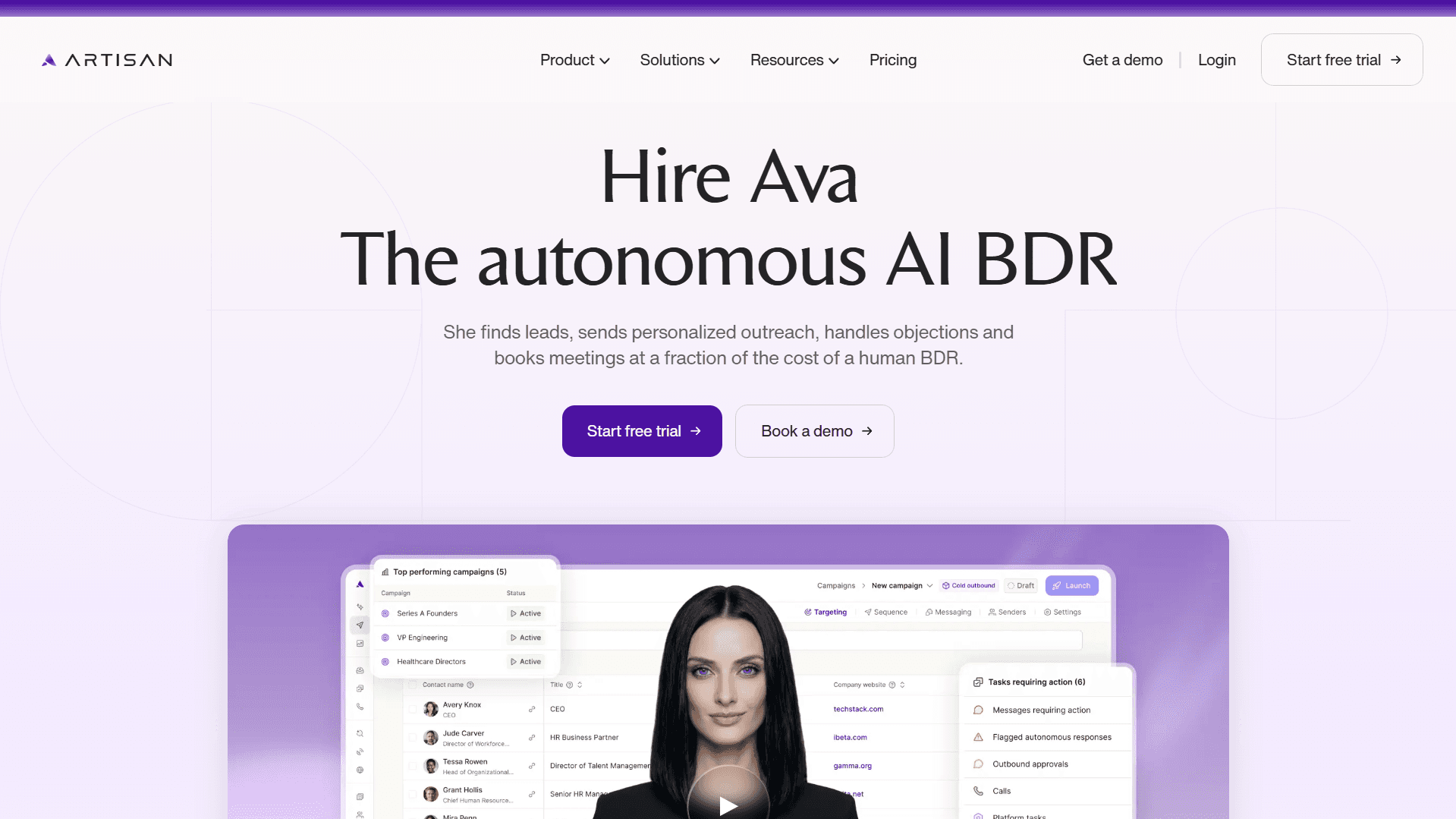
The autonomy is a dial, not a switch. You can run review-and-approve on every message, objections-only replies, or full autonomy, with plain-language escalation rules ("if the lead mentions pricing, escalate") and a complete audit trail. Artisan reports over 90% of its customers run Ava autonomously. This is not a preview of what the product will do. Paying customers rely on it right now, at scale, including global teams that run Ava centrally from sales ops for account executive (AE) teams that never log in. For adjacent roundups, see SDR tools and BDR tools.
Which one can you actually deploy this quarter?
Artisan, without qualification. It's live, it's proven, and you can start on a free trial. Monaco is a public beta with gated pricing, so deploying it means signing on to an early product and helping shape it. Both are valid choices, but they answer different needs. One is a purchase; the other is closer to a partnership with an early-stage company.
For a revenue leader carrying a number, this distinction usually settles it. You can point Ava at an ICP and have personalized campaigns running in days, with messaging tuned per lead rather than mail-merged. Two people in the same Artisan campaign receive two completely different messages; in a legacy sequencer only the name and title change. This level of one-to-one personalization at Marketo scale is shipping today, not a promise.
How do the two compare on proof and pricing?
Proof is where the gap is widest. Artisan names customers and publishes numbers. Raise sourced over $700K of ARR in 6 months with Ava, a 20x return. SumUp's Karlo Biuk reports a $52 cost per lead and 8 to 15 positive replies a week from previously unreachable local businesses across hundreds of thousands of emails. SaaStr's Jason Lemkin says the AI emails are "actually better than what our humans produced. Consistently better." Monaco is in beta, so it doesn't have a comparable published track record yet.
On pricing, Artisan is usage-based: you pay for work performed, not seats, with no platform fee and a free trial. The dialer seat is a flat $67/month with unlimited minutes plus one credit per call, roughly a third of what dedicated parallel dialers charge. Monaco's pricing is a gated, undisclosed flat fee, so you evaluate it blind. Transparency you can plan a budget around is its own advantage. For more, see Monaco pricing and reviews and how much an AI SDR costs compared with human SDRs.
Choose Monaco if...
You're excited to back Sam Blond's vision early and you're comfortable running a public beta.
You have the time and appetite to co-develop with an early-stage product and influence where it goes.
You're not under pressure to show pipeline results this quarter and can treat it as a longer bet.
You want to be an early reference customer for a well-funded new entrant and you value getting in on the ground floor.
Monaco is one of the more credible young players in the category, with strong leadership and over $85M behind it. If early-stage risk is acceptable to you, it's worth a conversation.
Choose Artisan if...
You need an autonomous AI BDR producing pipeline now, not after a beta matures.
You want named customers, published proof points, and a real track record before committing.
You need SOC 2 Type II, SSO, SAML, role-based access, and audit trails for an enterprise rollout today.
You want transparent, usage-based pricing and a free trial instead of a gated flat fee.
What customers say
CookUnity's Bruno Didier, Head of B2B, puts the difference plainly: "Ava runs highly targeted outreach at a scale we could never reach with a human-only team," at roughly $45 cost per lead across over 100,000 emails. This is the kind of attributed, in-production result that separates a shipping product from a promising beta. Teams that use Ava generate pipeline at roughly a fifth of the cost of a human BDR, and they're doing it in production, not in preview. For other options, see the best alternatives to hiring more SDRs.
FAQ
Is Monaco better than Artisan?
Monaco is well-led and well-funded, but it's in public beta with undisclosed pricing and little published proof. Artisan ships a proven autonomous AI BDR today with named customers and attributed results. If you're comfortable backing an early product, Monaco is credible; if you need results now, Artisan is the safer pick.
Is Monaco available yet?
Monaco is in public beta as of 2026. This means you can access it, but you're working with an early-stage product still being built out, and its pricing is a gated, undisclosed flat fee. Artisan is fully live with usage-based pricing and a free trial.
How much does Monaco cost?
Monaco's pricing is not published; it's a gated flat fee, and you'd need a sales conversation to learn it. Beta pricing also may not reflect eventual list pricing. Artisan's core platform is usage-based with no platform fee, so you pay for the work performed.
Does Monaco have customer proof like Artisan?
Not yet, because it's early. Artisan publishes named customers and numbers: Raise's over $700K of ARR in six months, SumUp's $52 cost per lead, SaaStr doubling open rates. For a buyer who wants evidence before committing, this track record is the difference.
Who's behind each product?
Monaco is led by Sam Blond, a respected GTM operator, and backed by a $50M Series B from Benchmark (over $85M total). Artisan was founded by Jaspar Carmichael-Jack and Sam Stallings, is a Y Combinator company, and has raised over $35M from investors including Y Combinator and HubSpot Ventures.
Which should an enterprise pick?
Artisan, if your rollout is happening now. It's SOC 2 Type II compliant, offers SSO, SAML, and role-based access on Enterprise plans, includes a forward-deployed strategist and dedicated CSM, and supports central sales-ops deployment for large AE teams. Monaco's beta status makes it a harder enterprise commitment today.
The bottom line
Monaco is a credible, well-backed early bet led by a strong operator, and if you can run a public beta, it's worth watching. But if you need an autonomous AI BDR that's proven, deployable, and producing pipeline this quarter, Artisan ships this today.
See how Ava the AI BDR works, explore the AI sales agent, start on the Artisan homepage, or review Artisan pricing.
Related reading
Jaspar Carmichael-Jack
Co-Founder & CEO @ Artisan
Jaspar is an entrepreneur with expertise in sales, marketing, and operations. He founded Artisan in 2023, a company automating workflows with AI employees.