Kixie vs. JustCall: Which should you choose in 2026?
A fair comparison of Kixie and JustCall on pricing, dialing, SMS, AI, and CRM fit, with clear buyer scenarios for each.
Key Takeaways
- Kixie is a sales-first calling and texting platform built around a power dialer and tight CRM sync. JustCall is a broader business phone system with voice, SMS, WhatsApp, and AI features.
- JustCall publishes per-seat pricing: Team at $29/user/month, Pro at $49/user/month, and Pro Plus at $89/user/month, all billed annually with a two-seat minimum, per its pricing page.
- Kixie no longer lists prices publicly. Its pricing page shows three tiers (Professional, Single-Line PowerDialer, Multi-Line PowerDialer) and routes you to a seven-day trial or a quote.
- JustCall's power dialer starts on the Pro plan; its predictive dialer (up to 10 lines) sits on the custom-priced SalesPro tier, per its pricing page.
- Kixie's Multi-Line PowerDialer plan reportedly runs up to around 10 simultaneous lines, with AI human detection offered as a premium add-on. ConnectionBoost is a separate connect-rate add-on.
- If you would rather not run a standalone dialer at all, an AI-run outbound platform folds calling into a wider motion priced on the work performed instead of per seat.
Kixie is the sharper pick for an outbound sales team that lives in its CRM and wants power dialing plus text automation with strong connect-rate protection. JustCall is the better buy if you want one transparently priced business phone system covering both sales and support, with multichannel messaging and AI coaching built in. Your stack decides.
How Kixie and JustCall compare at a glance
Tool | Best for | Standout capability | Dialer type | Public pricing |
Kixie | Outbound sales teams inside a CRM | Multi-line power dialing plus SMS automation and connect-rate protection | Multi-line power dialer, reportedly up to about 10 lines | Quote-based; seven-day trial (per its pricing page) |
JustCall | Teams that want one phone system for sales and support | Multichannel voice, SMS, WhatsApp, and AI coaching | Power dialer (Pro); predictive up to 10 lines (SalesPro) | From $29/user/mo annual (per its pricing page) |
What is the real difference between Kixie and JustCall?
Kixie is a sales engagement dialer; JustCall is a business phone system that happens to sell hard to sales teams. This framing settles most decisions. Kixie centers on outbound rep productivity: a power dialer, click-to-call from the CRM, automated text sequences, local presence numbers, and spam-reputation tooling to keep connect rates up. It assumes you already have a way to handle inbound support and just want reps dialing more. For help on the calls themselves, see our cold calling scripts.
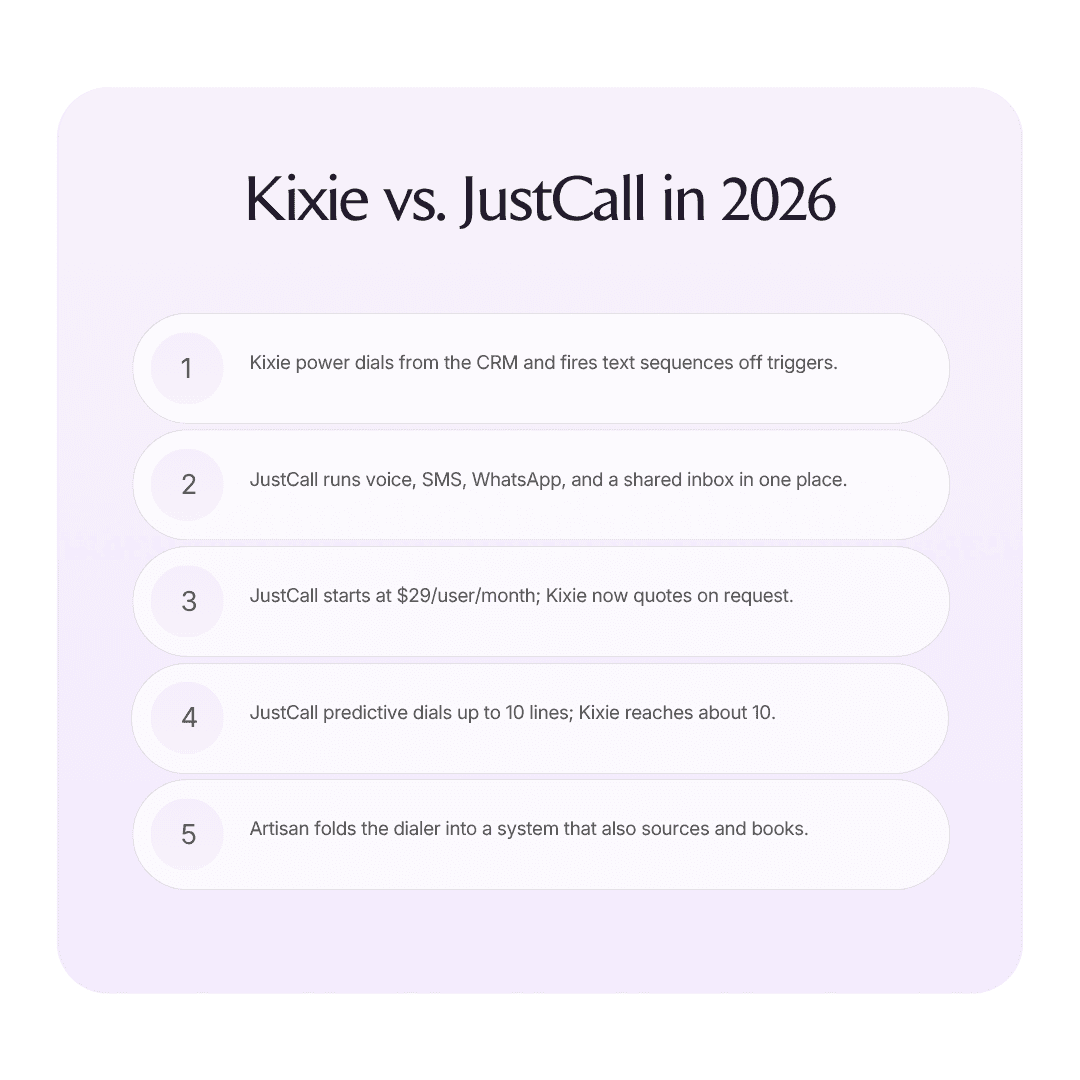
JustCall, from SaaS Labs, is wider. It runs voice, SMS, WhatsApp messaging, and a shared inbox across over 100 CRM integrations, then layers AI on top: call scoring, real-time agent assist, and coaching. It serves support desks and sales floors from the same platform. Where Kixie optimizes the outbound call, JustCall optimizes the whole phone footprint of a business.
Which has better pricing, Kixie or JustCall?
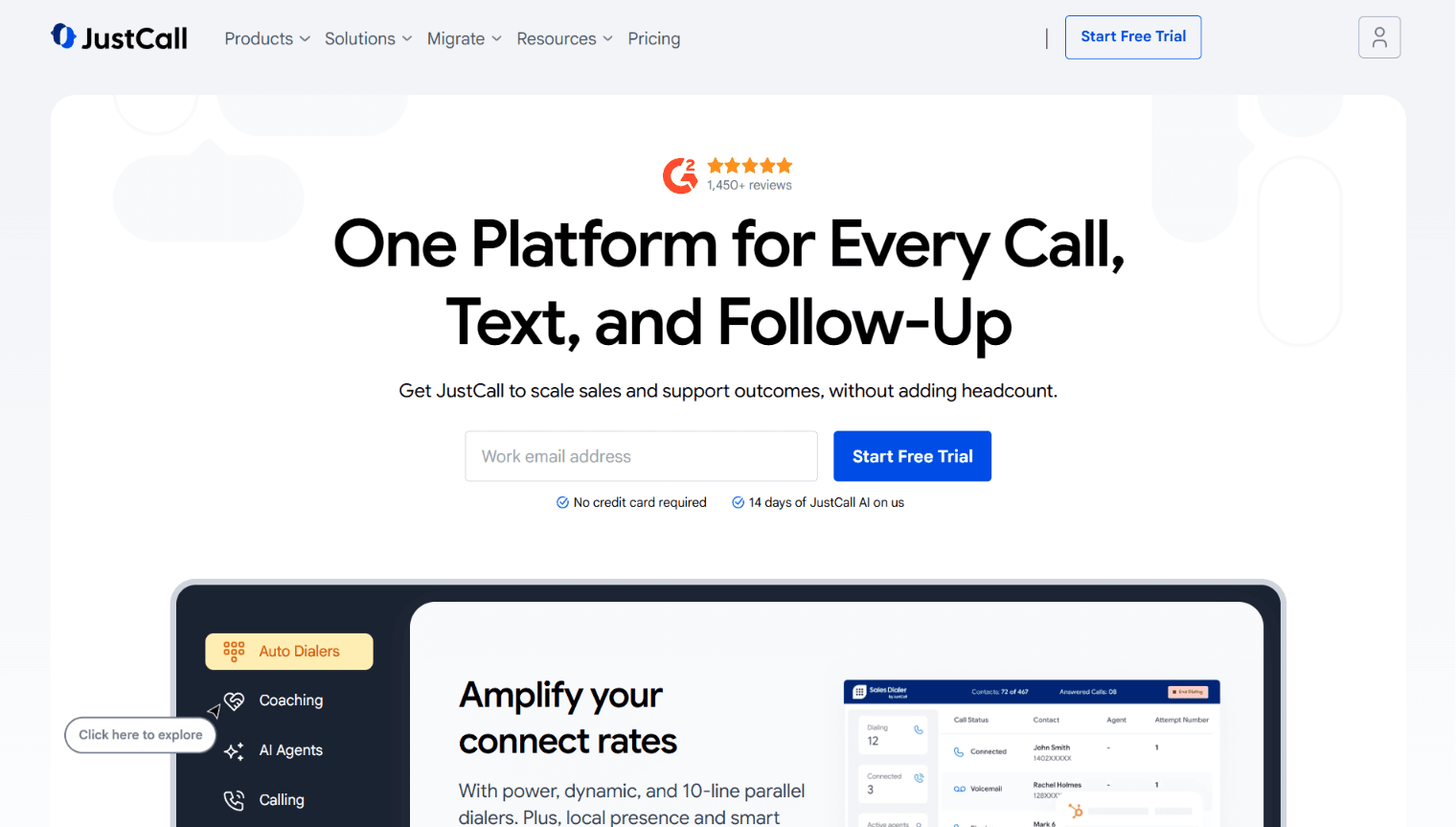
JustCall wins on transparency. Its pricing page lists Team at $29/user/month, Pro at $49/user/month, and Pro Plus at $89/user/month, all billed annually with a two-seat minimum. The Business tier is custom-priced with a 10-seat minimum, and the sales-heavy SalesPro tier is also quote-based. A 14-day free trial is available, and JustCall's AI Voice Agent add-on runs $99/month for 100 minutes or $249/month for 300 minutes, per its pricing page.
Kixie is harder to pin down. It historically published per-seat rates, but its pricing page now shows only three tier names (Professional, Single-Line PowerDialer, Multi-Line PowerDialer) with no numbers, pushing buyers to a seven-day trial or a sales quote. Premium capabilities like AI human detection and conversation intelligence are add-ons, so the sticker figure and the working figure can diverge. If published pricing matters to your procurement process, JustCall is the clearer read.
Which has the better dialer for high-volume outbound?
For raw parallel volume, JustCall's SalesPro tier goes furthest, running a predictive dialer of up to 10 lines, per its pricing page. Predictive dialing over-dials more aggressively than Kixie's Multi-Line PowerDialer plan, which reportedly runs up to around 10 simultaneous lines with AI human detection available as a premium add-on. If your motion is maximum-dials-per-hour cold calling, JustCall's predictive option has the higher ceiling, though predictive dialing carries dead-air and compliance considerations that suit call-center-style teams more than boutique ones.
Kixie's edge is quality per dial instead of sheer count. Its ConnectionBoost feature and spam-reputation tooling target the category's biggest problem: numbers being flagged, which quietly lowers pickup rates. For a team of account executives who need to actually reach decision-makers on a smaller number of dials, Kixie's connect-rate focus and CRM-native workflow can beat a wider line count that connects to voicemail. For more dialer options, see the best Dialpad alternatives, the best CloudTalk alternatives, the best autodialers, and the best outbound dialer.
Which fits your CRM and existing stack better?
Both integrate widely, but they optimize for different centers of gravity. Kixie is known for deep, sales-oriented sync with HubSpot, Salesforce, and Pipedrive, with click-to-call, automatic activity logging, and text sequences firing off CRM triggers. If your reps live inside HubSpot all day, Kixie feels like a native extension of it.
JustCall spans over 100 integrations and leans toward being the communications hub across a business, including support tooling and helpdesks. Its WhatsApp and SMS breadth matters for teams that sell internationally or run conversational support. Pick Kixie when the CRM is the command center and calling should orbit it; pick JustCall when the phone system itself needs to be the shared surface for several teams.
Should you choose Kixie or JustCall?
Choose Kixie if you run an outbound sales team anchored in HubSpot, Salesforce, or Pipedrive, you want power dialing plus automated text follow-up, and connect-rate protection matters more to you than a broad phone system. It rewards teams that want reps dialing and texting inside the CRM with minimal setup.
Choose JustCall if you want a single transparently priced platform covering both sales and support, you value multichannel messaging (SMS and WhatsApp) and AI coaching, or you want the option of a predictive dialer as you scale. Its published entry pricing and breadth of integrations make it the safer default for a mixed sales-and-support org.
The shared limitation is worth naming: Kixie and JustCall are both dialers. Whichever you pick, your reps still run the calling, and the sourcing, sequencing, and follow-up around it sit in other tools you also operate. If neither is right, see the best Kixie alternatives and the best JustCall alternatives.
There is a third path. If you would rather not operate a standalone dialer at all, Artisan folds a compliance-aware dialer into a wider AI-run outbound motion, where Ava, its AI outbound sales agent, handles sourcing, sequencing, and replies. Calling runs as steps inside that system with power and parallel dialing across up to three lines, and Ava dials the calls while a rep takes the live conversation. Pricing is usage-based, so you pay for the work Ava performs rather than per seat, and over 90% of Artisan customers run Ava autonomously.
That is a different purchase from either dialer here, because the AI runs the motion instead of your reps working a dial list. See how it stacks up against dedicated dialers in the best AI dialers and parallel dialers, or the AI sales agent overview. See also Artisan vs. Aircall, Artisan vs. Nooks, and Artisan vs. Orum.
Frequently asked questions
Is Kixie or JustCall cheaper?
JustCall has the lower and clearer entry point: $29/user/month on Team, billed annually with a two-seat minimum, per its pricing page. Kixie no longer publishes per-seat prices, so a true cost comparison requires a quote. On transparency alone, JustCall is easier to budget, but Kixie's real cost depends on which add-ons (AI human detection, conversation intelligence) your team needs.
Does Kixie or JustCall have a better dialer?
It depends on your motion. JustCall's SalesPro tier offers a predictive dialer of up to 10 lines for maximum volume, per its pricing page. Kixie's Multi-Line PowerDialer plan reportedly runs up to around 10 lines but emphasizes connect quality through spam-reputation tooling. High-volume cold-calling teams may prefer JustCall's ceiling; quality-per-dial teams often prefer Kixie's approach.
Is JustCall a full phone system or just a dialer?
JustCall is a full business phone system. It handles inbound and outbound voice, SMS, WhatsApp, a shared inbox, and AI features like call scoring and coaching across over 100 integrations, per its pricing page. This breadth is its main advantage over Kixie, which is focused more narrowly on outbound sales calling and texting.
Can Kixie and JustCall both send SMS?
Yes. Both support SMS, and it is a core part of each platform's sales workflow. Kixie is known for automated text sequences tied to CRM triggers, while JustCall adds WhatsApp messaging and bulk SMS campaigns on higher tiers. JustCall's Team plan includes 500 SMS segments, per its pricing page; check current messaging limits with each vendor before committing.
Do Kixie and JustCall integrate with HubSpot and Salesforce?
Both do. Kixie is especially known for deep, sales-oriented sync with HubSpot, Salesforce, and Pipedrive, including click-to-call and automatic logging. JustCall integrates with over 100 CRMs and helpdesks. If your team's entire workflow lives inside a single CRM, test Kixie's native experience first; if you need a communications hub across several tools, JustCall's breadth helps.
What if I do not want to manage a dialer myself?
Then a standalone dialer may be the wrong category. An AI-run outbound platform runs calling as one step inside a larger motion that also sources leads, writes and sends outreach, and handles replies. That suits teams that want pipeline generated instead of another tool to configure, with cost tracking the work performed instead of layered add-ons.
Is there an alternative to both Kixie and JustCall?
Yes. Both are dialers that leave your reps running the calling and the rest of the motion in separate tools. If you would rather the outbound job ran itself, an autonomous platform is the alternative. Artisan folds a compliance-aware dialer with power and parallel dialing across up to three lines into a wider motion where Ava, its AI outbound sales agent, sources, sequences, and handles replies, priced on usage rather than per seat. See Artisan's AI sales agent for how it differs from a standalone dialer.
Which is better for a small sales team in 2026?
For a small outbound team that wants to start dialing fast with clear pricing, JustCall's $29/user/month Team plan is the easiest on-ramp, per its pricing page. If that same small team lives inside HubSpot and cares most about reaching people rather than dialing volume, Kixie's connect-rate focus and CRM-native flow can be the better fit despite the quote-based pricing.

Artisan Team
Expert insights from the team at Artisan
Our writing team blends direct operational experience, in-house data, and thorough research to bring you the very latest insights and updates about sales and GTM automation.