Artisan vs. Orum: Which fits your team?
Artisan runs a dialer inside one AI-led outbound system with usage-based pricing. Orum is an enterprise parallel dialer. Here is how to choose.
Key Takeaways
- Artisan's dialer is one channel inside a workflow Ava, an AI business development representative (BDR), runs end to end: sourcing, phone enrichment, multichannel outreach, replies, and booking. Orum is a specialist connection engine that plugs into a stack you already own.
- Artisan's pricing is usage-based, so Ava's work runs on credits and you pay for the work she performs, with dialer seats and phone numbers billed separately. Orum's live page is gated; its Launch tier is reported at about $250/user/month on annual billing, per third-party estimates.
- Orum's edge is parallelism and reach: up to 5 lines on Launch and up to 10 on the custom Ascend tier, with international dialing on Ascend. Artisan runs up to 3 simultaneous lines.
- You can try Artisan for free, and you pay for the outbound work performed instead of a premium annual commitment per caller.
- Orum acquired Scout AI on July 15, 2026, adding AI capabilities; it remains a calling-first platform rather than a full outbound system.
- Artisan reports that over 90% of customers run Ava autonomously, so calling sits inside one AI-run sequence instead of a separate tool reps switch into.
Artisan and Orum both put your reps into more live conversations, from opposite starting points. Artisan puts a dialer inside one AI-led outbound system that sources leads, writes messaging, handles replies, and books meetings. Orum is an enterprise parallel dialer built for peak connect volume. Choose Artisan to run the whole motion; choose Orum for maximum throughput.
The short version: Connection engine vs. outbound system
Orum is built to solve one hard problem well: put a rep into more live conversations per hour. Its parallel dialing, AI answer detection, and reach across tiers are aimed squarely at teams whose bottleneck is connect rate. If your reps have good lists and good messaging and simply need more human pickups per hour, Orum is a strong, focused tool.
Artisan solves a wider problem. A calling step is one channel inside a system where Ava also decides who to call, enriches the phone number, writes the outreach across email and social media, works the replies, and books the meeting. So the comparison is less about which dialer performs better and more about whether you want a faster dialer or the calling handled inside the system that runs the rest of outbound. We will take it stage by stage.
How do Artisan and Orum decide who to call?
Artisan owns this stage; Orum inherits it. Ava sources best-fit leads from a database of over 250 million B2B professionals across over 200 countries, plus Artisan Local Data covering over 250 million local businesses. She runs waterfall phone enrichment across roughly a dozen providers, charged only when a number is found, and ranks leads by conversion likelihood. Intent signals such as funding rounds, newly hired executives, and active hiring can build a call list, so reps dial people chosen by fit and timing.
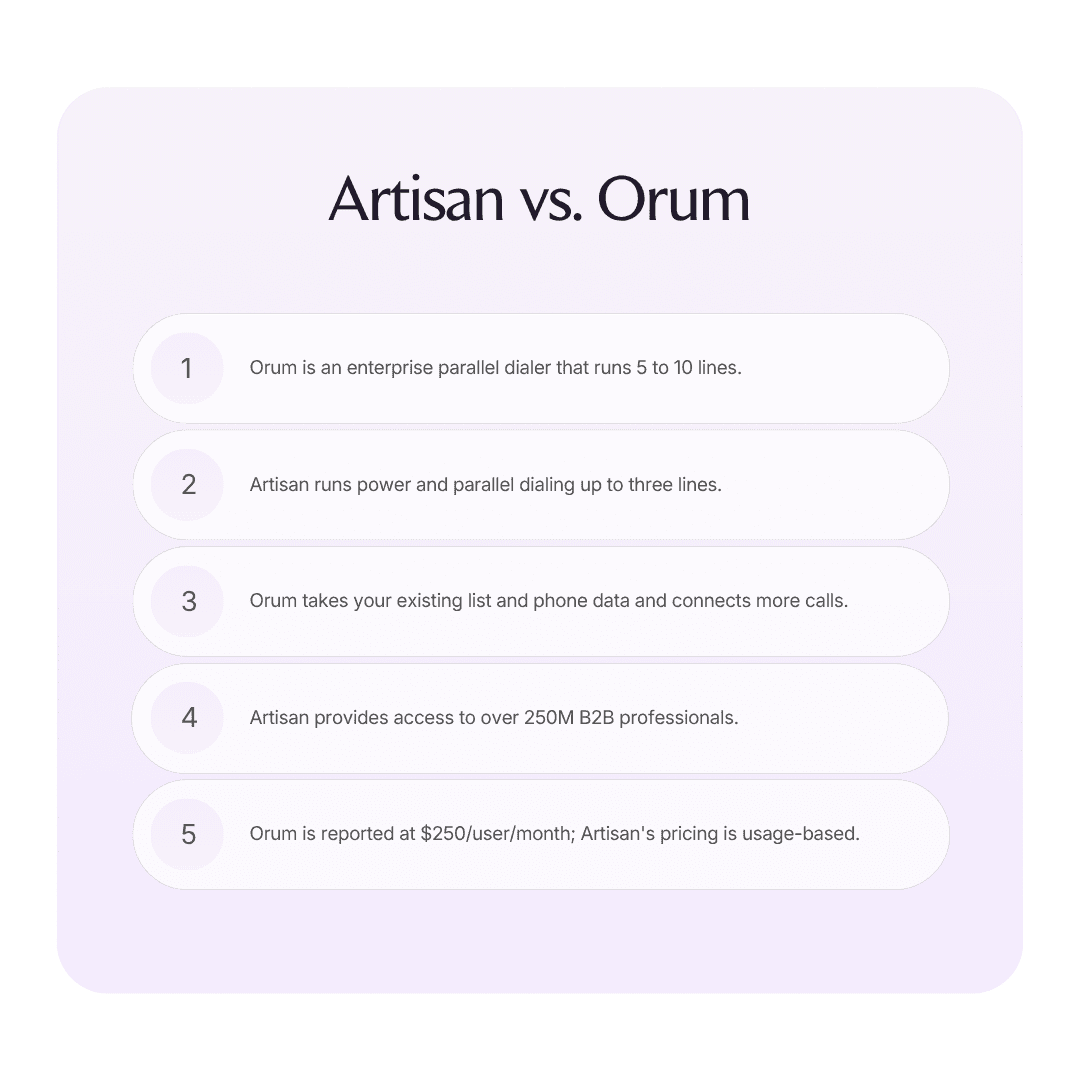
Orum begins after this stage. As a connection engine, it takes the list and the phone data from your existing tools and focuses on making more of those numbers connect. This division of labor is clean if your data and prioritization are already strong. It is a gap if part of the problem is the quality of who lands on a dial list.
How do they handle the actual calling?
This is Orum's home turf, and Artisan concedes the ceiling honestly. Orum is an enterprise parallel dialer: up to 5 simultaneous lines on its Launch tier and up to 10 on the custom Ascend tier, with international dialing on Ascend and AI answer detection throughout. For a team whose whole day is dialing, this parallelism is the product, and it is more than Artisan offers.
Artisan runs power dialing and parallel dialing up to three lines with AI answer detection, plus live AI talking points before connect, live transcription, auto-classified outcomes, AI call summaries with action items, and automatic number selection so a lead sees a local-looking number. It is designed as enterprise-grade calling rather than a bolt-on: org-level pooled numbers, callback routing so a returned call reaches the rep who placed it, and automatic per-lead enforcement of calling hours in the lead's local time, do-not-call checks, and consent-aware recording. Reputation monitoring and per-number daily ceilings protect a large team's connect rates. The limit is real and narrow, since Artisan stops at three lines, so a maximum-volume parallel floor will out-dial it on Orum's higher tiers. For the broader tooling around this, see best autodialers, best outbound dialer, and cold calling scripts.
What happens after the call connects?
The systems split here. With Orum, the connection happens and the follow-up, sequencing, and much of the CRM work continue in your other tools. Orum's job is the conversation; the surrounding motion is on your reps and your stack, though its Scout AI acquisition points at more automation to come.
With Artisan, a call is a step in a sequence Ava already runs. She drafts the post-call follow-up email, logs the outcome natively to Salesforce or HubSpot against the right owner, and keeps the lead advancing across email and social media. When a prospect replies on any channel, Ava qualifies, answers objections from your knowledge base, and escalates on plain-language rules you set. A connect feeds a motion that keeps moving without a human to wire tools together.
How do Artisan and Orum book meetings?
Artisan books; Orum routes it back to you. Ava schedules meetings on the right rep's calendar with CRM-owner routing, so a promising live call becomes a confirmed meeting automatically. Orum is the conversation accelerant, and the booking and downstream sequencing live in your other systems.
If you already run a strong booking and routing layer and only need more connects to feed it, Orum drops in cleanly. If you want fewer tools and fewer hand-offs between a call and the calendar, Artisan owning this stretch is the better shape.
How do the two compare on price?
The two are priced on different models. Artisan's pricing is usage-based. Ava's work runs on credits, so you pay for what she performs: qualifying, enriching, personalizing, and sending messages. Dialer seats and phone numbers are billed separately, the AI talking points, transcription, follow-up drafts, recordings, and analytics come with the dialer, and you can try Ava for free; see the pricing page.
Orum's live pricing page is gated. Third-party estimates put its Launch tier around $250/user/month on annual billing, with Ascend priced by quote. The decision is straightforward. If you need 5 to 10 simultaneous lines and international reach across many markets, Orum's higher tiers earn their premium; if 3 lines cover you, Artisan gives you the calling plus the rest of the job, priced against the work performed. For a deeper look at Orum's plans, see Orum pricing and reviews.
Situation to fit
Your situation | Better fit |
You want calling handled inside the system that sources, writes, and books | Artisan |
Your team's core job is high-volume parallel dialing | Orum |
You need 5 to 10 simultaneous lines or international dialing at scale | Orum |
You want calling priced alongside the rest of the outbound work | Artisan |
You are consolidating a stack of 5 to 8 outbound tools into one platform | Artisan |
You already own data, sequencing, routing, and CRM logging | Orum |
You want an AI that runs outbound at over 90% autonomy | Artisan |
Connect rate is your single biggest bottleneck right now | Orum |
Choose Orum if...
Your reps' main constraint is connect rate and you want the most live conversations per hour a parallel dialer can produce. Orum is built for exactly this.
You need more than three simultaneous lines, or you dial internationally at scale and want the reach on Orum's Ascend tier.
You run a floor of dedicated callers and already own the data, sequencing, routing, and CRM logging you want, so a specialist connection engine fits neatly on top.
You are comfortable with gated, quote-based pricing and an annual commitment in exchange for the parallelism.
If this is your team, Orum is a sound choice and we would say so plainly.
Where Artisan pulls ahead
For most teams a dialer is one part of a job that only works when the list, the message, the replies, and the booking are handled too. Artisan is built around this whole job. Ava runs it from sourcing to booked meeting, calling included, which is why a large account executive team can have sales ops operate the platform centrally while reps simply take the meetings that land. Artisan is SOC 2 Type II compliant with a full audit trail and role-based access, and its autonomy is a dial: review and approve everything, replies only, or let Ava run unsupervised, with plain-language escalation rules.
SumUp is one example of what happens when the whole motion runs as one system. Working with Ava, the team sent over 400,000 personalized emails at a $52 cost per lead and now receives 8 to 15 positive replies a week from local small and medium-sized businesses it could not previously reach. This is the sort of outcome a standalone connection engine cannot produce on its own, because sourcing and messaging sit outside it.
So the honest framing is wider than dialer against dialer. It sets a faster connection engine against a system where the AI runs outbound end to end and calling is one channel it operates. For more on this model, see how the AI BDR job is automated and how the AI sales agent serves an enterprise team. If you are comparing dedicated parallel dialers, our Artisan vs. Nooks page covers the other category leader. See also the best AI dialers and parallel dialers, the best Orum alternatives, Orum vs. Nooks, and Orum vs. Aircall.
FAQ
Is Orum better than Artisan for connect rate?
For a team whose job is high-volume dialing, Orum's parallelism goes further: up to 5 lines on Launch and up to 10 on the custom Ascend tier, against Artisan's 3, plus international dialing on Ascend. If maximum connects per hour is your single metric, Orum wins that dimension. Artisan trades peak throughput for a system that also sources, writes, and books, priced against the work it performs.
How much does Artisan's dialer cost versus Orum?
Artisan's pricing is usage-based. Ava's work runs on credits, so you pay for the work she performs, and dialer seats and phone numbers are billed separately, with a free trial available. Orum's page is gated; its Launch tier is reported near $250/user/month annually, with Ascend by quote. Orum is a premium, sales-led purchase, while Artisan's cost tracks the outbound work you actually run.
Does Artisan support international calling like Orum?
To a degree. Artisan provides phone numbers in the United States, Canada, the United Kingdom, Mexico, and Colombia, and dials into the United States, Canada, the United Kingdom, France, Germany, Brazil, India, Israel, Japan, and Australia. Orum markets broader international dialing on its Ascend tier. If your calling spans markets outside this list, this reach is a real reason to consider Orum's top tier.
What did Orum's Scout AI acquisition change?
Orum acquired Scout AI on July 15, 2026, signaling more AI capability inside a calling-first platform. It is a meaningful move, but it does not turn Orum into a full outbound system that sources leads, writes multichannel messaging, and books meetings the way Artisan's Ava does.
Can Orum find leads and write outreach the way Artisan does?
No. Orum is a connection engine that assumes you already have a list, phone data, and a message. Artisan's Ava sources leads from a database of over 250 million B2B professionals, runs waterfall phone enrichment, writes email, social media, and call steps, handles replies, and books meetings, with the dialer as one step in that flow.
Which is the stronger enterprise fit?
Artisan for a consolidated motion; Orum for a dedicated call floor that needs peak throughput. Artisan brings pooled org-level numbers with callback routing, automatic per-lead compliance, central admin with CRM owner mapping, SOC 2 Type II attestation, and usage-based pricing that scales with the work performed. Orum brings more simultaneous lines and international reach for teams whose entire day is dialing.
Do I still need a sequencer and CRM tooling with Artisan?
No. Artisan runs email, social media, and calling in one sequence, logs activity natively to Salesforce and HubSpot with owner mapping, and books on the right calendar. With Orum you keep your existing sequencing, routing, and CRM tools and add a faster dialer on top of them.

Artisan Team
Expert insights from the team at Artisan
Our writing team blends direct operational experience, in-house data, and thorough research to bring you the very latest insights and updates about sales and GTM automation.