Orum pricing and reviews (2026)
What Orum costs in 2026, what its tiers include, and what reviewers actually say about the parallel dialer, with a lower-cost alternative.

Key Takeaways
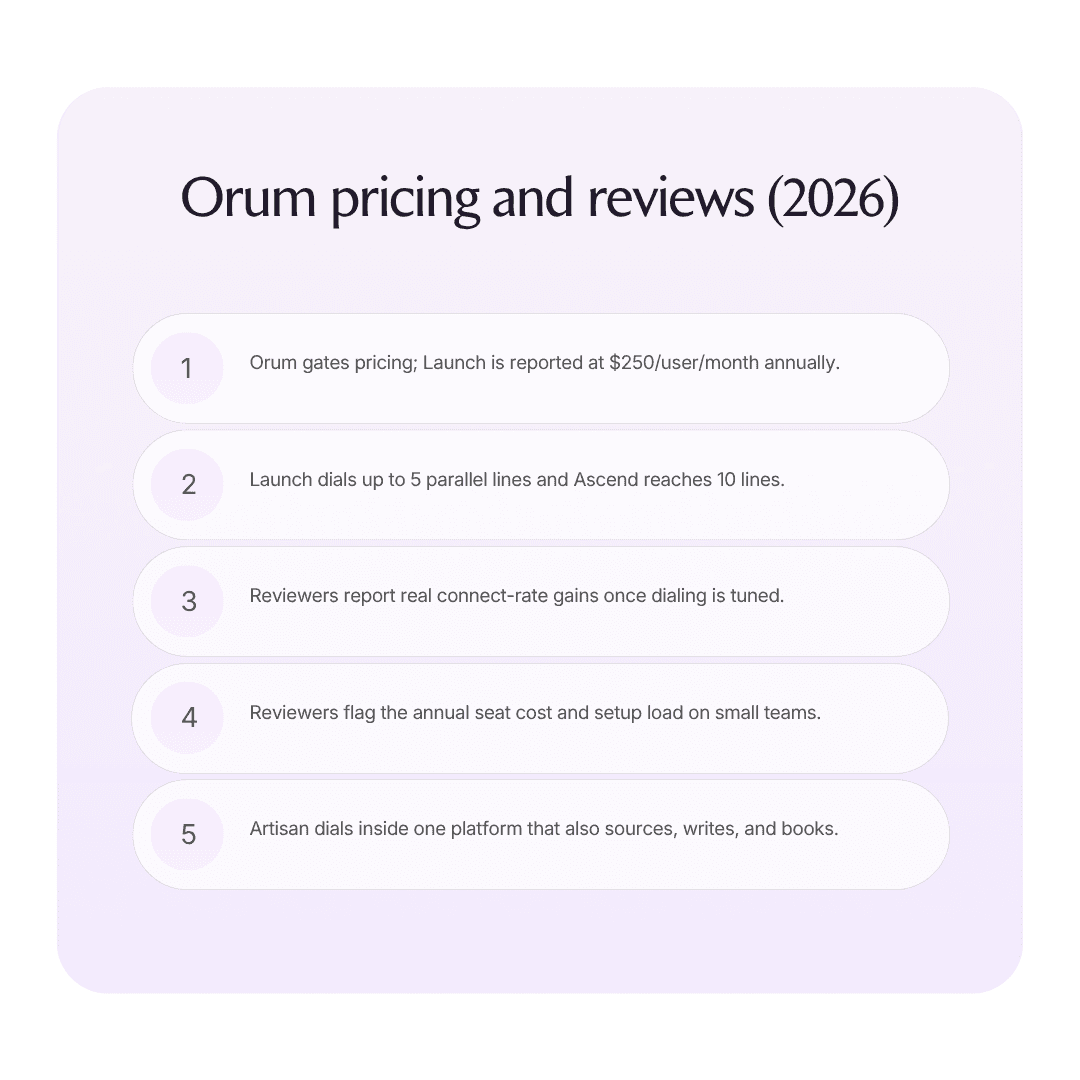
- Orum's public pricing is now gated. The best third-party estimate for the Launch tier is about $250/user/month on an annual contract, with Ascend priced custom.
- Launch dials up to 5 lines at once; Ascend goes up to 10 and adds international dialing. Both are sold through a demo, not self-serve checkout.
- Orum is a dialer, not a full sales stack. You still bring your own data, sequencer, and CRM sync around it.
- Orum acquired conversation-intelligence startup Scout AI on July 15, 2026, folding call coaching deeper into the platform.
- Artisan runs parallel dialing inside a full AI sales platform priced on usage rather than per seat, so calling is not a separate annual line item on top of the rest of your stack.
Orum is an enterprise parallel dialer, and it no longer publishes prices. Third parties peg its entry Launch tier at roughly $250/user/month billed annually, with a custom Ascend tier for higher line counts and international dialing. Reviewers credit real connect-rate gains and flag the cost and setup as heavy for smaller teams.
How much does Orum cost in 2026?
Orum's pricing is gated. The live site routes buyers to a demo instead of listing tiers, so any figure you see quoted is a third-party estimate. The most consistently reported entry point is around $250/user/month for the Launch plan on an annual contract. The higher Ascend tier is custom and quoted by team size and requirements.
That puts Orum in the same band as the other dedicated parallel dialers: a premium, seat-based tool sold on connect-rate lift instead of price. Two structural details matter more than the sticker. First, it is billed annually, so you are committing for a year at a time. Second, it is a dialer in isolation, which means the seat cost sits on top of whatever you pay for contact data, a sequencer, and the rest of the outbound stack.
Orum pricing at a glance (2026)
Tier | Reported price | Lines | What's included |
Launch | About $250/user/mo, annual (estimate, gated) | Up to 5 parallel | Parallel dialing, AI answer detection, call recording, CRM integrations, analytics |
Ascend | Custom, contact sales | Up to 10 parallel | Everything in Launch plus international dialing, advanced admin and controls |
Figures reflect third-party reporting. Orum does not publish rates, so treat the Launch number as an estimate and confirm current pricing directly with the vendor. Line counts are the reported maximums per tier.
What does Orum actually cost in practice?
The seat price is only part of the bill. A few realities show up once you move past the demo.
Orum is sold on annual contracts, so a 10-seat team at the reported Launch rate is looking at roughly $30,000 a year before any add-ons or the jump to Ascend. If your calling volume is seasonal or your team size fluctuates, that lock-in is a real cost.
It is also one layer of the stack. Orum makes calls. It does not source contacts, enrich phone numbers as a primary database, write the email steps that precede a call, or handle the replies afterward. Teams typically run Orum alongside a data provider and a sequencing tool, which means the true cost of calling is Orum plus two or three other subscriptions.
Ramp matters too. Parallel dialing changes how reps work, and lifting connect rates without spooking prospects with dead air takes practice, script discipline, and admin setup. Reviewers who rate Orum highly usually invested in this ramp. Teams that bought it and used it like a normal power dialer tend to feel they overpaid.
What do reviewers say about Orum?
The consensus is positive on outcomes and mixed on fit. Here is the honest split, drawn from what users report rather than any star rating.
Connect rates are the headline praise. Users consistently report talking to more people per hour once parallel dialing is dialed in, and the AI answer detection that skips voicemails and bad numbers draws specific credit for cutting dead time. The interface is generally called clean and fast, and the analytics give managers a clear read on rep activity and pickup rates.
Price and contract terms lead the complaints, especially from smaller teams that found the annual seat cost hard to justify against their call volume. Some reviewers report occasional call-quality and connection hiccups, a known trade-off of aggressive multi-line dialing. Others note that value depends heavily on data quality, since dialing more bad numbers faster does not help, so the tool rewards teams that already have clean, well-enriched lists. A few flag that the depth of setup and best practices needed to hit the advertised connect rates is more than a lightweight team expects.
Who is Orum best for, and who should skip it?
Orum suits mid-market and enterprise outbound teams whose entire motion is high-volume calling, with the rep headcount and management discipline to run parallel dialing properly. If your reps live on the phone and connect rate is the metric that moves your number, a dedicated parallel dialer earns its price, and Orum is one of the two category leaders.
Skip Orum if you are a small team, your outbound is email-led with calling as a secondary channel, or you do not want to buy and stitch a separate dialer onto a separate data tool and a separate sequencer. In those cases the annual seat cost and the standalone-tool overhead outweigh the connect-rate lift. For the wider category, see best autodialers, best outbound dialer, and cold calling scripts.
Artisan: Parallel dialing inside one AI-run system
If you are pricing Orum, it is worth knowing that a dialer does not have to be a standalone line item. Artisan is an AI-first outbound platform where the dialer is built in, and Ava, its AI business development representative (BDR), runs the whole motion around it: she finds best-fit leads across a database of over 250 million B2B professionals in over 200 countries, plus Artisan Local Data with over 250 million local businesses, enriches verified phone numbers, sequences email, social media, and call steps together, and handles replies. Calling is a step inside that sequence, not a separate app your reps switch into. Ava dials the calls and a rep takes the live conversation.
On cost, the shape of the bill is the real difference. Artisan's model is usage-based, so you pay for the work Ava performs rather than per seat, with no platform fee and a free trial, and that work includes live AI talking points loaded before the call connects, live transcription, auto-classified outcomes, AI-drafted follow-up emails, recordings, and analytics. Numbers are pooled at the org level with personal callback routing, so a lead who calls back reaches the right rep, and compliance is enforced automatically per lead: local calling hours, federal do-not-call checks, and consent-aware recording.
The honest concession is line count. Artisan's parallel dialing runs up to three lines with AI answer detection, while Orum's Ascend tier goes to 10. A team whose entire strategy is maximum-volume parallel calling, and nothing else, may still want a dedicated dialer despite the premium annual seat cost. For most teams, three lines inside a system where the AI also does the prospecting, writes the outreach, and books the meetings is the better trade. See Artisan pricing for the full picture. For head-to-head detail, see Artisan vs. Orum, Orum vs. Aircall, and Orum vs. Nooks.
Frequently asked questions
Is Orum worth it?
For a calling-heavy mid-market or enterprise team with the volume to justify it, yes. Reviewers consistently report meaningful connect-rate gains once parallel dialing is set up well, and that lift can pay back the seat cost quickly for reps who live on the phone. For small or email-led teams, the annual seat price and standalone-tool overhead are harder to justify against actual call volume.
Is Orum expensive?
At a reported entry point around $250/user/month on an annual contract, Orum sits at the premium end of the dialer market, and Ascend is higher and custom-quoted. It is priced on connect-rate value instead of affordability. Bundled dialers that run calling as part of a broader platform, like Artisan, charge for the work performed instead of a committed annual seat.
Why doesn't Orum publish its pricing?
Orum moved to a demo-gated model, so tiers are quoted after a sales conversation instead of listed publicly. This is common among enterprise-focused dialers and data tools. The trade-off for buyers is that comparison requires estimates from third-party reports until you receive a formal quote, so build extra time into your evaluation.
What are the cheaper alternatives to Orum?
Salesfinity publishes parallel-dialing plans at $149 and $349/user/month, and Koncert lists an AI Parallel plan at $99/user/month. Trellus offers a parallel add-on around $150/month as a browser overlay. Artisan bundles parallel dialing into a full AI sales platform with usage-based pricing and no platform fee. For more options, see the best Orum alternatives, the best AI dialers and parallel dialers, the best Salesfinity alternatives, and the best JustCall alternatives.
How many lines does Orum dial at once?
Reported figures put the Launch tier at up to 5 simultaneous lines and the custom Ascend tier at up to 10. Higher line counts raise connect rates but also raise the risk of dead air and spam flagging, so the practical sweet spot depends on your list quality and how tightly your scripts are managed.
What changed with Orum in 2026?
Orum acquired conversation-intelligence startup Scout AI on July 15, 2026, bringing call coaching and analysis deeper into the platform. It also moved its pricing behind a demo, so figures that were once public are now quoted individually. Both are worth noting if you are comparing against dated reviews that still cite old numbers.
Do I still need other tools alongside Orum?
Usually yes. Orum is a dialer, so most teams pair it with a contact database for phone numbers, a sequencing tool for the email steps around calls, and CRM sync. That stack adds cost and integration work on top of the seat price. Platforms like Artisan fold data, sequencing, dialing, and reply handling into one system so the calling is not a separate bill.
The bottom line
Orum is a strong parallel dialer for teams built around the phone, and reviewers back up the connect-rate story. Just price it honestly: a gated, annual, premium seat cost that sits on top of the rest of your outbound stack. If you would rather have parallel dialing as one built-in capability of an AI that runs the whole motion, Artisan delivers it inside a usage-based platform, and Ava handles the prospecting, sequencing, and replies around the call. Start with the AI BDR explainer if you want the category context first.

Artisan Team
Expert insights from the team at Artisan
Our writing team blends direct operational experience, in-house data, and thorough research to bring you the very latest insights and updates about sales and GTM automation.