The best Orum alternatives in 2026
Orum alternatives for 2026, ranked. Artisan runs calling in one AI outbound system, plus Nooks, Salesfinity, Koncert, Kixie and PhoneBurner.
Key Takeaways
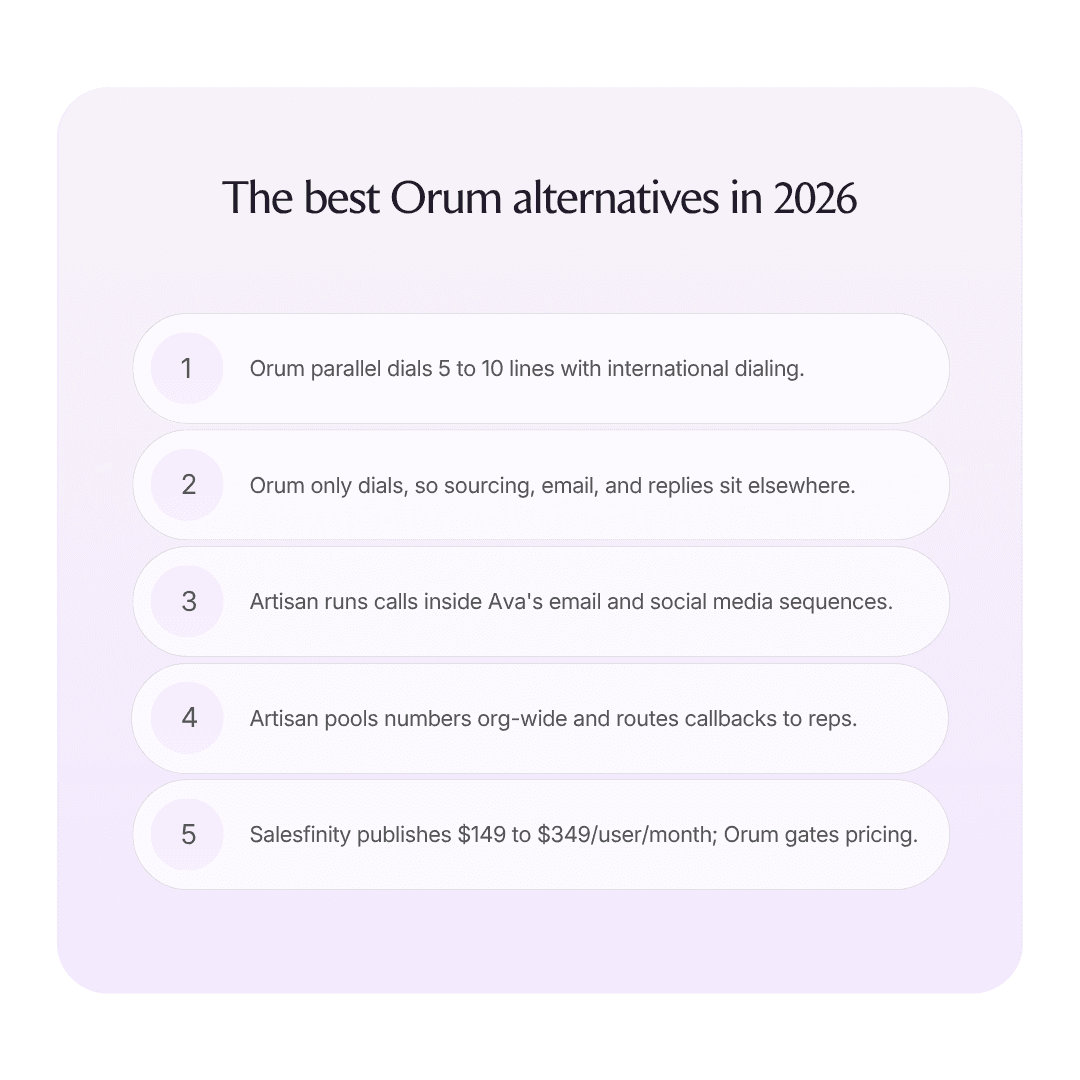
- Orum is an enterprise-grade pure parallel dialer: 5 to 10 lines, broad international coverage, strong connect rates. It is calling-only, and its pricing is gated.
- Artisan runs the dialer inside one AI-driven outbound system with usage-based pricing, so you pay for the work Ava actually performs rather than for a fixed bundle.
- Artisan parallel dials up to 3 lines with AI answer detection. The line count is a real limit: Orum reaches 5 to 10 lines and Nooks runs multi-line, so a pure maximum-volume call floor may still prefer them.
- Orum's live page is gated, with Launch reported around $250/user/month and Ascend custom. Nooks is reported around $4,000 to $5,000/user/year, annual. Salesfinity publishes $149 to $349/user/month for five lines.
- SumUp reported a $52 cost per lead and 8 to 15 positive replies per week from previously unreachable local businesses using Ava.
- Numbers on Artisan are pooled at the org level and available in the US, Canada, the UK, Mexico, and Colombia.
The best Orum alternative for most teams is Artisan, because it runs parallel dialing inside one AI-driven outbound system on published, usage-based pricing, not a standalone enterprise call floor behind a gated quote. Orum is a strong pure parallel dialer with real international reach. If calling is one channel in a wider motion, an all-in-one wins.
Orum is built for enterprise call floors: 5 to 10 simultaneous lines, AI answer detection, and international dialing on its Ascend tier. This depth is genuine. It is also the whole product, which means Orum dials and nothing more, at pricing you have to book a demo to learn. Teams that look for an alternative usually want calling joined to the rest of outbound, at a number they can compare today.
Orum alternatives compared
Rank | Tool | Best for | Standout capability | Public pricing |
1 | Artisan | Teams that want calling inside one AI outbound system | Dialer as a step in Ava's multichannel sequences | Usage-based, free trial |
2 | Nooks | Parallel call floors that want a virtual salesfloor | Multi-line with live coaching | Demo-gated (reportedly ~$4,000 to $5,000/user/year, annual) |
3 | Salesfinity | Teams that want transparent parallel pricing | 5 lines at a published per-seat rate | $149 to $349/user/month |
4 | Koncert | Teams that want multiple dialing modes | AI parallel, flow, and agent-assisted dialers | $6 to $99/user/month public ladder |
5 | Kixie | SMB teams that want calling plus texting | Power dialing with SMS and CRM integration | Demo-gated |
6 | PhoneBurner | Teams that prioritize number reputation | Single-line power dialing with ARMOR spam remediation | Published per-seat pricing |
How we chose
The criteria are weighted for a buyer who is deciding whether they need a dedicated enterprise dialer or a calling channel inside a system:
1. How much of the outbound job the tool does. Pure dialers lift connect rates; a full system links calling to sourcing, email, and reply-handling.
2. Pricing transparency. Published pricing beats gated quotes, and we flag which tools make you book a demo.
3. Parallel depth and compliance. Line count, AI answer detection, and automatic enforcement of calling hours, do-not-call (DNC) rules, and consent-aware recording.
4. Deployment at scale. Pooled numbers, callback routing, CRM owner mapping, and reputation monitoring that protect a large team's connect rates.
Why do teams look for an Orum alternative?
Two things push teams to shop: Orum is calling-only, and its pricing is gated.
Orum is a strong dialer and only a dialer. It parallel dials 5 to 10 lines, detects live answers, and offers international dialing on its Ascend tier, but it does not source leads, write or send email, or handle replies. So an outbound team runs Orum next to a data provider, a sequencer, and a deliverability layer, integrates them, and reconciles the reporting across all of them. The connect rates are excellent; the surrounding stack is the cost.
On price, Orum's live page is gated, with Launch reported around $250/user/month, while its higher Ascend tier is custom-quoted behind a demo. A buyer comparing dialers must book a demo to price the enterprise tier, and at these rates a large call floor is a heavy annual commitment. Orum also acquired the conversation-intelligence tool Scout AI in July 2026, so some buyers factor in near-term integration questions as that product folds in. For the full breakdown, see Orum pricing and reviews.
We hear the same triggers again and again:
You buy a dialer, then a stack around it. Calling is one purchase; sourcing, email, and replies are three more.
Pricing is gated. You cannot compare Orum on cost without a demo.
Enterprise scale means reputation management. Protecting connect rates across a big team is continuous work, and the category's top worry.
None of this is a knock on Orum's dialing. It is the reason a team whose calling is one channel of many looks for a different center of gravity.
The best Orum alternatives in 2026
1. Artisan: Calling inside one AI outbound system
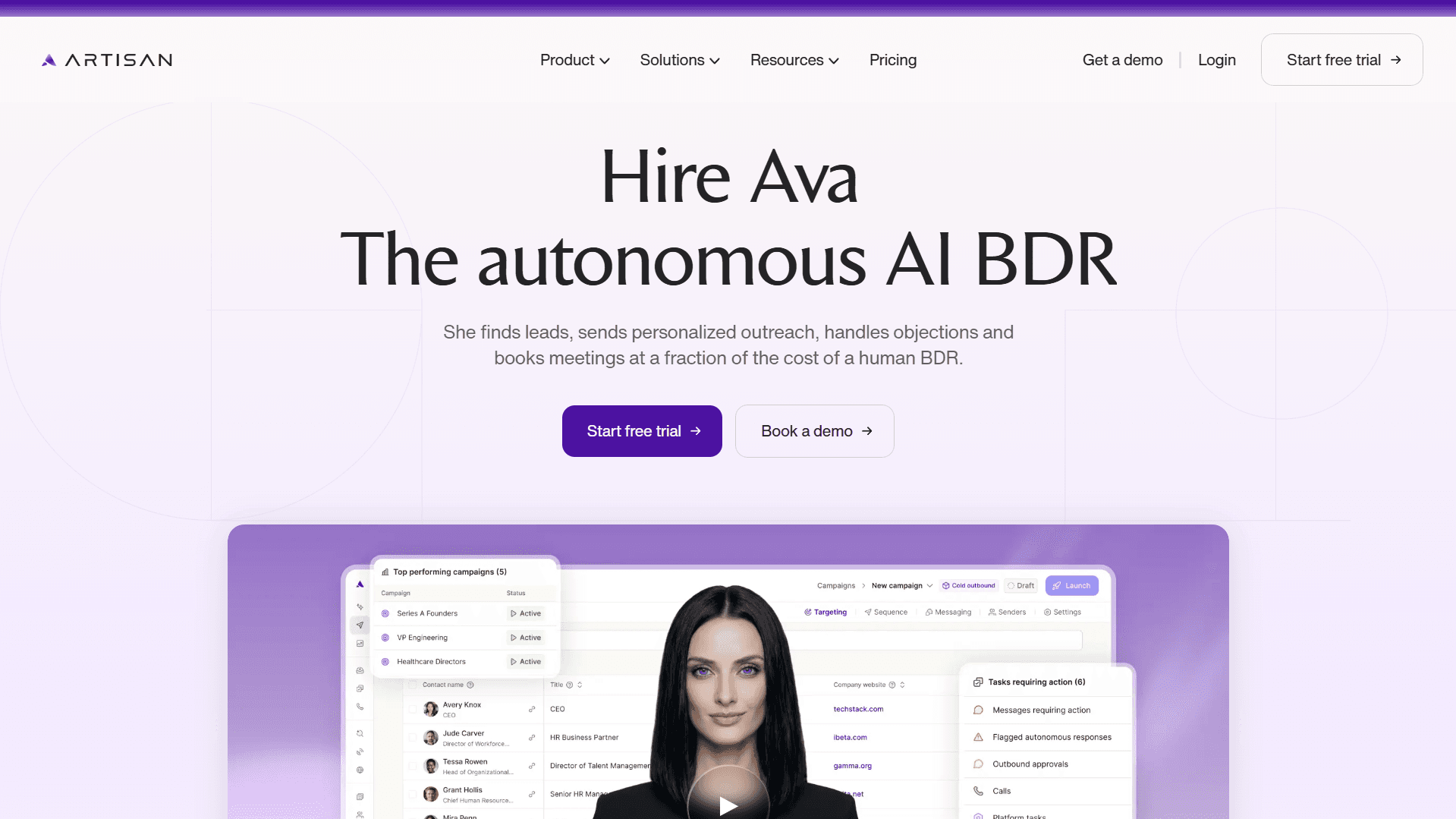
Artisan is the alternative for teams that want the dialer to be one step in an AI-run motion instead of a separate enterprise floor. Calls run as steps inside Ava's multichannel sequences, alongside email and social media outreach, so the system that sources a lead and writes the message also places the call and logs the result. Ava parallel dials up to three lines with AI answer detection, loads live AI talking points before the call connects, transcribes live, auto-classifies outcomes, drafts the follow-up email, and can drop a voicemail with automatic area-code matching. For category roundups, see the best outbound dialer options and best autodialers.
The deployment story is built for real teams. Numbers are pooled at the org level with personal callback routing, so a lead who calls back reaches the right rep's phone. Calling-hours enforcement, DNC checks, and consent-aware recording apply automatically per lead. Central admin maps CRM owners so calls log to the right rep, and per-number ceilings plus carrier spam-reputation monitoring defend connect rates across a large team. Numbers are available in the US, Canada, the UK, Mexico, and Colombia. For calling technique, see proven cold calling scripts.
The economics are the sharpest contrast with Orum. Artisan's pricing is usage-based: Ava's work runs on credits, so you pay for what she actually performs, whether that is qualifying, enriching, personalizing, or sending. You can read how the model works without a demo, and you can try Ava for free. The dialer sits inside that same system, with talking points, transcription, AI-drafted follow-ups, recordings, and analytics part of the motion rather than a separate purchase. For a direct comparison, see Artisan vs. Orum.
The line count is a real limit. Artisan parallel dials up to 3 lines, while Orum reaches 5 to 10 and Nooks runs multi-line. A team whose entire motion is maximum-volume parallel calling, and nothing else, may still want a dedicated floor. For teams whose calling is one channel in a broader motion, one system beats a dialer with a stack around it.
"Ava runs highly targeted outreach at a scale we could never reach with a human-only team," said Bruno Didier of CookUnity. SumUp reported a $52 cost per lead and 8 to 15 positive replies per week from previously unreachable local businesses using Ava.
Best for: startups through enterprise that want calling as one channel in an AI-run outbound system.
Who should pick something else: pure call floors whose only job is maximum-volume parallel dialing at 5 to 10 lines.
Pricing: usage-based, with a free trial. See artisan.co/pricing.
2. Nooks: The virtual salesfloor
Nooks is the alternative for teams that want a dedicated parallel dialer with heavy rep enablement. It dials multiple lines with AI answer detection and wraps the calling in a virtual salesfloor with live coaching, backed by a $43M Series B. For a high-volume calling team that lives on the phones together, the Nooks salesfloor experience is a real draw.
The trade mirrors Orum's. Nooks is calling-only, so sourcing, email, and replies live elsewhere, and its pricing is demo-gated and billed annually, reported around $4,000 to $5,000/user/year. It is a capable dialer with a stack still to build around it. Our dialer roundup compares the pure-parallel field in detail. See also Orum vs. Nooks.
Best for: parallel call floors that want live coaching and a shared salesfloor.
Who should pick something else: teams that want calling connected to the rest of outbound, or published pricing.
Pricing: demo-gated, annual; reportedly roughly $4,000 to $5,000/user/year.
3. Salesfinity: Transparent parallel pricing
Salesfinity is the pick for teams that want genuine parallel dialing without a demo to see the cost. It publishes $149 to $349/user/month for five lines, making it the transparent counterpart to Orum and Nooks in the pure-dialer tier. For a calling team that wants the number up front, this openness is a real advantage over the gated leaders.
Salesfinity is still a dedicated dialer, so the same boundary holds: it dials, and the rest of your outbound stack sits elsewhere. Within the standalone-dialer category, its published pricing is the differentiator.
Best for: calling teams that want five-line parallel dialing at a known price.
Who should pick something else: teams that want the dialer inside a full outbound system.
Pricing: $149 to $349/user/month for five lines, per Salesfinity's pricing page.
4. Koncert: Multiple dialing modes
Koncert is for teams that want to vary how they dial. It offers an AI parallel dialer, a flow dialer, and an agent-assisted dialer, so reps can match a dialing style to each campaign, all within one platform. This flexibility suits teams that run several different calling motions. Like the others in this tier it handles calls and not the surrounding motion, and its pricing varies by dialing mode across a public per-seat ladder from $6 to $99/user/month.
Best for: teams that want to switch between parallel, flow, and agent-assisted dialing.
Who should pick something else: teams that want calling unified with sourcing, email, and replies.
Pricing: $6 to $99/user/month public ladder, varying by dialing mode.
5. Kixie: Calling plus texting for SMB
Kixie suits smaller teams that want a power dialer bundled with texting and CRM integration. It pairs outbound calling with SMS and logs activity to your CRM, so a small or midsize business (SMB) sales team can run calls and texts from one place. Its pricing is demo-gated.
Kixie is a power dialer rather than a high-line parallel floor, so it is a different shape from Orum: lighter on parallel depth, broader on channel mix for a small team. It fits SMB motions, not enterprise call floors.
Best for: SMB teams that want calling, texting, and CRM logging together.
Who should pick something else: teams that need high-line parallel dialing or a full AI-run outbound motion.
Pricing: demo-gated.
6. PhoneBurner: Single-line, reputation-first
PhoneBurner is the deliberate contrarian: a single-line power dialer that trades parallel volume for deliverability. Its ARMOR spam remediation targets the category's number-one worry, number reputation, by focusing on protecting caller ID health rather than maximizing simultaneous lines. For teams whose connect rates suffer from spam flagging, this focus is the whole point.
PhoneBurner will not match Orum on raw parallel throughput, by design. It is single-line, so it suits quality-over-quantity calling where every dial reaching a real person matters more than dialing five at once. Its per-seat pricing is published.
Best for: teams that prioritize number reputation and connect quality over parallel volume.
Who should pick something else: teams that need high-line parallel dialing for maximum call volume.
Pricing: published per-seat pricing, per PhoneBurner's pricing page.
Stay with Orum if...
Orum is the right choice for a specific profile. Keep it if:
Your entire motion is maximum-volume parallel calling and you need 5 to 10 simultaneous lines.
You call into many countries and Orum's international dialing on the Ascend tier is a hard requirement.
You already run a settled stack for sourcing, email, and replies, and you only need a deep enterprise dialer to plug into it.
Leaving a capable enterprise parallel dialer to fix a problem it never had is a mistake. If your calling is truly standalone and international volume is your need, Orum is a defensible place to stay. If calling is one channel among several, consolidation is the better move.
How a dedicated dialer compares to an AI BDR
The choice comes down to whether calling is your whole motion or one channel in it. A dedicated dialer like Orum maximizes parallel connect rates and does nothing else. An AI sales agent like Ava places calls as one step in a sequence that also sources a lead, writes and sends the email, and handles the reply. If your team runs multichannel outbound, a standalone dialer means buying and integrating a stack around it; consolidating into an AI business development representative (BDR) removes both the integration work and the gated pricing. For more matchups, see Orum vs. Aircall and Artisan vs. Aircall.
What changed in dialers in 2026?
Orum acquired the conversation-intelligence tool Scout AI in July 2026, deepening its analytics while adding integration questions for new buyers.
Number reputation and spam flagging remained the category's top buyer worry, lifting demand for automatic reputation monitoring and remediation.
Published dialer pricing gained ground against gated enterprise quotes as buyers resisted quote-only models.
Parallel dialing continued shifting from a standalone category toward a channel inside broader AI-run outbound systems.
Frequently asked questions
What is the best alternative to Orum? For teams that want calling connected to the rest of outbound at a published price, Artisan is the strongest alternative, because the dialer runs inside Ava's multichannel sequences. For a pure enterprise call floor, Nooks is the closest dedicated rival, with a virtual salesfloor and multi-line dialing.
What is the best enterprise alternative to Orum? Artisan is the pick for teams that want calling governed inside one system: pooled org-level numbers, callback routing, automatic DNC and calling-hours enforcement, CRM owner mapping, and reputation monitoring. If the motion is purely maximum-volume international parallel calling, Orum's own 5-to-10-line depth is hard to match.
How much does Orum cost? Orum's live page is gated, with Launch reported around $250/user/month, and its higher Ascend tier custom-quoted behind a demo. Artisan works differently: its pricing is usage-based, so you pay for the work Ava performs rather than for a fixed seat bundle, with no demo required to see how the model works.
How many parallel lines does Artisan support versus Orum? Artisan parallel dials up to 3 lines with AI answer detection; Orum reaches 5 to 10. For a team whose whole motion is maximum-volume calling, this difference matters. For teams where calling is one channel in a broader sequence, 3 lines inside one AI-run system is usually the better trade.
Can Artisan replace Orum for a calling team? For teams that run multichannel outbound, yes: the dialer is a native step in Ava's sequences with talking points, transcription, and auto-classified outcomes. For teams whose only motion is high-line international parallel calling, a dedicated 5-to-10-line floor like Orum can still be the right tool.
Which Orum alternative is most transparent on price? Salesfinity, which publishes $149 to $349/user/month for five lines, and Artisan, whose usage-based model is published rather than quoted. Orum quotes its Ascend tier and Nooks its whole product behind a demo, so comparing them on cost requires a sales conversation.

Artisan Team
Expert insights from the team at Artisan
Our writing team blends direct operational experience, in-house data, and thorough research to bring you the very latest insights and updates about sales and GTM automation.