Artisan vs. Aircall: Which fits your team?
Artisan runs a sales dialer inside one AI-led outbound system. Aircall is a business phone system with a sequential power dialer. How to choose.
Key Takeaways
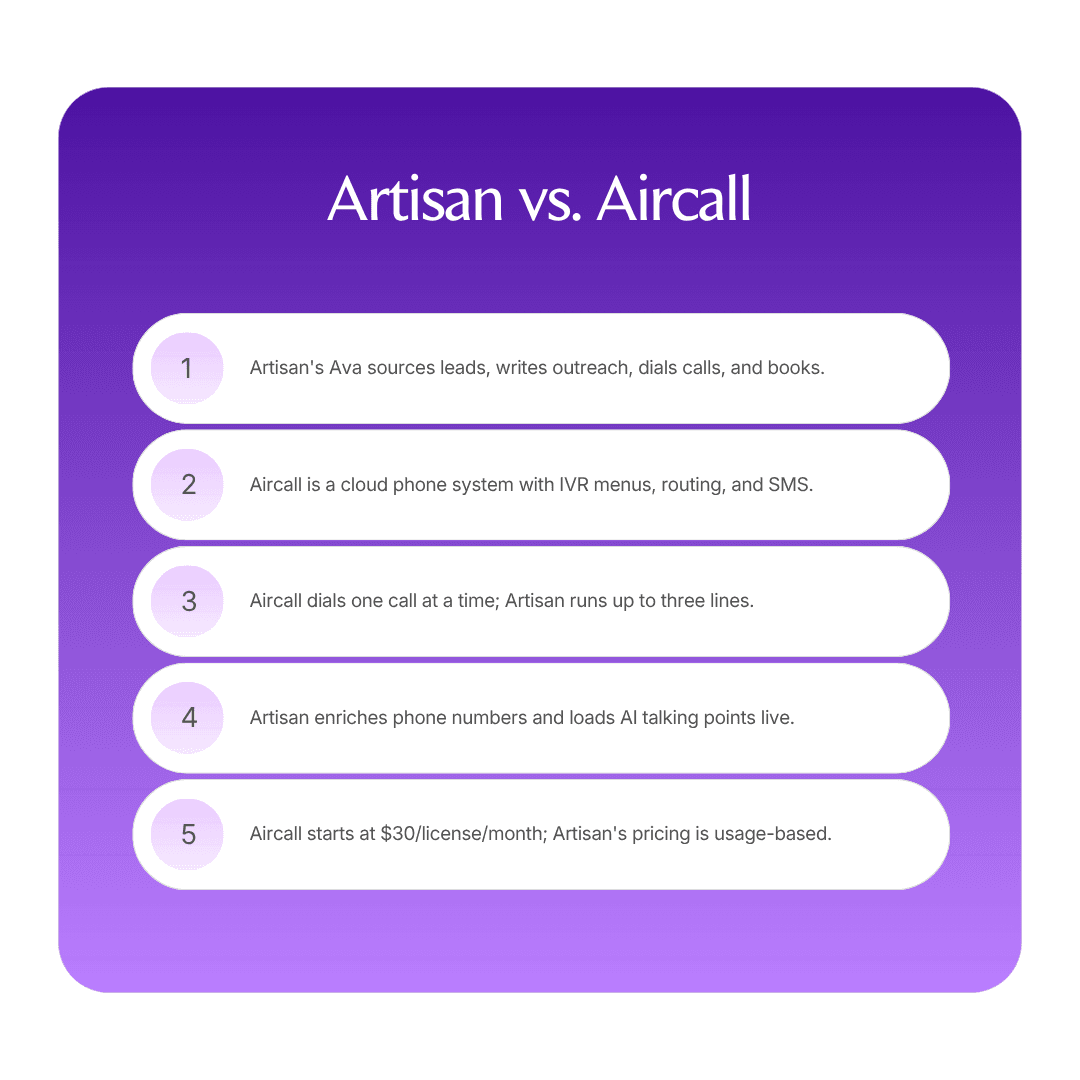
- Artisan's dialer is one step inside a workflow Ava, an AI business development representative (BDR), runs end to end. Aircall is a business phone platform whose power dialer is one feature among call routing, interactive voice response (IVR) menus, and support telephony.
- Artisan's pricing is usage-based, so Ava's work runs on credits and you pay for the work she performs, with dialer seats and phone numbers billed separately. Aircall runs about $30/license/month on Essentials and $50 on Professional, on annual billing with a three-license minimum, per its pricing page.
- Aircall's sales dialer is sequential, taking one call at a time with auto-advance, and it does not run parallel lines. Artisan runs power and parallel dialing up to three lines with AI answer detection.
- Aircall is a mature, general-purpose phone system with a large app marketplace, strong if you need inbound support telephony and outbound in one tool. Artisan is purpose-built for AI-run sales outbound.
- Artisan reports that over 90% of customers run Ava autonomously, so calling sits inside one sequence with email and social media instead of a phone app reps operate manually.
- Artisan enriches phone numbers, loads live AI talking points before connect, drafts a follow-up email, and books a meeting; Aircall focuses on placing and routing a call.
Artisan and Aircall both put a dialer in front of your reps, but they come from different worlds. Artisan is an AI-led outbound system where calling is one channel Ava runs alongside sourcing, messaging, replies, and booking. Aircall is a cloud phone system with a sequential power dialer. Choose Artisan for AI-run outbound; choose Aircall for a full phone system.
The short version: Phone system vs. outbound system
Aircall's heritage is telephony. It began as a cloud phone system for support and business calling, and it does that broadly: call routing, IVR menus, shared numbers, a deep app marketplace, and a sequential power dialer for outbound. If you need one tool that answers support lines and also lets reps dial down a list, Aircall covers a lot of ground.
Artisan works differently. It is an outbound platform where a call is a step inside a sequence Ava owns, next to email and social media. She decides who to call, finds the number, writes the surrounding outreach, works the replies, and books the meeting. So the real question is less about whose dialer performs better and more about whether you want a business phone system with an outbound dialer, or the calling handled inside the system that runs the rest of sales outbound. We will go stage by stage.
How do Artisan and Aircall decide who to call?
Artisan builds a call list; Aircall expects you to bring it. Ava sources best-fit leads from a database of over 250 million B2B professionals across over 200 countries, plus Artisan Local Data covering over 250 million local businesses. She runs waterfall phone enrichment across roughly a dozen providers, charged only on a successful match, and ranks leads by conversion likelihood. Intent signals such as funding rounds, new executive hires, and active hiring can trigger the list, so the numbers your reps dial are chosen by fit and timing.
Aircall does not source or enrich prospect data. As a phone system, it connects to your CRM and dials the contacts your other tools produce. If you already own strong data and prioritization, this is fine. If part of the problem is who ends up on a call list, Aircall does not address it.
How do they handle the actual calling?
Both dial; they differ on method and intelligence. Aircall's sales dialer is sequential. It queues a list and auto-advances one call at a time, with click-to-dial, call recording, and notes. It is a clean power dialer, and for a rep who works a list it does the job. It does not run parallel lines.
Artisan runs power dialing and parallel dialing up to three lines with AI answer detection, and layers on sales-specific intelligence: live AI talking points loaded before a call connects, live transcription, auto-classified outcomes, AI call summaries with action items, and automatic number selection so a lead sees a local-looking number. Numbers are pooled at the org level with callback routing, so a returned call reaches the rep who placed it, and calling hours in the lead's local time, do-not-call checks, and consent-aware recording are enforced automatically per lead. Reputation monitoring and per-number daily ceilings protect connect rates. Aircall covers the telephony basics well; Artisan is built specifically to make an outbound sales call more likely to connect and convert.
What happens after the call?
This is where an outbound system separates from a phone system. With Aircall, a call ends, the recording and notes log to your CRM, and the follow-up, sequencing, and next steps run in your other tools. Aircall placed and captured the call; the rest of the motion is on your reps and your stack.
With Artisan, a call is a step in a sequence Ava already runs. She drafts the follow-up email, logs the outcome natively to Salesforce or HubSpot against the right owner, and keeps the lead advancing across email and social media. When a prospect replies on any channel, Ava qualifies, answers objections from your knowledge base, and escalates on plain-language rules. A call advances a motion instead of ending one.
How do Artisan and Aircall book meetings?
Artisan books meetings; Aircall hands them off. Ava schedules on the right rep's calendar with CRM-owner routing and turns a good call into a confirmed meeting without manual scheduling. Aircall is the phone layer, so booking and downstream sequencing live in your calendar and CRM tools.
If you want one system that also answers your support lines and you are content to run booking elsewhere, Aircall's breadth is the draw. If you want the stretch from call to calendar handled in one place, Artisan owning it is the stronger shape.
How do the two compare on price?
They are priced for different jobs. Aircall runs about $30/license/month on Essentials and $50 on Professional, billed annually with a three-license minimum, per its pricing page. This buys a business phone system with a sequential dialer.
Artisan's pricing is usage-based. Ava's work runs on credits, so you pay for what she performs: qualifying, enriching, personalizing, and sending messages. Dialer seats and phone numbers are billed separately, and you can try Ava for free; see the pricing page. Comparing the two line by line is difficult, because Aircall sells a phone system while Artisan's dialer is part of a platform that replaces the separate sourcing, sequencing, and reply tools you would otherwise pay for around Aircall. Compare total motion cost, not just a per-license sticker.
Situation to fit
Your situation | Better fit |
You want calling handled inside the system that sources, writes, and books | Artisan |
You need inbound support telephony and business calling in one tool | Aircall |
You want AI talking points, transcription, and auto follow-up on sales calls | Artisan |
You mainly need call routing, IVR, and shared numbers | Aircall |
You are consolidating a multi-tool outbound stack into one platform | Artisan |
You want a broad app marketplace of telephony integrations | Aircall |
You want an AI that runs outbound at over 90% autonomy | Artisan |
You need a straightforward sequential power dialer and nothing more | Aircall |
Choose Aircall if...
You need a full business phone system, and an outbound dialer on its own will not cover it. Aircall handles inbound support, call routing, IVR menus, and shared numbers, which Artisan does not set out to do.
Your reps want a simple sequential power dialer that plugs into an existing CRM and sequencing stack, and you do not need parallel lines or AI call assistance.
You value Aircall's mature app marketplace and want telephony that connects broadly across support, success, and sales tools.
Your per-license budget is the deciding factor and you already run sourcing, messaging, and booking in other systems.
If this is your setup, Aircall is a reasonable choice and we would not push you off it.
Where Artisan pulls ahead
Aircall is a good phone system. Outbound is a different job, and it is the whole point of Artisan. Ava runs the motion from sourcing to booked meeting, calling included, so a large account executive team can have sales ops operate the platform centrally while reps take the meetings that land. Artisan is SOC 2 Type II compliant with a full audit trail and role-based access, and autonomy is a dial: review and approve every action, replies only, or let Ava run unsupervised, with plain-language escalation rules.
CookUnity shows the difference in kind. Bruno Didier, CEO of CookUnity Business, puts it plainly: "Ava runs highly targeted outreach at a scale we could never reach with a human-only team." The team sent over 100,000 personalized emails at roughly a $45 cost per lead, the sort of end-to-end output a phone system plus a rep cannot produce, because sourcing, messaging, and follow-up all sit outside the phone.
So the honest comparison is wider than dialer against dialer. It sets a business phone system against a system where the AI runs outbound end to end and calling is one channel it operates. For the broader view, see how the AI BDR job is automated, how the AI sales agent fits an enterprise team, and what Artisan consolidates into one platform.
FAQ
Is Aircall a sales dialer or a phone system?
Both, but a phone system first. Aircall began as a cloud business phone platform for support and business calling, with call routing, IVR, and shared numbers, and it added a sequential power dialer for outbound. Artisan, by comparison, is an outbound sales system where the dialer is one channel Ava runs alongside sourcing, messaging, replies, and booking.
Does Aircall do parallel dialing like Artisan?
No. Aircall's sales dialer is sequential and works a list one call at a time with auto-advance. Artisan runs power dialing and parallel dialing up to three lines with AI answer detection, plus live AI talking points, live transcription, and post-call summaries built for outbound sales.
How much does Artisan's dialer cost versus Aircall?
Artisan's pricing is usage-based. Ava's work runs on credits, so you pay for the work she performs, and dialer seats and phone numbers are billed separately. Aircall runs about $30/license/month on Essentials and $50 on Professional, billed annually with a three-license minimum. Aircall's per-license cost is easy to model in advance, while Artisan's cost tracks the outbound work performed.
Can Aircall find leads and write outreach like Artisan?
No. Aircall places and routes calls; it does not source prospects, enrich phone numbers as a sales database, write outreach, or book meetings. Artisan's Ava sources leads from a database of over 250 million B2B professionals, runs waterfall phone enrichment, writes email, social media, and call steps, works replies, and books meetings.
Which should a sales team pick for outbound?
For AI-run outbound, Artisan, because it handles the whole motion and not only the call. Choose Aircall when your priority is a general business phone system that also answers inbound support lines, and you already run sourcing, sequencing, and booking in other tools. The two are optimized for different jobs.
Does Artisan replace my phone system?
For outbound sales calling, yes. Artisan provides numbers in the United States, Canada, the United Kingdom, Mexico, and Colombia, pooled at the org level with callback routing and automatic per-lead compliance. It is not designed to be a full support phone system with IVR menus and inbound routing, which is where Aircall's telephony breadth still fits.
Is Artisan's calling enterprise-ready?
Yes. It offers pooled org-level numbers with personal callback routing, automatic per-lead enforcement of calling hours, do-not-call checks and consent-aware recording, central admin with CRM owner mapping, reputation monitoring, per-number daily ceilings, SOC 2 Type II attestation, and usage-based pricing that tracks the work performed instead of a fixed seat count.
Related reading

Artisan Team
Expert insights from the team at Artisan
Our writing team blends direct operational experience, in-house data, and thorough research to bring you the very latest insights and updates about sales and GTM automation.