The best Aircall alternatives in 2026
The best Aircall alternatives for outbound sales in 2026, ranked. Artisan runs calling inside one AI-driven system, plus Nooks, Orum, Dialpad and more.
Key Takeaways
- Aircall is a business phone system built for support and inside teams. Outbound sales teams often want a dialer that lives inside prospecting, not a separate telephony app they log into.
- Artisan ranks first for outbound because the dialer runs as call steps inside AI-driven multichannel campaigns, alongside email and social media.
- Artisan does power and parallel dialing up to three lines with AI answer detection. Dedicated parallel dialers like Nooks and Orum run more simultaneous lines for teams whose whole motion is volume calling.
- Over 90% of Artisan customers run Ava autonomously, so calls sit alongside email and social media steps the AI sources, writes, and follows up on.
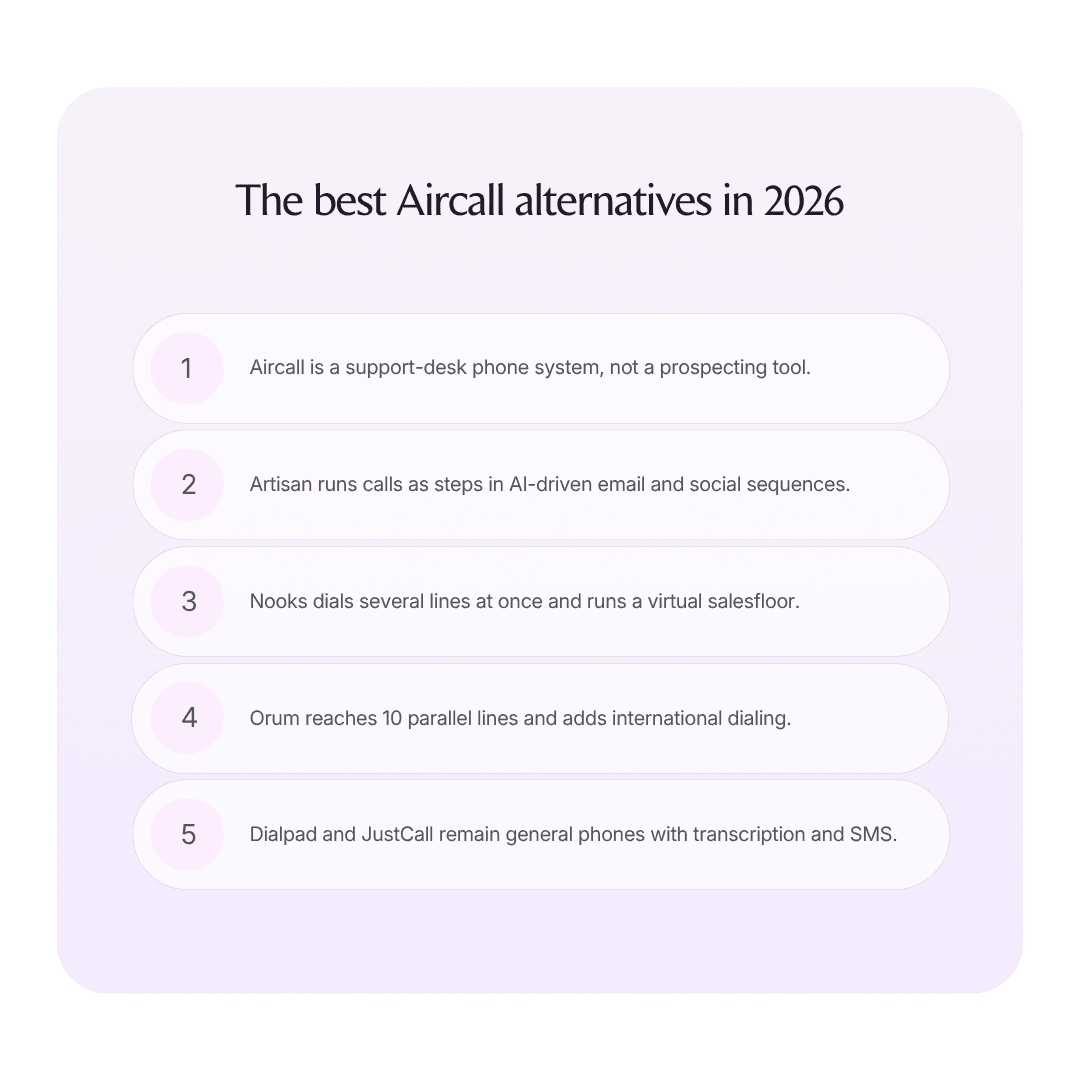
- Choose based on the job: a sales system that dials (Artisan), a maximum-volume call floor (Nooks, Orum), or a general business phone (Dialpad, JustCall).
The best Aircall alternative for outbound sales is Artisan, because it puts calling inside one AI-run outbound system instead of a standalone phone app. Calls become steps in an AI-driven sequence, Ava handles the work around them, and pricing is usage-based. For pure high-volume call floors, Nooks and Orum go wider.
Comparison table
Rank | Tool | Best for | Standout capability | Public pricing |
1 | Artisan | Outbound teams that want calling inside one AI-run system | Dialer as steps in AI-driven sequences, over 90% autonomous | Usage-based, published at artisan.co/pricing; free trial |
2 | Nextiva | SMB teams that want a business phone and a call center at one price | Inbound call center included on the $25 Engage tier, no user minimum | Engage $25/user/month annual ($50 monthly), per its pricing page |
3 | Nooks | Pure parallel-dial call floors | Multi-line parallel, virtual salesfloor | Reportedly ~$4,000 to $5,000/user/year, demo-gated (annual) |
4 | Orum | Enterprise parallel dialing across regions | Up to 10 lines, international dialing on Ascend tier | Launch $250/user/month; Ascend custom, gated |
5 | Dialpad | Teams that want AI voice plus meetings | Native AI transcription and coaching | Sell tier from $39/user/month, per its pricing page |
6 | JustCall | SMB phone plus SMS with a sales dialer | Voice and texting in one app | Team $29 to Pro Plus $89/user/month, per its pricing page |
7 | Kixie | Reps who want power dialing plus SMS | Local presence and voicemail drop | Demo-gated (was ~$35 to $95/user/month) |
8 | PhoneBurner | Single-line power dialing with spam care | ARMOR number-reputation remediation | Standard $140 to Premium $183/user/month annual |
Why do teams look for an Aircall alternative?
Aircall is a solid cloud phone system. It is aimed at support desks and inside teams that need call routing, interactive voice response (IVR), and a shared number, and it prices per seat with a three-license minimum, roughly $30 to $50/user/month per its pricing page. This design is the friction for outbound sales. The dialer is a separate app from wherever your leads, sequences, and replies live, so reps swivel between tools and calls do not automatically become the next step in a cadence. Aircall also leans on an app marketplace to connect to CRMs and sequencers, which means the outbound motion is something you assemble rather than something the phone was built to run. If your reps spend their day prospecting, a sales-native dialer usually beats a general business phone.
How we chose
We ran four tests, weighted for outbound sales instead of support telephony:
Does the tool just dial, or does it source leads, write outreach, dial, and handle replies?
Calls that run as steps inside a sequence beat a standalone softphone reps switch to.
Published costs beat demo-gated quotes.
Number pooling, CRM owner mapping, calling-hours enforcement, and do-not-call (DNC) checks matter at team scale.
What is the best overall Aircall alternative?
1. Artisan: Calling inside one AI-run outbound system
Artisan is the strongest Aircall alternative for outbound because the phone is not the product. It is one channel inside a system where an AI business development representative (BDR) named Ava sources leads from a database of over 250 million B2B professionals across over 200 countries, enriches them with waterfall email and phone data, writes the outreach, and books meetings. Calls run as steps in the same multichannel sequence as email and social media, so a dial is never a context switch.
The dialer is enterprise-grade. Power dialing and parallel dialing reach up to three lines with AI answer detection, live talking points loaded before the call connects, live transcription, auto-classified outcomes, and an AI-drafted follow-up email. Numbers are pooled at the org level with personal callback routing, so a lead who calls back reaches the right rep. Compliance runs automatically per lead, covering calling-hours enforcement, federal DNC checks, consent-aware recording, and carrier spam-reputation monitoring that protects a large team's connect rates.
Pricing is the blunt argument. Artisan is usage-based, so you pay for the work Ava actually performs: qualifying, enriching, personalizing, and sending messages. Over 90% of customers run Ava autonomously. For a head-to-head, see Artisan vs. Aircall.
Best for: outbound teams from startup to enterprise that want the whole motion in one system, with sales ops running Ava centrally for account executives (AEs) who never log in. Who should pick something else: teams whose entire day is maximum-volume parallel calling and nothing else may want a dedicated 5-to-10-line floor. Pricing: usage-based, with a free trial and no platform fee. See Artisan pricing.
2. Nextiva: Call center features at a business-phone price
Nextiva is a unified communications platform covering voice, video, chat, SMS, and social, so its scope matches Aircall's rather than a sales dialer's. The Engage plan is the practical argument: at $25 per user per month billed annually it includes call recording, an inbound call center, live chat with a chatbot, a toll-free number with 2,000 minutes, and CRM integrations, with no minimum user count against Aircall's three-license floor. Its AI layer, XBert, answers calls, texts, and chats 24/7, books appointments, and escalates complex requests with full context, priced separately from $99 per month.
Best for: SMB sales and support teams that want a phone system, an inbound call center, and an AI receptionist from one vendor, at any headcount. Who should pick something else: outbound teams that need parallel dialing and calls running as steps in an AI-driven sequence, since Nextiva's strength is inbound. Pricing: Engage $25/user/month annual ($50 month-to-month), per its pricing page; XBert from $99/month.
3. Nooks: The parallel-dialing call floor
Nooks is a leading parallel dialer for teams whose motion is volume calling. It dials multiple lines at once with AI answer detection and runs a virtual salesfloor where reps huddle and coach live. Nooks raised a $43M Series B. Pricing is demo-gated, reported by third parties at around $4,000 to $5,000/user/year on annual billing, which is the tradeoff for a dedicated floor. Compare directly in Nooks vs. Aircall and Artisan vs. Nooks.
Best for: teams of sales development representatives (SDRs) that do hundreds of dials a day as their core job. Who should pick something else: teams that also need lead sourcing, email, and reply handling in the same tool. Pricing: demo-gated; reportedly ~$4,000 to $5,000/user/year on annual billing per third-party reports.
4. Orum: Enterprise parallel dialing across regions
Orum is the enterprise parallel dialer, pushing up to 10 simultaneous lines with AI answer detection and offering international dialing on its Ascend tier. It acquired Scout AI in July 2026, adding to its conversation-intelligence story. Its Launch plan is $250/user/month, with the Ascend tier custom-quoted and gated. For a global call floor, it is a capable specialist. Compare directly in Orum vs. Aircall and Artisan vs. Orum.
Best for: large, international SDR floors that optimize connect rate above all. Who should pick something else: teams that want calls as one step in a broader AI-run cadence rather than a standalone dial engine. Pricing: Launch $250/user/month; Ascend custom, gated.
5. Dialpad: AI voice plus meetings
Dialpad is an AI-native business communications platform with voice, meetings, and a contact center, plus real-time transcription and coaching. It is a closer match to Aircall's scope of running a whole company's phones than to a sales dialer, but its sales tier gives reps AI-assisted calling. If you want unified communications with AI baked in, it competes directly.
Best for: teams that want one platform for internal comms and customer calls. Who should pick something else: outbound teams that want a dialer wired into prospecting, not a unified communications suite. Pricing: Sell tier from $39 to $150/user/month, per its pricing page.
6. JustCall: Phone plus SMS for smaller teams
JustCall is a cloud phone and texting platform aimed at small and medium-sized business (SMB) sales and support, with a sales dialer, SMS, and CRM integrations. It is easier to stand up than an enterprise stack and covers voice and text in one app. For a small team that wants Aircall-style telephony with a lighter price and built-in SMS, it is a reasonable swap.
Best for: small sales and support teams that want voice and SMS together. Who should pick something else: teams that need the AI to source and write, not just dial and text. Pricing: Team $29 / Pro $49 / Pro Plus $89/user/month annual, per its pricing page.
7. Kixie: Power dialing plus SMS for reps
Kixie is a rep-focused power dialer with local presence dialing, voicemail drop, and SMS, wired tightly into CRMs. It speeds up manual outbound calling without the complexity of a parallel floor. Reps who live in the CRM and want faster single-line dialing tend to like it.
Best for: individual reps and small teams that want quick CRM-connected dialing. Who should pick something else: teams that need parallel lines or an AI running the surrounding cadence. Pricing: demo-gated (was reportedly ~$35 to $95/user/month).
8. PhoneBurner: Single-line dialing with spam care
PhoneBurner is deliberately single-line, trading raw parallel volume for call quality and its ARMOR number-reputation remediation, which targets the category's biggest worry: spam flagging. It is a clean power dialer for teams that would rather protect connect rates than chase maximum dials. For more picks in this style, see the best autodialers.
Best for: teams that prioritize number reputation and call quality over parallel volume. Who should pick something else: teams that want parallel lines or a full outbound system. Pricing: Standard $140 / Professional $165 / Premium $183/user/month annual.
Stay with Aircall if...
Keep Aircall if telephony is the point. If you run a support desk or an inside team that needs shared numbers, IVR, call routing, and a marketplace of app integrations, Aircall does that job well and outbound sales is a side use. The alternatives above matter when calling is one part of a prospecting motion instead of the whole reason you bought a phone system.
SumUp shows the consolidation payoff. Its growth lead, Karlo Biuk, reported a $52 cost per lead and 8 to 15 positive replies per week from previously unreachable local SMBs after moving outreach onto Artisan. The calls were part of the same AI-run motion, not a separate tool.
Want the deeper dialer breakdown? See our guide to the best AI dialers and parallel dialers, and the primer on what an AI BDR actually does. See also the best outbound dialer and our cold calling scripts.
FAQ
What is the best alternative to Aircall for outbound sales?
Artisan, if you want the dialer inside a system that also sources leads, writes outreach, and handles replies. Calls run as steps in an AI-driven sequence, priced by usage. If your team only needs a high-volume call floor, Nooks or Orum are stronger single-purpose picks with multi-line parallel dialing (Orum up to 10 lines).
Is Aircall a good sales dialer?
Aircall is a good business phone system, but it is built for support and inside teams rather than outbound prospecting. It routes calls, shares numbers, and connects to other tools through a marketplace. For sales, the dialer sits apart from your leads and sequences, so a sales-native tool where calls are cadence steps usually fits outbound better.
What is the best enterprise alternative to Aircall?
For enterprise outbound, Artisan combines a compliant dialer with central-ops deployment: pooled org-level numbers, CRM owner mapping so calls log to the right rep, automatic DNC and calling-hours enforcement, and SOC 2 Type II attestation. Pricing is usage-based, so cost follows the work Ava performs. For a global standalone call floor, Orum's up-to-10-line dialer with international dialing on its Ascend tier is the specialist pick.
How does Artisan's dialer pricing compare to Aircall's?
Artisan is usage-based. You pay for the work Ava performs across qualifying, enriching, personalizing, and sending, and the dialer runs inside that same platform. Aircall prices per seat with a reported three-user minimum per its pricing page. Confirm current tiers directly, since telephony pricing changes often.
Does Artisan do parallel dialing like Nooks or Orum?
Yes, up to 3 lines with AI answer detection, run as steps inside multichannel campaigns. This covers most outbound teams. Nooks runs multi-line parallel dialing and Orum reaches up to 10 lines, so a team whose entire motion is maximum-volume parallel calling may still prefer a dedicated floor.
Can Artisan replace both my phone system and my sequencer?
For outbound, yes. Artisan runs email, social media outreach, and dialer call steps in one AI-driven sequence, with lead sourcing, enrichment, reply handling, and meeting booking in the same platform. This consolidates the dialer, the sequencer, and the data tools most teams stitch together. It is not a full company-wide phone system for support and internal calls the way Aircall or Dialpad are.
The bottom line
Aircall is a phone system. If outbound sales is the job, the better move is a system that dials as one part of running the whole motion. Artisan puts calling inside an AI-driven outbound engine, with Ava handling the sourcing, writing, and follow-up around every call. For a pure parallel-dial floor, Nooks and Orum stay the specialists. See how the AI sales agent fits together.

Artisan Team
Expert insights from the team at Artisan
Our writing team blends direct operational experience, in-house data, and thorough research to bring you the very latest insights and updates about sales and GTM automation.