Artisan vs. Nooks: Which fits your team?
Artisan runs a dialer inside one AI-led outbound system that also sources, writes, and books. Nooks is a dedicated parallel-dialing floor. Here is how to choose.
Key Takeaways
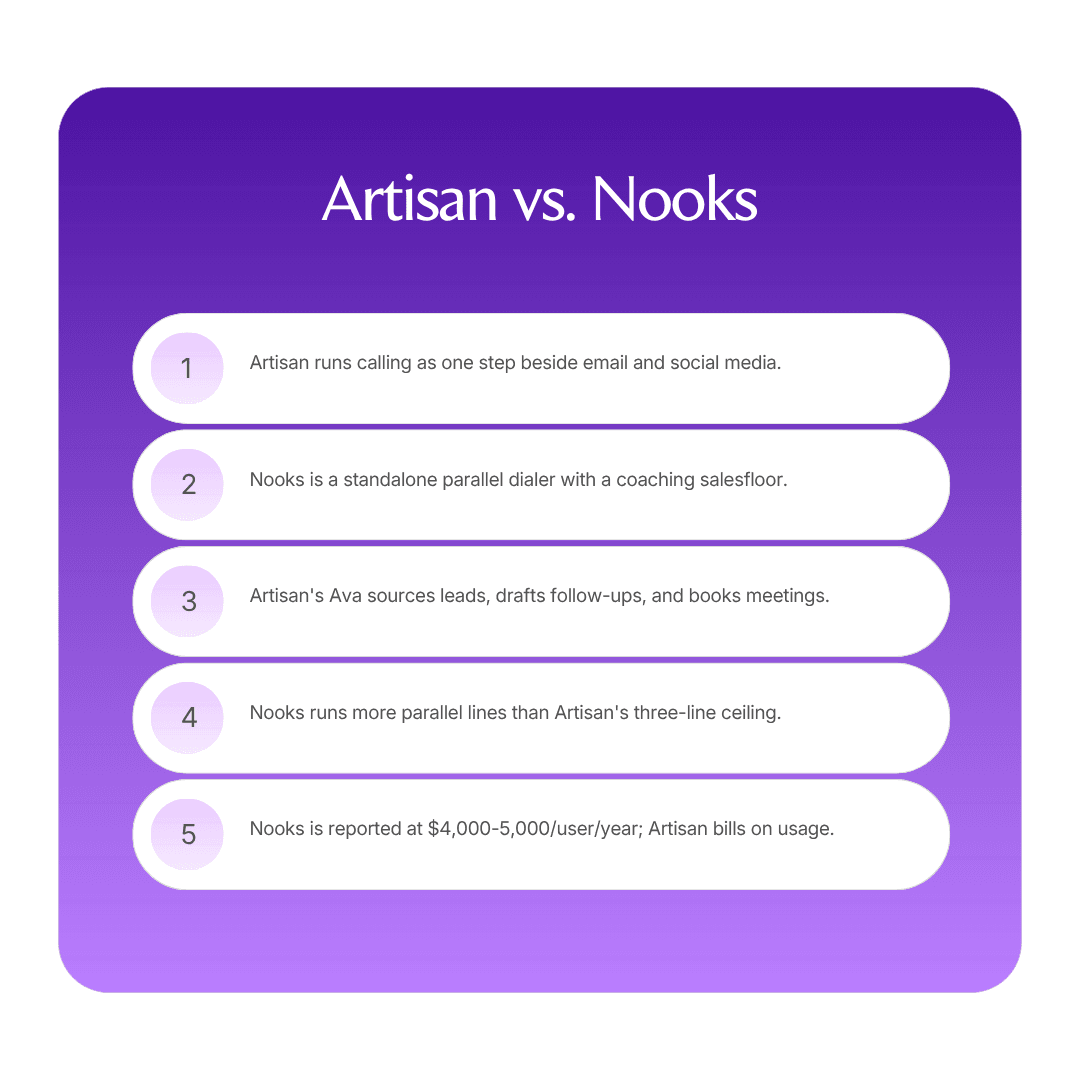
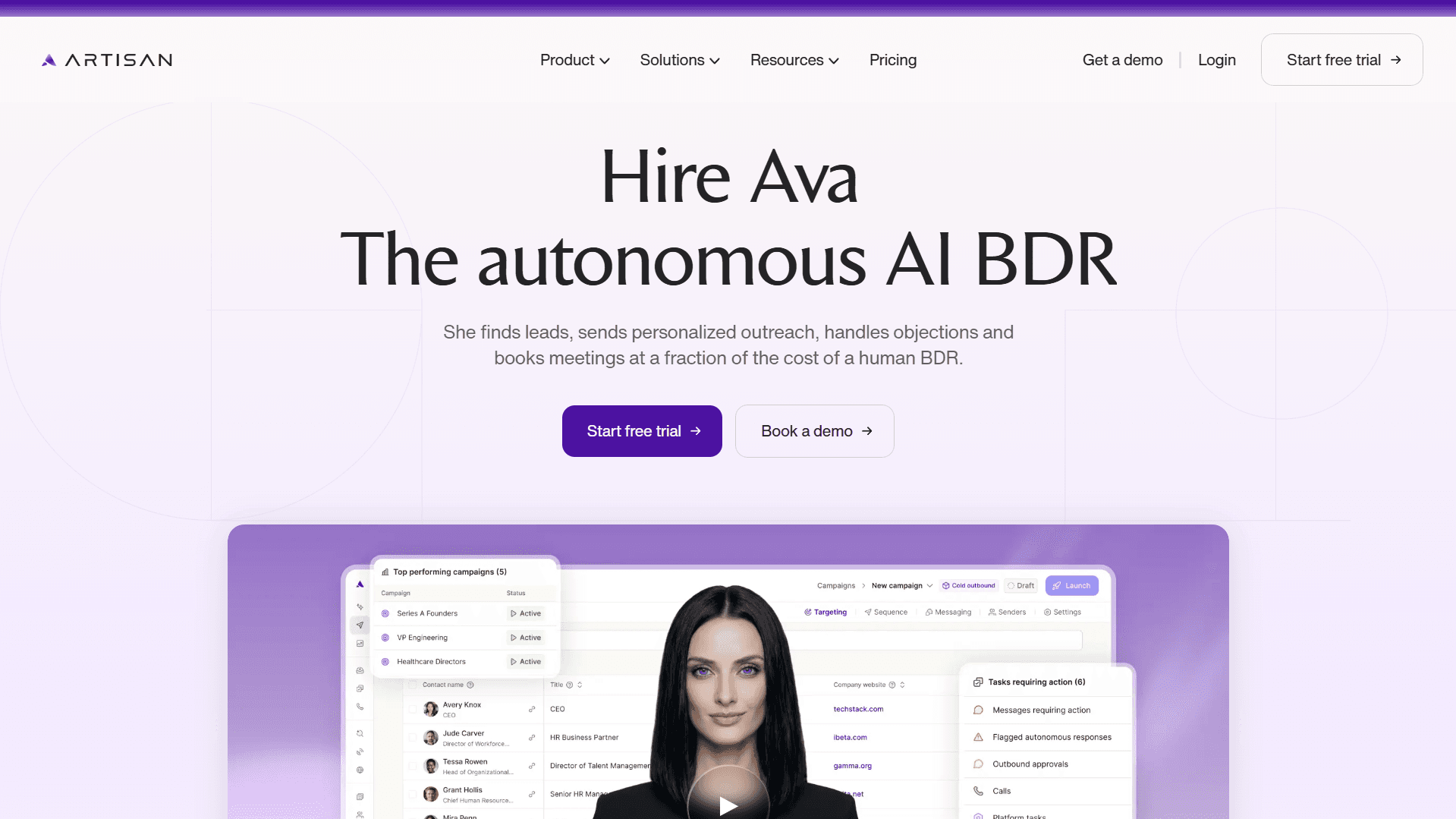
- Artisan's dialer is one step inside a system where Ava, Artisan's AI business development representative (BDR), also sources leads, enriches phone numbers, writes multichannel outreach, handles replies, and books meetings. Nooks is a standalone calling product that assumes your reps already have a list and a message.
- Artisan's pricing is usage-based, so you pay for the work Ava performs rather than per seat. Nooks is demo-gated and reported at roughly $4,000 to $5,000/user/year (about $333 to $417 a month) on a five-seat annual minimum, per third-party estimates.
- Artisan replaces the dialer plus much of the data, sequencing, and reply-handling stack around it, so the real comparison is one platform against a calling layer and the tools it needs beside it.
- Nooks wins on raw parallel throughput. Dedicated parallel dialers run more simultaneous lines than Artisan's three, and Nooks' virtual salesfloor is purpose-built for coaching a room of full-time callers.
- Artisan reports that over 90% of its customers let Ava run autonomously, so calling sits alongside email and social media in one AI-run sequence instead of a separate tool your reps switch into.
- Nooks raised a $43M Series B led by Kleiner Perkins in October 2024, and it is the clearer specialist if calling is the entire job.
Artisan and Nooks both help teams talk to more prospects, but they solve different problems. Artisan puts a dialer inside one AI-led outbound system that also finds leads, writes messaging, and books meetings. Nooks is a dedicated parallel-dialing floor. Choose Artisan to consolidate; choose Nooks for a pure high-volume calling team.
The short version: Two different jobs
Nooks is one of the parallel-dialing category leaders. If you run a floor of dedicated callers whose day is dialing, its virtual salesfloor, live coaching, and call review are strong, and it multiplies connects the way a good parallel dialer should. It is a specialist, and it is good at the thing it specializes in.
Artisan works differently. It is an outbound platform where the calling step is one channel alongside email and social media, all run by Ava. The real question is whether you want a calling tool, or want the calling handled inside a system that also finds, writes to, and books the lead. Below, we walk the buying decision by sales-journey stage.
How do Artisan and Nooks decide who to call?
Artisan does this stage for you; Nooks assumes it is already done. Ava sources best-fit leads from a database of over 250 million B2B professionals across over 200 countries, plus Artisan Local Data with over 250 million local businesses, enriches verified phone numbers, and ranks leads by conversion likelihood before any call step fires. Intent signals like funding rounds, new executive hires, and hiring activity can trigger the list, so fit and timing decide who your reps dial instead of whoever sits next in a static CSV.
Nooks starts after this work is done. It is a calling layer, so the list, the phone data, and the prioritization come from your existing stack. That is fine if you already own strong data tooling and just need to burn through a clean list faster. It is a gap if part of what you are trying to fix is who ends up on the call sheet in the first place.
How do they handle the actual calling?
This is where Nooks is strongest and where Artisan is honest about a limit. Nooks is a dedicated parallel dialer with AI answer detection and a salesfloor built for volume: reps dial together, managers listen in and coach live, and the team reviews calls together. Across the dedicated parallel-dialer category, tools run more simultaneous lines than Artisan does, commonly in the five to ten range, which is the point of buying one. For the broader category, see the best AI dialers and parallel dialers and the best autodialers.
Artisan runs power dialing and parallel dialing across up to three lines with AI answer detection, live AI talking points loaded before the call connects, live transcription, auto-classified outcomes, AI voicemail drop, and automatic area-code matching. It is built as enterprise-grade calling: numbers are pooled at the org level, a lead calling back reaches the right rep's phone, and calling-hours limits, federal do-not-call checks, and consent-aware recording are enforced automatically per lead. Per-number daily call limits protect a large team's connect rates. What Artisan does not do is push past three simultaneous lines. A team whose entire motion is maximum-volume parallel calling will out-dial Artisan on a dedicated tool. For more on tooling and technique, see the best outbound dialer options and proven cold calling scripts.
What happens after someone picks up?
Here the systems diverge again. With Nooks, the call ends and your rep moves to the next task in whatever tools they use for follow-up, sequencing, and CRM logging. The connect is logged; the rest of the follow-through is on the rep and the surrounding stack.
With Artisan, the call is a step in a sequence Ava already owns. She drafts the follow-up email after the call, logs the outcome natively to Salesforce or HubSpot against the right rep and owner, and keeps the lead moving across email and social media without a human stitching tools together. If the prospect replies on any channel, Ava qualifies, answers objections from your knowledge base, and escalates on plain-language rules ("if the lead mentions pricing, escalate"). The call does not sit in isolation; it advances a motion.
How do Artisan and Nooks book meetings?
Artisan closes the loop; Nooks hands it back to your reps. Ava books meetings on the right rep's calendar with CRM-owner routing, so a connect that turns into interest becomes a booked meeting without manual scheduling. Nooks is the conversation engine, and the booking, routing, and downstream sequencing live in your other tools.
For a team that already has that downstream machine humming, Nooks slotting in as the calling accelerant is a clean fit. For a team trying to reduce the number of tools and hand-offs, Artisan folding calling into one owned workflow is the stronger shape.
How do the two compare on cost?
Artisan publishes its pricing; Nooks does not. Artisan's model is usage-based, so you pay for the work Ava performs rather than per seat, and that covers the AI talking points, transcription, follow-up drafts, recordings, and analytics. There is no platform fee, and Ava can be tried for free. See the pricing page.
Nooks is demo-gated. Third-party estimates put it at roughly $4,000 to $5,000/user/year, about $333 to $417 a month, typically on an annual contract with a five-seat minimum. Two structural differences matter more than any single figure. A committed seat bills whether or not a rep dials that month, and that seat covers calling alone, so your data provider and your sequencer sit on top of it. What you are weighing is fewer simultaneous lines against a system that does the rest of the job. For Nooks' details, see Nooks pricing and reviews and Nooks vs. Aircall.
Situation to fit
Your situation | Better fit |
You want calling handled inside the system that also sources, writes, and books | Artisan |
Your entire team is dedicated callers running a high-volume parallel floor | Nooks |
You want calling priced on work performed instead of committed seats | Artisan |
You want live coaching and call review for a room of full-time SDRs | Nooks |
You are trying to cut a five- to eight-tool stack down to one platform | Artisan |
You already own strong data, sequencing, and routing and only need more dials | Nooks |
You want an AI to run outbound with light supervision | Artisan |
You need more than three simultaneous parallel lines today | Nooks |
Choose Nooks if...
Calling is your entire go-to-market motion and raw connect volume is the metric that matters most. Dedicated parallel dialers exist for exactly this, and Nooks is one of the category leaders.
You run a floor of full-time sales development representatives (SDRs) and want a virtual salesfloor built for live coaching, listen-in, and team call review.
You already have data, enrichment, sequencing, routing, and CRM logging you are happy with, and you want a calling layer that plugs into them instead of a platform that replaces them.
Your throughput needs exceed three simultaneous lines and you are willing to pay a per-seat premium, on an annual contract, for the extra parallelism.
If those describe you, Nooks is a defensible pick and we would not argue you out of it.
Where Artisan pulls ahead
For most teams, calling is one channel that only works when the list, the message, the follow-up, and the booking are all handled. That is the shape Artisan is built for. Ava owns the workflow from sourcing through booked meeting, calling included, so a large account executive (AE) team can have sales ops run the whole thing centrally while reps take the meetings that land. Artisan is SOC 2 Type II compliant, with a full audit trail and role-based access, and control is adjustable rather than binary: review and approve every action, replies only, or full autonomy.
Chain of Events, the team behind the RAISE Summit, saw what this consolidation is worth. It sourced over $700K of ARR in six months with Ava, a 20x return on its investment, without adding the stack or the headcount that a human-run calling floor would require.
That is the real comparison: a calling tool against a system where the AI runs outbound and calling is simply one of the things it does. For the wider picture of how that job is automated, see our guide to the AI BDR and how the AI sales agent fits an enterprise team. If you are cross-shopping parallel dialers specifically, our Artisan vs. Orum comparison covers the other category leader. See also Orum vs. Nooks and the best Nooks alternatives.
FAQ
Is Nooks better than Artisan for pure call volume?
For a team whose entire job is high-volume parallel dialing, yes, in one dimension. Dedicated parallel dialers like Nooks run more simultaneous lines than Artisan's three, commonly in the five to ten range across the category, and Nooks' salesfloor is purpose-built for coaching full-time callers. Artisan trades that peak throughput for a system that also sources, writes, and books.
How much does Artisan's dialer cost compared to Nooks?
Artisan's pricing is usage-based and published, so you pay for the work Ava performs rather than for committed seats, and there is no platform fee. Nooks is demo-gated; third-party estimates put it near $4,000 to $5,000/user/year on a five-seat annual minimum, billed whether or not a rep dials that month.
Does Artisan do parallel dialing?
Yes. Artisan runs power dialing and parallel dialing across up to three lines with AI answer detection, live AI talking points, transcription, auto-classified outcomes, and AI voicemail drop. It does not push past three simultaneous lines, which is the one place a dedicated parallel dialer like Nooks goes further.
Can Nooks find leads and write outreach like Artisan?
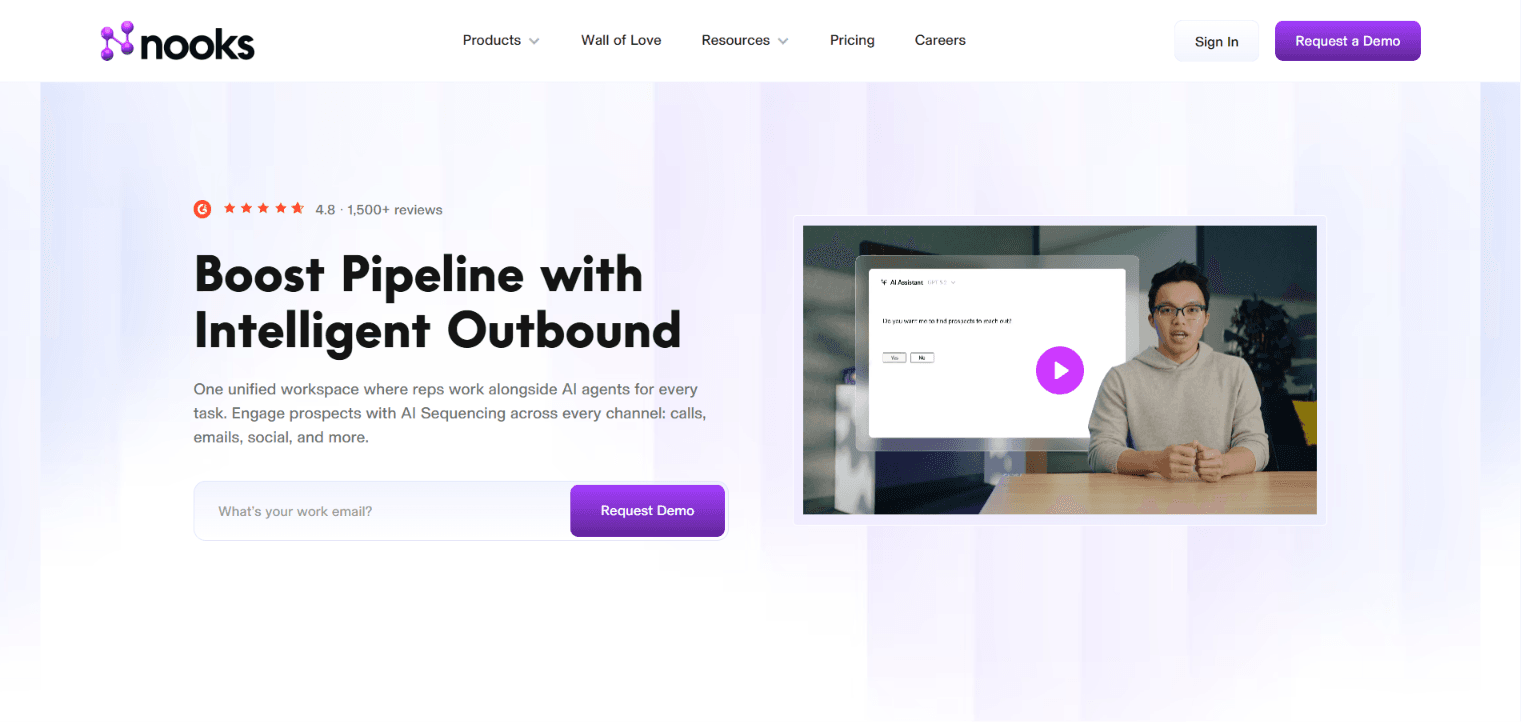
No. Nooks is a calling product; it assumes you already have a list, phone data, and a message. Artisan's Ava sources leads from over 250 million B2B professionals across over 200 countries, enriches verified phone numbers, writes multichannel outreach, handles replies, and books meetings, with the dialer as one step inside that flow.
Do I still need a separate sequencer or CRM tool with Artisan?
No, and that is the point of consolidation. Artisan runs email, social media, and calling in one sequence, logs activity natively to Salesforce and HubSpot with owner mapping, and books meetings on the right calendar. With Nooks you keep your existing sequencing, routing, and CRM tooling and add calling on top.
Which is the better fit for an enterprise team?
Artisan, in most cases. It offers pooled org-level numbers with callback routing, automatic compliance enforcement per lead, central admin with CRM owner mapping, SOC 2 Type II attestation, and usage-based economics that stay predictable as the team grows. Nooks is the stronger pick specifically when a large, dedicated calling floor needs peak parallel throughput above everything else.
Is Nooks a stable company to buy from?
By the available signals, yes. Nooks raised a $43M Series B led by Kleiner Perkins in October 2024 and is widely regarded as one of the parallel-dialing category leaders. Our comparison is about fit, not vendor stability; for a dedicated call floor, Nooks is a credible specialist.

Artisan Team
Expert insights from the team at Artisan
Our writing team blends direct operational experience, in-house data, and thorough research to bring you the very latest insights and updates about sales and GTM automation.