Nooks pricing and reviews (2026)
What Nooks costs in 2026, what its plans include, and what reviewers say about the parallel dialer and salesfloor, with a lower-cost alternative.
Key Takeaways
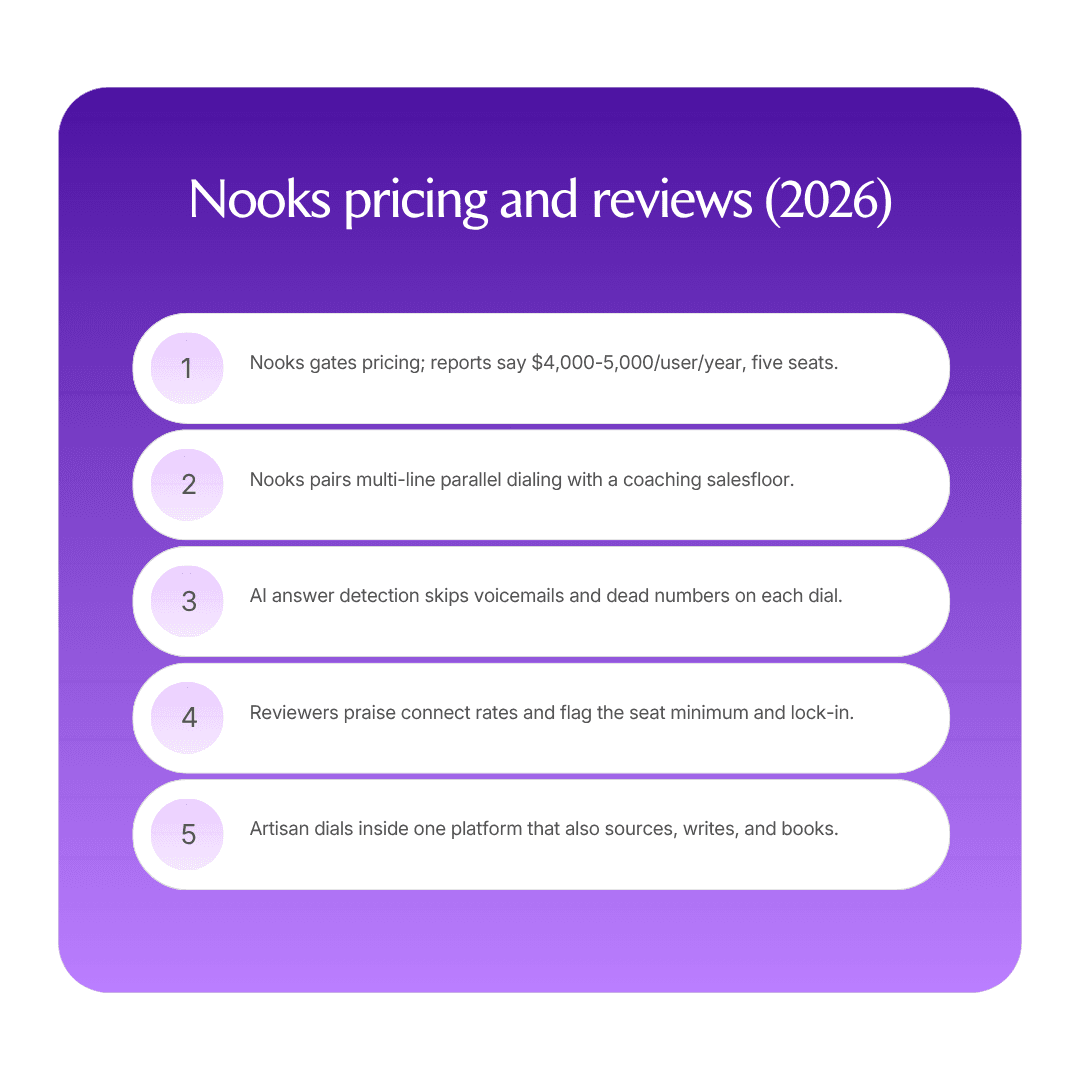
- Nooks is demo-gated. Reported pricing runs about $4,000 to $5,000/user/year, roughly $333 to $417 a month, usually with a five-seat minimum on an annual contract.
- It pairs multi-line parallel dialing with a virtual salesfloor for live coaching, plus AI answer detection to skip voicemails and dead numbers.
- Nooks raised a $43 million Series B led by Kleiner Perkins in October 2024, one of the better-funded dialers in the category.
- It is a dialer and calling workspace, not a full outbound stack. You still bring data, sequencing, and CRM around it.
- Artisan runs parallel dialing inside a full AI sales platform priced on usage rather than per seat, so calling is not a committed annual seat on top of your other tools.
Nooks is a parallel dialer and virtual salesfloor, and it does not publish prices. Third-party reports put it at roughly $4,000 to $5,000/user/year, typically with a five-seat minimum and annual billing. Reviewers praise the connect-rate lift and the coaching-friendly salesfloor, and flag the cost and setup as heavy for smaller teams.
How much does Nooks cost in 2026?
Nooks does not list pricing publicly; the site routes buyers to a demo. The most consistently reported figures put it between $4,000 and $5,000/user/year, which works out to roughly $333 to $417 per user a month, generally with a five-seat minimum and annual billing. Any number you see quoted is a third-party estimate, so confirm current pricing with the vendor before you budget.
Two things shape the real bill. It is annual and seat-based, so you commit for a year across a minimum team size. And it is a dedicated calling tool, which means the seat cost sits on top of your data provider, your sequencer, and your CRM.
Nooks pricing at a glance (2026)
Plan | Reported price | Billing | What's included |
Nooks (per seat) | About $4,000-5,000/user/yr (estimate, gated) | Annual, about a five-seat minimum | Multi-line parallel dialing, AI answer detection, virtual salesfloor, call recording and coaching, analytics, CRM integrations |
Enterprise | Custom, contact sales | Annual | Higher volume, advanced admin and security, custom terms |
Figures reflect third-party reporting. Nooks publishes no rates, so treat these as estimates. Nooks markets multi-line parallel dialing but does not publish an exact simultaneous-line count, so we do not cite one.
What does Nooks actually cost in practice?
The per-seat estimate understates the commitment in a few ways.
Start with the seat minimum. With a reported five-seat floor, the entry cost is effectively the per-user rate multiplied by five, even if only three reps will use it heavily. At the reported range, that is roughly $20,000 to $25,000 a year to begin.
Then there is the annual lock-in. Nooks is sold on annual contracts, so if your team size or calling volume shifts mid-year, you are still paying for the seats you committed to.
It is also one part of the stack. Nooks handles calling and coaching. It does not source net-new contacts as a primary database, write the multichannel sequence that sets up the call, or autonomously work the replies afterward. Most teams run it beside a data tool and a sequencer, so the true cost of calling is Nooks plus the tools around it.
Adoption effort is the last hidden line. The salesfloor and parallel dialing deliver most of their value when a team actually changes how it works: live listening, real-time coaching, tight scripts. Teams that invest in that ramp report strong results. Teams that treat it as a faster phone tend to feel the price outran the payoff.
What do reviewers say about Nooks?
The consensus is genuinely positive on results, with cost and complexity as the recurring caveats. Here is the split, based on what users report rather than any star rating.
Connect rates and conversations-per-hour are the headline win, and reviewers credit the AI answer detection for cutting the dead time of voicemails and bad numbers. The virtual salesfloor draws specific praise from managers: being able to listen in, coach live, and build a team energy around calling blocks is something a plain dialer does not offer. The product is generally called modern and well-designed, and the AI features layered on top of the dialer receive positive mentions.
Price leads the criticism, especially the seat minimum and annual commitment for smaller teams. Some users report occasional call-connection and audio glitches, a known trade-off of multi-line dialing. Others note that outcomes depend heavily on list quality, since dialing bad numbers faster does not help. A few mention a learning curve to use the salesfloor and coaching features to their full extent, and that the value case is weakest for teams whose outbound is not phone-first.
Who is Nooks best for, and who should skip it?
Nooks suits mid-market and enterprise sales development teams whose motion is built on outbound calling, especially ones that want a coaching and salesfloor layer to develop reps rather than a dialer alone. If connect rate and rep ramp are what move your pipeline, and you have the headcount to make a five-seat minimum easy, Nooks is one of the category leaders and earns consideration.
Skip Nooks if you are a small team, your outbound leans on email with calling as a secondary channel, or you do not want to add and integrate a standalone dialer on top of separate data and sequencing tools. The seat minimum, annual lock-in, and stack overhead outweigh the connect-rate lift in those cases. For head-to-head comparisons, see Nooks vs. Aircall and Orum vs. Nooks.
Artisan: Parallel dialing inside one AI-run system
If you are evaluating Nooks, it is worth knowing the dialer does not have to be its own line item. Artisan is an AI-first outbound platform where calling is built in and Ava, its AI business development representative (BDR), runs the whole motion around it. She sources best-fit leads from a database of over 250 million B2B professionals in over 200 countries, plus Artisan Local Data with over 250 million local businesses, enriches verified phone numbers, sequences email, social media, and call steps together, and handles replies. The call is a step in that sequence, not a separate app reps log into. Ava dials the calls and a rep takes the live conversation.
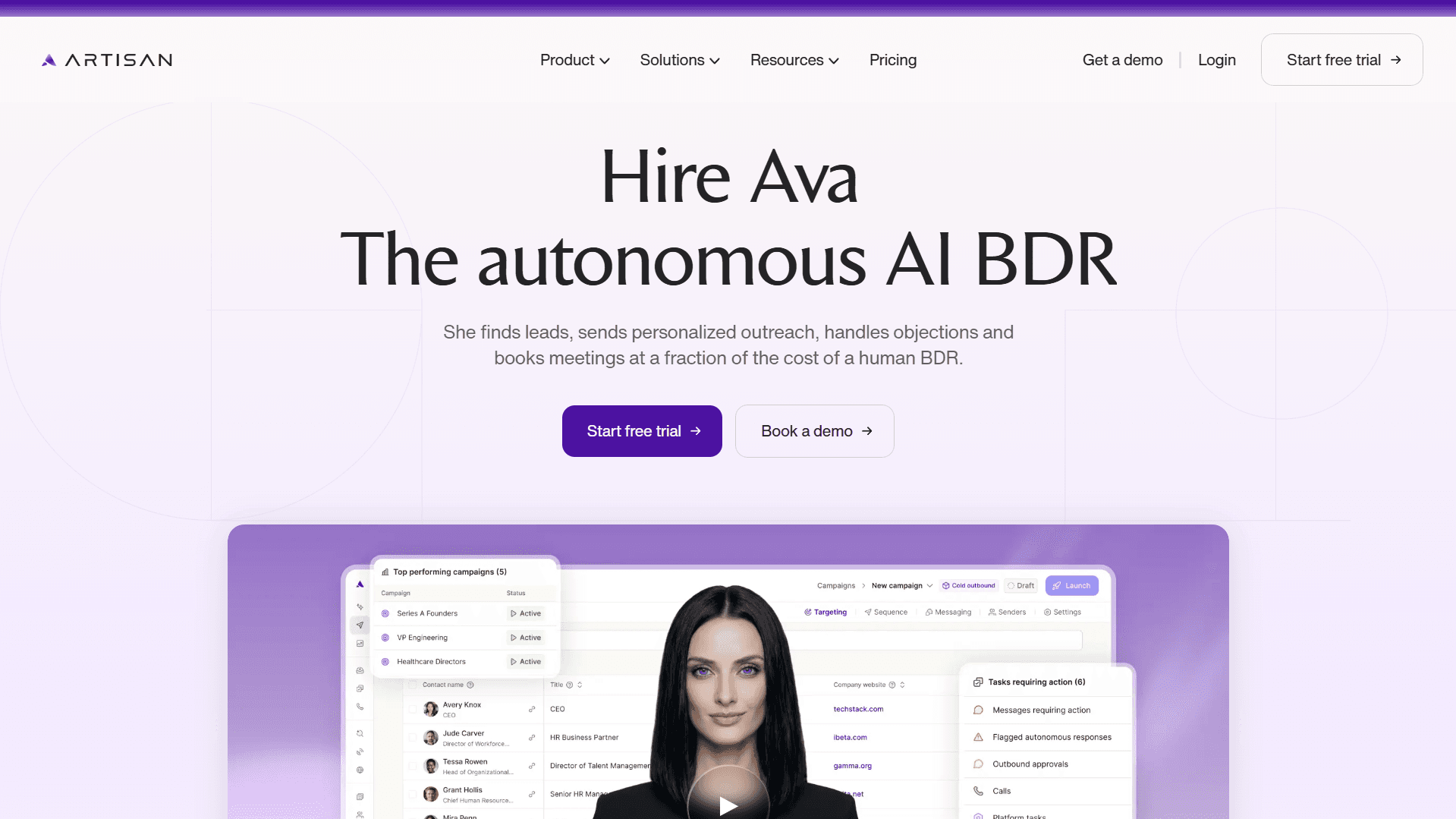
The shape of the bill is the other difference. Artisan's pricing is usage-based, so you pay for the work Ava performs rather than per seat, with no platform fee and a free trial. That work includes live AI talking points loaded before the call connects, live transcription, auto-classified outcomes, AI-drafted follow-up emails, recordings, and analytics. Against a committed annual seat that bills whether or not a rep dials, the difference is which costs track activity. Numbers are pooled at the org level with personal callback routing, so a returning call reaches the right rep, and compliance is enforced automatically per lead, including local calling hours, federal do-not-call checks, and consent-aware recording.
The honest concession is scope of the calling floor. Artisan's parallel dialing runs up to three lines with AI answer detection, and it does not include a virtual salesfloor for live group coaching, which is a genuine Nooks strength. A team whose entire strategy is maximum-volume parallel calling with a dedicated coaching floor may still prefer a specialist and pay the premium seat cost for it. For most teams, three lines inside a system where the AI also prospects, writes, and books is the stronger trade. See Artisan pricing. For the direct comparison, see Artisan vs. Nooks.
Frequently asked questions
Is Nooks worth it?
For a phone-first mid-market or enterprise team, reviewers generally say yes: the connect-rate lift and the coaching salesfloor deliver real value once the team adopts them properly. The payoff is weakest for small teams or email-led motions, where the reported five-seat minimum and annual cost are hard to justify against actual call volume.
Is Nooks expensive?
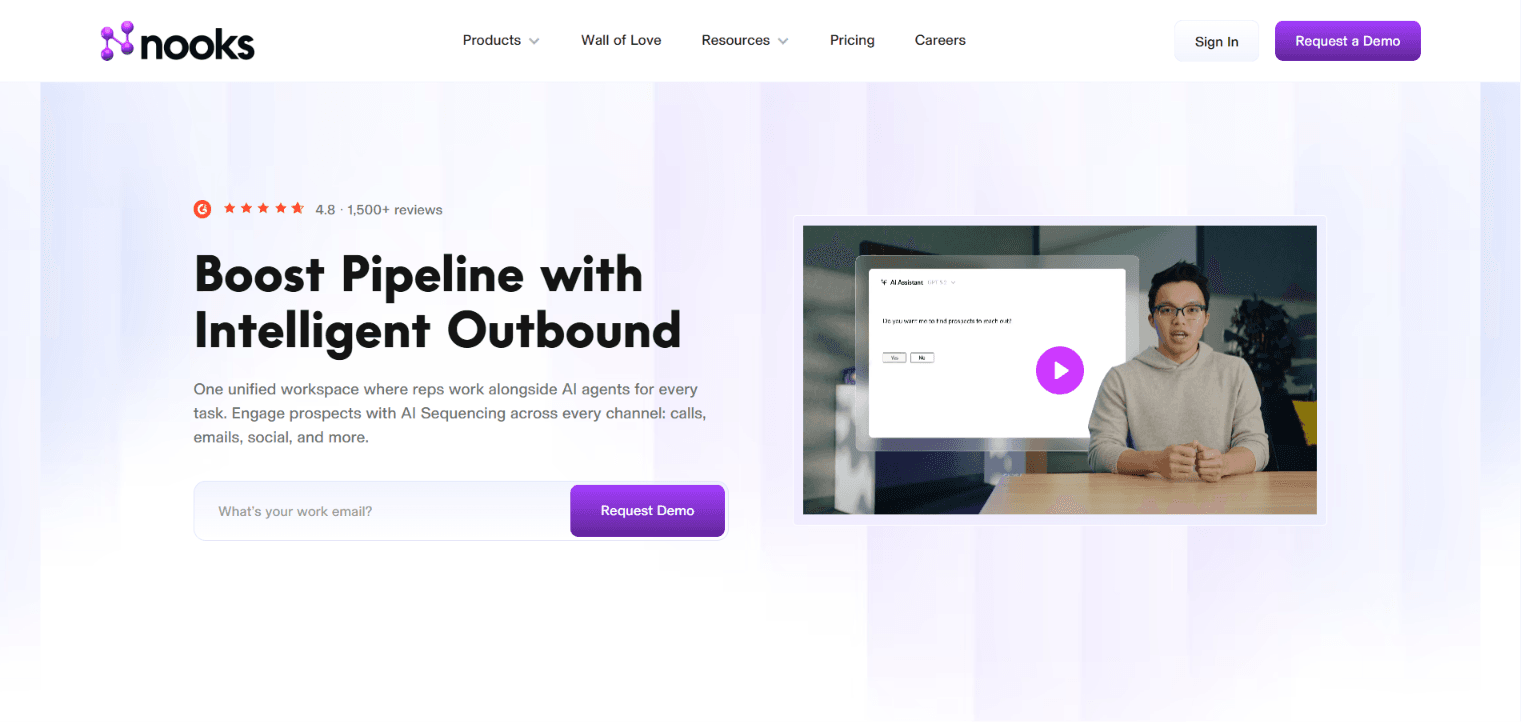
At a reported $4,000 to $5,000/user/year with a five-seat minimum, Nooks sits at the premium end of the dialer market. It is priced on connect-rate and coaching value instead of affordability. Bundled dialers that run calling inside a broader platform, such as Artisan, charge for the work performed instead of a committed annual seat.
Why doesn't Nooks publish its pricing?
Nooks uses a demo-gated model, so tiers are quoted after a sales conversation instead of listed on the site. That is common for enterprise-focused sales tools. For buyers, it means early comparison relies on third-party estimates until you receive a formal quote, so allow extra time in your evaluation.
What are cheaper alternatives to Nooks?
Salesfinity publishes parallel plans at $149 and $349/user/month, and Koncert lists an AI Parallel tier at $99/user/month. Trellus offers a parallel add-on around $150/month as a browser overlay. Artisan bundles parallel dialing into a full AI sales platform with usage-based pricing and no platform fee. For more options, see the best Nooks alternatives and the best AI dialers and parallel dialers.
How many lines does Nooks dial at once?
Nooks markets multi-line parallel dialing but does not publish an exact simultaneous-line count, so treat any specific number you see as unverified. More lines generally raise connect rates but also raise the risk of dead air and spam flagging, so the practical setting depends on list quality and how tightly scripts and cadences are managed.
Do I need other tools alongside Nooks?
Usually yes. Nooks handles calling and coaching, so most teams pair it with a contact database for phone numbers, a sequencing tool for the email steps around calls, and CRM sync. That adds cost and integration work on top of the seat price. Platforms like Artisan fold data, sequencing, dialing, and reply handling into one system, so calling is not a separate bill.
How well funded is Nooks?
Nooks raised a $43 million Series B led by Kleiner Perkins in October 2024, making it one of the better-capitalized dialers in the category. Funding is a reasonable signal of staying power and continued investment in the product, which matters if you are committing to an annual contract.
The bottom line
Nooks is a strong pick for teams whose engine is outbound calling and who want a coaching salesfloor built around it, and reviewers back the connect-rate story. Price it with eyes open: a gated, annual, premium seat cost with a minimum, sitting on top of your data and sequencing tools. If you would rather have parallel dialing as one built-in capability of an AI that runs the whole motion, Artisan delivers it inside a usage-based platform, and Ava handles the prospecting, sequencing, and replies around the call. The AI BDR explainer has the category context. For more on the calling category, see best autodialers, best outbound dialer, and cold calling scripts.

Artisan Team
Expert insights from the team at Artisan
Our writing team blends direct operational experience, in-house data, and thorough research to bring you the very latest insights and updates about sales and GTM automation.