Orum vs. Nooks: Which should you choose in 2026?
A fair comparison of Orum and Nooks, the two parallel-dialer leaders, on lines, coaching, global reach, and pricing, with clear buyer scenarios.

Key Takeaways
- Orum and Nooks are the two most-cited parallel dialers for outbound sales; both connect reps only to live pickups through AI answer detection.
- Orum dials 5 to 10 lines and offers international dialing on its top (Ascend) tier, which positions it for enterprise and global calling teams.
- Nooks dials multiple lines and surrounds the dialer with a virtual salesfloor, AI coaching, call analytics, and AI-assisted prospecting, which positions it as an SDR productivity platform.
- Neither publishes pricing. Orum is reported around $250/user/month; Nooks is reported around $4,000 to $5,000/user/year, both unverified and demo-gated.
- Orum acquired Scout AI in July 2026; Nooks raised a $43M Series B. Both are actively investing in AI.
- A third path runs the dialer inside a wider AI-run outbound system on usage-based pricing, for teams that would rather not buy a standalone parallel dialer.
Both are top parallel dialers, and the split is about scope. Orum leans enterprise and global, with 5 to 10 lines and international dialing on its top (Ascend) tier. Nooks wraps parallel dialing in a broader productivity suite for sales development representatives (SDRs), with a virtual salesfloor, AI coaching, and prospecting. Global throughput wants Orum; a coaching-driven SDR floor wants Nooks.
How Orum and Nooks compare at a glance
Tool | Best for | Standout capability | Lines | Public pricing |
Orum | Enterprise and global outbound volume | Parallel dialing at scale with international dialing on the Ascend tier | 5 to 10 | Not published; reported around $250/user/month (gated) |
Nooks | Growing SDR teams that want coaching plus dialing | Virtual salesfloor, AI coaching, and prospecting around the dialer | Multi-line | Not published; estimated $4,000 to $5,000/user/year (third-party, unverified) |
What is the core difference between Orum and Nooks?
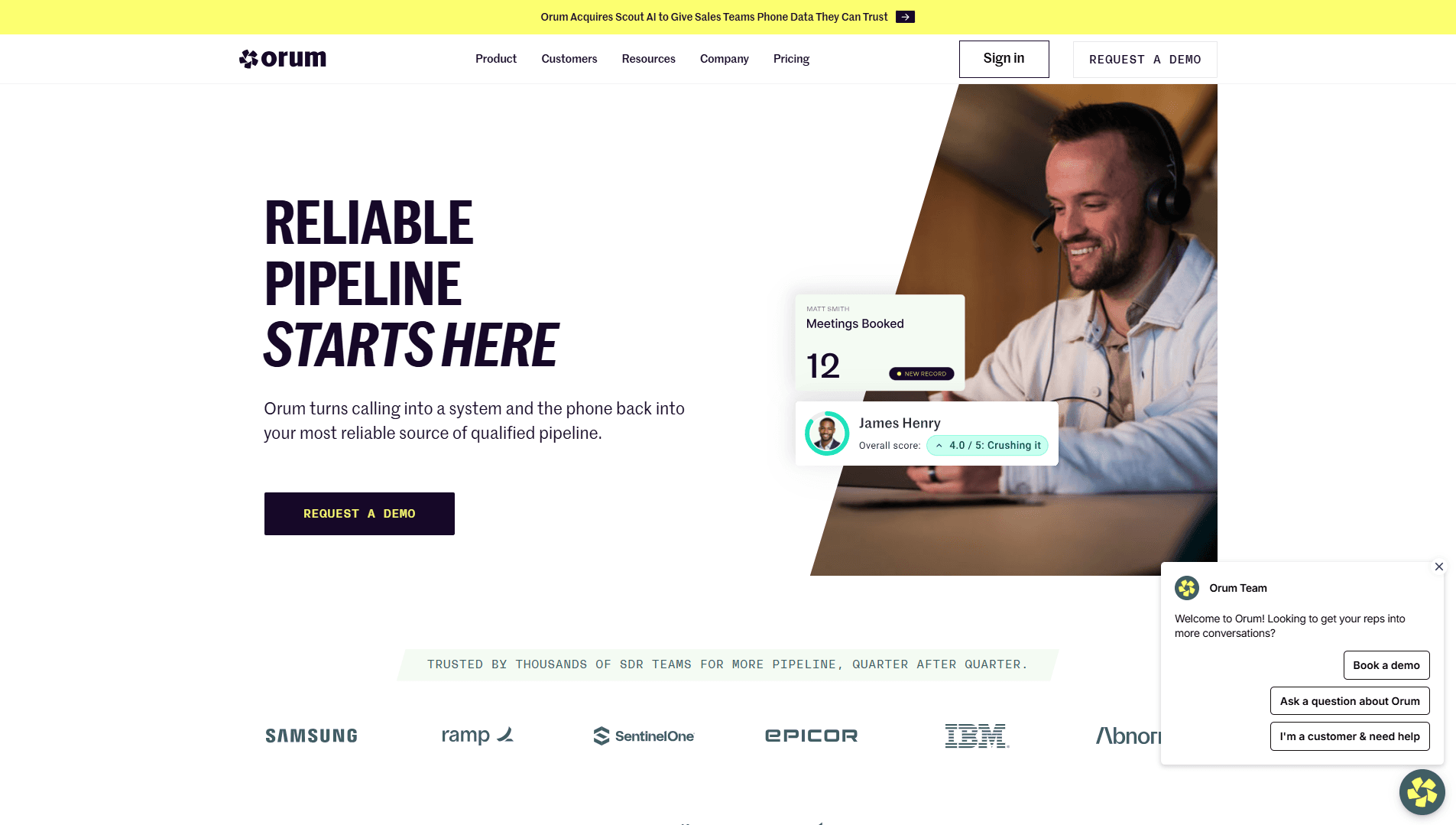
Both dial multiple numbers at once and patch a rep in only when a human answers, so the connect-rate mechanism is similar. The difference is what surrounds the dial. Orum is focused on the calling engine itself, tuned for maximum throughput and breadth, with 5 to 10 lines and international dialing on its top (Ascend) tier. This makes it the more natural pick for large or internationally distributed teams whose priority is conversations at scale.
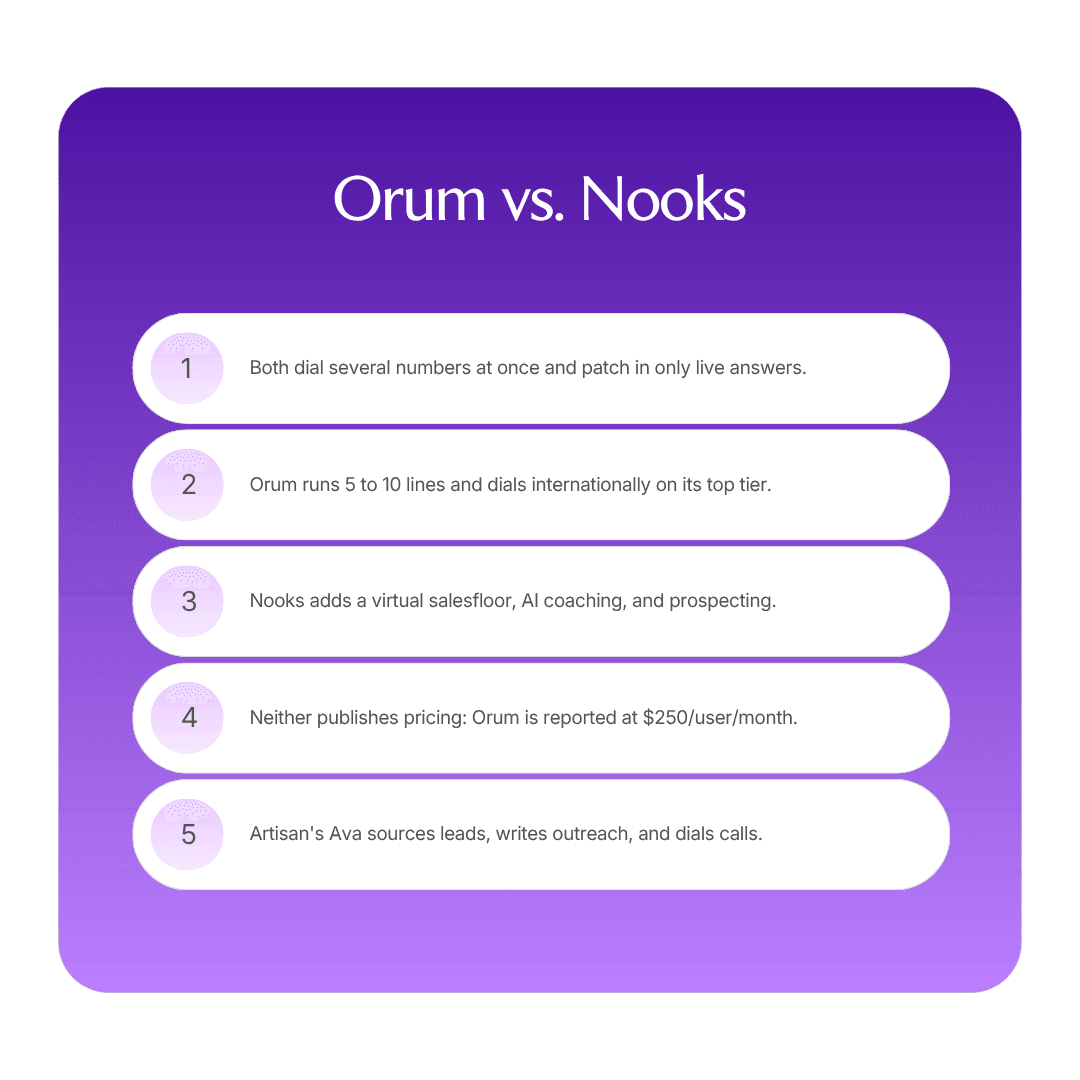
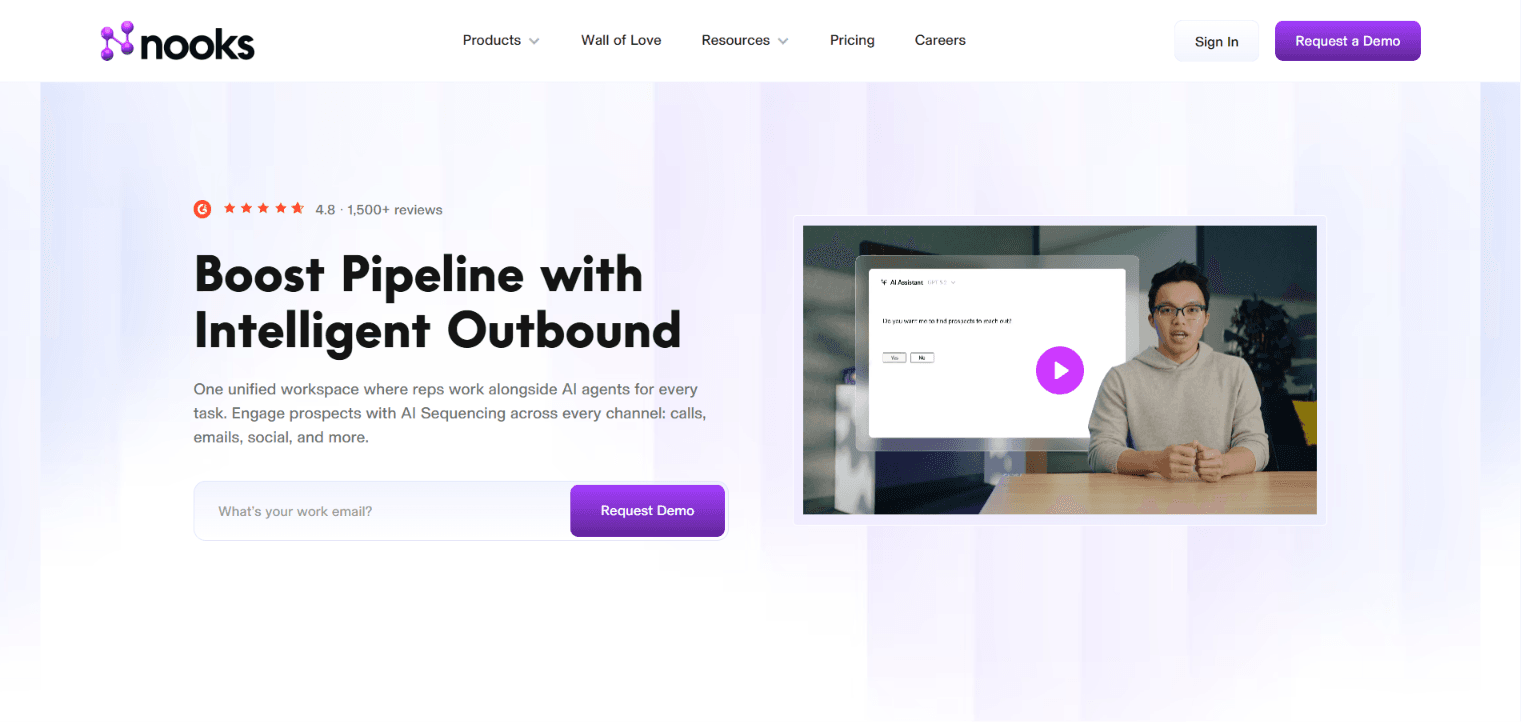
Nooks treats the dialer as one part of a wider SDR productivity platform. Alongside multi-line parallel dialing, it runs a virtual salesfloor where reps dial together and managers listen live, plus AI coaching, call analytics, and AI-assisted prospecting and list building. If you want to lift a whole sales development function beyond placing more calls, Nooks reaches further past the phone.
Which parallel dialer connects more conversations?
For raw line count and reach, Orum publishes the higher ceiling and offers 5 to 10 simultaneous lines against Nooks' multi-line dialing, plus the country coverage to run the same motion across regions. A large outbound org that measures live conversations per hour and calls into many markets will find Orum's throughput and breadth hard to match. Its July 2026 acquisition of Scout AI adds further AI capability to this calling core.
That said, more lines is not automatically more pipeline. Parallel dialing at high line counts increases dead-air and spam-flag risk, and connect quality depends on number reputation and how well reps convert the conversations they receive. Nooks' coaching and salesfloor exist precisely to raise conversion on the calls that do connect. So Orum tends to win on volume of connects, while Nooks competes on making each connect count. For broader roundups and call prep, see the best autodialers, the best outbound dialer, and proven cold calling scripts.
Which is better beyond the dialer?
Nooks, if you value the surrounding workflow. Its virtual salesfloor recreates the energy and real-time feedback of a physical sales floor for remote and hybrid teams, and its AI coaching and analytics help managers improve calls at scale. Nooks also folds in AI-assisted prospecting and list building, so a rep can move from finding contacts to dialing them inside one tool. For a growing SDR team that wants ramp, coaching, and culture in the product, this breadth matters.
Orum keeps a tighter focus on the calling engine and its efficiency. It integrates with the CRM and sales engagement stack you already run instead of trying to own prospecting and coaching outright. For a team that already has strong coaching and list-building elsewhere and just wants the fastest, broadest dialer to plug in, Orum's narrower focus works in its favor.
Which has clearer pricing, Orum or Nooks?
Neither, honestly. Both are demo-gated, and both price well above general phone systems because parallel dialing's connect-rate lift is the value. Orum is reported at roughly $250/user/month; Nooks is reported around $4,000 to $5,000/user/year. Every one of these figures is unverified and sourced from third parties, so treat them as directional and expect a sales-led quote either way.
What you can weigh instead is trajectory and fit. Nooks raised a $43M Series B and is often cited as the category leader for the SDR-productivity flavor of parallel dialing. Orum acquired Scout AI in July 2026 and leans enterprise and international. Ask each vendor for a quote against your seat count and call volume, and confirm current line counts and country coverage before you commit, since both are moving quickly. For fuller breakdowns, see Orum pricing and reviews and Nooks pricing and reviews.
Should you choose Orum or Nooks?
Choose Orum if you run a large or international outbound team, you want the highest line count and widest country coverage, and you already have coaching and prospecting handled elsewhere. It is the throughput-and-reach specialist, and it shines when calling at scale across regions is the whole point.
Choose Nooks if you want more than a dialer: a virtual salesfloor, AI coaching, analytics, and prospecting to lift a growing SDR team end to end. It is the productivity-suite take on parallel dialing, and it fits teams that care about ramp and rep development as much as dial volume.
There is a third path. Both of these are demo-gated specialists your reps still operate, and both price well above a general phone system. If you would rather not run a standalone parallel dialer at all, Artisan folds calling into a wider AI-driven outbound motion where its AI employee Ava sources leads, writes and sends outreach, and handles replies, with the dialer as one step.
On cost, it offers power and parallel dialing up to three lines with automatic compliance checks, priced on a usage-based model where Ava's work runs on credits and dialer seats and numbers are billed separately, and over 90% of customers run it autonomously. This is a different purchase from a specialist dialer: you buy an outcome priced against the work performed, not a tool to staff and configure. See where each tool lands in the best AI dialers and parallel dialers and how Artisan's pricing works. For head-to-head views, Artisan vs. Orum and Artisan vs. Nooks compare them directly.
Frequently asked questions
Is Orum or Nooks the better parallel dialer?
It depends on scope. Orum offers 5 to 10 lines and international dialing on its top (Ascend) tier, which favors enterprise and global volume. Nooks dials multiple lines but surrounds it with a virtual salesfloor, AI coaching, and prospecting. For maximum throughput and international reach, Orum leads; for coaching and a broader SDR workflow, Nooks does.
How much do Orum and Nooks cost?
Neither publishes pricing. Orum is reported around $250/user/month; Nooks is reported around $4,000 to $5,000/user/year. All of these figures are unverified third-party estimates, and both vendors require a demo and quote. Expect specialist pricing well above a general phone system, reflecting the connect-rate value of parallel dialing.
How many lines do Orum and Nooks dial at once?
Orum advertises 5 to 10 simultaneous lines on its higher tiers, while Nooks runs multi-line parallel dialing without publishing an exact count. More lines can mean more connects per hour, but also more dead-air and spam-flag risk, so number reputation and rep conversion matter as much as line count. Confirm current limits with each vendor, as they change.
Does Nooks do more than dialing?
Yes. Beyond parallel dialing, Nooks offers a virtual salesfloor for reps to dial together, AI coaching, call analytics, and AI-assisted prospecting and list building. This breadth is its main differentiator from Orum, which stays more focused on the calling engine itself and integrates with the prospecting and coaching tools you already use. See also Nooks vs. Aircall.
What is Orum's Scout AI acquisition about?
Orum acquired Scout AI in July 2026 to deepen its AI capabilities around the dialer. It reflects continued investment in AI-assisted calling on top of Orum's enterprise parallel-dialing core. As with any recent acquisition, check how far the combined capabilities have shipped before making it a deciding factor in your evaluation.
Which should a growing SDR team pick?
For a growing SDR team that values coaching, ramp, and a shared calling culture, Nooks' salesfloor and AI coaching often fit better. For a team scaling into many markets that just needs the fastest, broadest dialer, Orum's line count and country coverage fit better. Match the tool to whether you need rep development or pure throughput.
Is there an alternative to both Orum and Nooks?
Yes. A standalone parallel dialer may be the wrong category if what you want is pipeline instead of dials. Artisan runs calling as one step inside a wider AI-run outbound platform, alongside lead sourcing, message writing, sending, and reply handling, on usage-based pricing, so it generates qualified pipeline instead of simply placing dials. It suits teams that want an outcome priced against the work performed instead of a premium specialist tool to staff, configure, and negotiate. For more options, see the best Nooks alternatives and the best Dialpad alternatives.

Artisan Team
Expert insights from the team at Artisan
Our writing team blends direct operational experience, in-house data, and thorough research to bring you the very latest insights and updates about sales and GTM automation.