Nooks vs. Aircall: Which should you choose in 2026?
A fair comparison of Nooks and Aircall on dialing model, pricing, AI coaching, and stack fit, with clear buyer scenarios for each.
Key Takeaways
- Nooks is a parallel dialer plus AI salesfloor for outbound sales development; Aircall is a general-purpose cloud phone system for both sales and support.
- Nooks dials several numbers at once with AI answer detection, then connects reps only to live humans. Aircall's power dialer advances through a list one call at a time.
- Aircall publishes pricing: Essentials at $30/license/month and Professional at $50/license/month, both annual with a three-license minimum, per its pricing page. The power dialer sits on Professional.
- Nooks does not publish pricing; third parties report roughly $4,000 to $5,000/user/year (demo-gated, annual), unverified. Nooks raised a $43M Series B.
- Nooks is a specialist for cold-calling volume; Aircall is a breadth play that covers inbound support, outbound sales, and over 250 integrations.
- A third option runs the dialer inside a wider AI-run outbound system on usage-based pricing, if you would rather not buy a dedicated dialer.
These tools solve different problems. Nooks is a parallel dialer and virtual salesfloor built for high-volume outbound teams of sales development representatives (SDRs) that want to multiply live conversations. Aircall is a cloud business phone system for sales and support, with a single-line power dialer as one feature among many. Volume-calling teams want Nooks; a company that needs a phone system wants Aircall.
How Nooks and Aircall compare at a glance
Tool | Best for | Standout capability | Dialing model | Public pricing |
Nooks | High-volume outbound SDR teams | Parallel dialing plus AI virtual salesfloor and coaching | Parallel, multi-line | Not published; estimated $4,000 to $5,000/user/year (third-party, unverified) |
Aircall | Sales and support teams that need one phone system | Unified cloud telephony with over 250 integrations | Power dialer, single line (Professional) | From $30/license/month annual (per its pricing page) |
Are Nooks and Aircall even in the same category?
Not really, and this is the point. Nooks is a parallel dialer: it calls multiple prospects at once, uses AI to filter out voicemails and dial tones, and patches a rep in only when a real person picks up. Around this it wraps a virtual salesfloor where reps dial together, hear each other's calls, and receive AI coaching and call analytics. It is a purpose-built machine for one job, cold-calling volume, aimed at sales development teams. For what reps say on those calls, see our cold calling scripts.
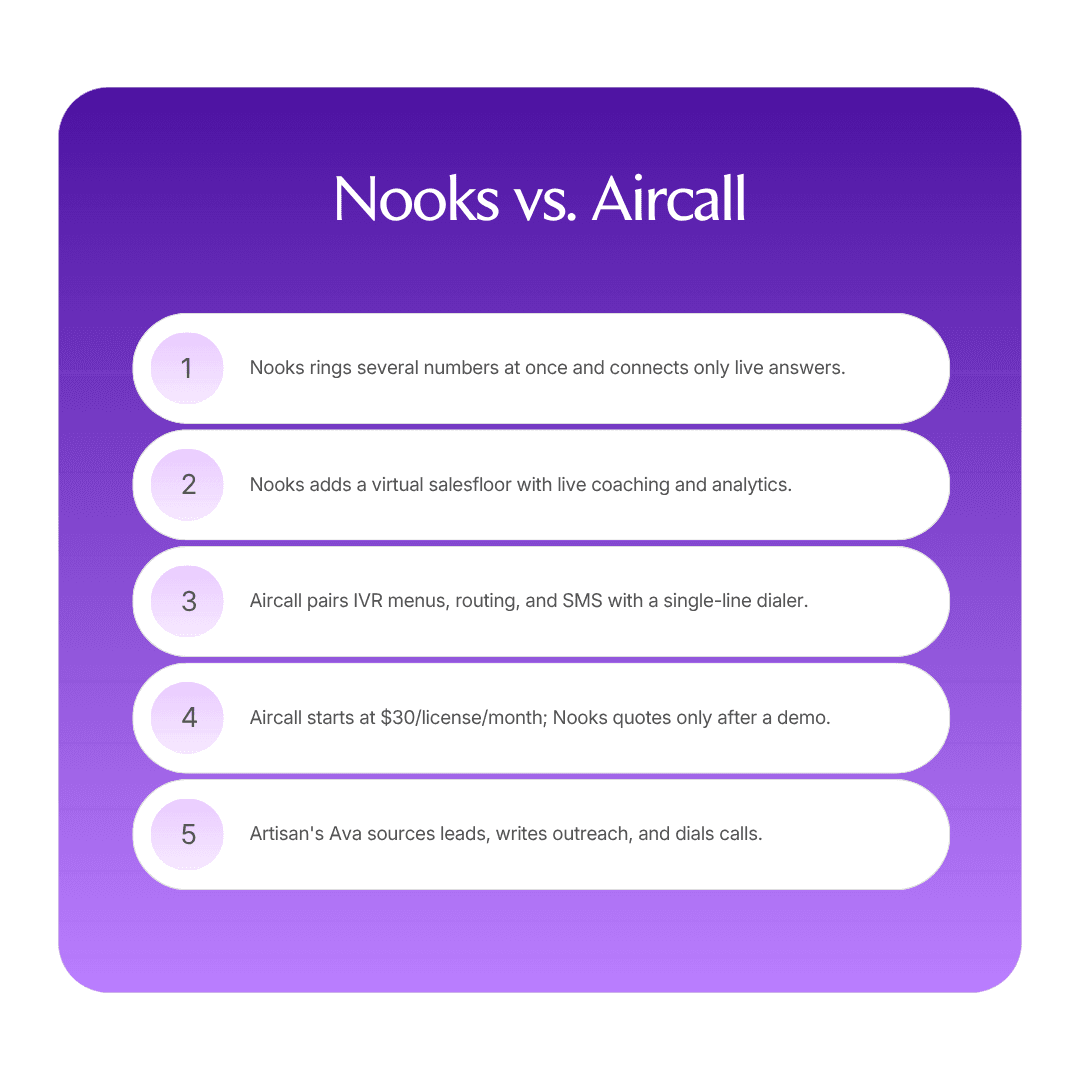
Aircall is a cloud phone system. It handles inbound and outbound calls, interactive voice response (IVR) menus, call routing, a shared number, SMS, and analytics, and it serves support desks and sales teams from the same product across over 250 integrations. It includes a power dialer, but this dialer is single-line and auto-advances through a list one call at a time instead of running several lines in parallel. Choosing between them is really choosing between a specialist and a generalist.
Which has the better dialer for cold-calling volume?
Nooks, clearly, if raw connected conversations are the goal. Parallel dialing is a connect-rate multiplier: by ringing several numbers at once and dropping dead calls automatically, a rep can reach far more live humans per hour than single-line dialing allows. Nooks pairs this with its salesfloor and coaching so managers can listen in and improve calls in real time. For an SDR team whose entire day is outbound dials, this is the category Nooks leads. For how the dialing models differ, see parallel vs. power vs. predictive dialer.
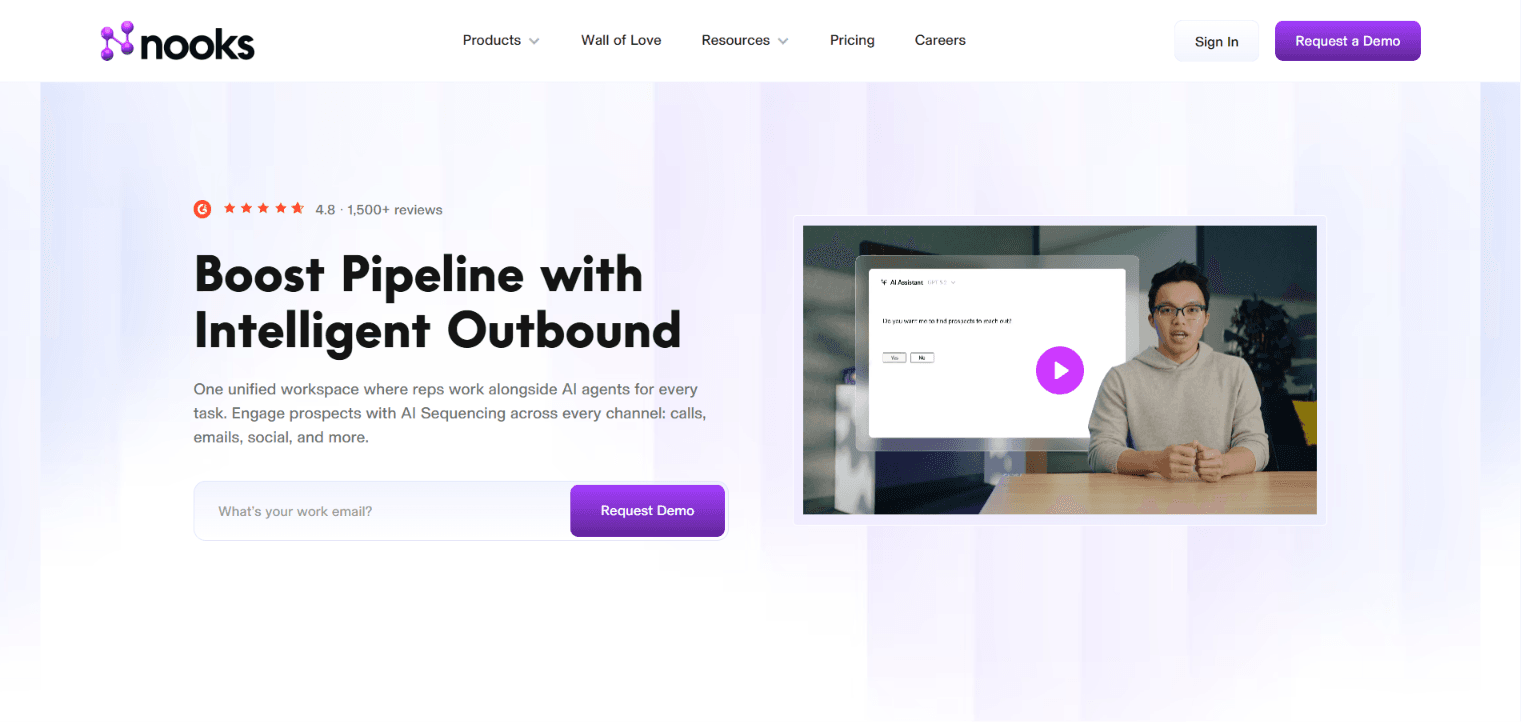
Aircall's power dialer is useful, but it works on a different mechanism. One call at a time with auto-advance and voicemail drop suits a team that also handles inbound, wants clean call logging in the CRM, and values a unified phone system over maximum dial throughput. If your reps split time between calling, taking inbound, and support, Aircall's single-line approach fits the reality; if they only cold-call all day, they will out-dial it quickly. For the wider field, see the best autodialers.
Which has clearer pricing, Nooks or Aircall?
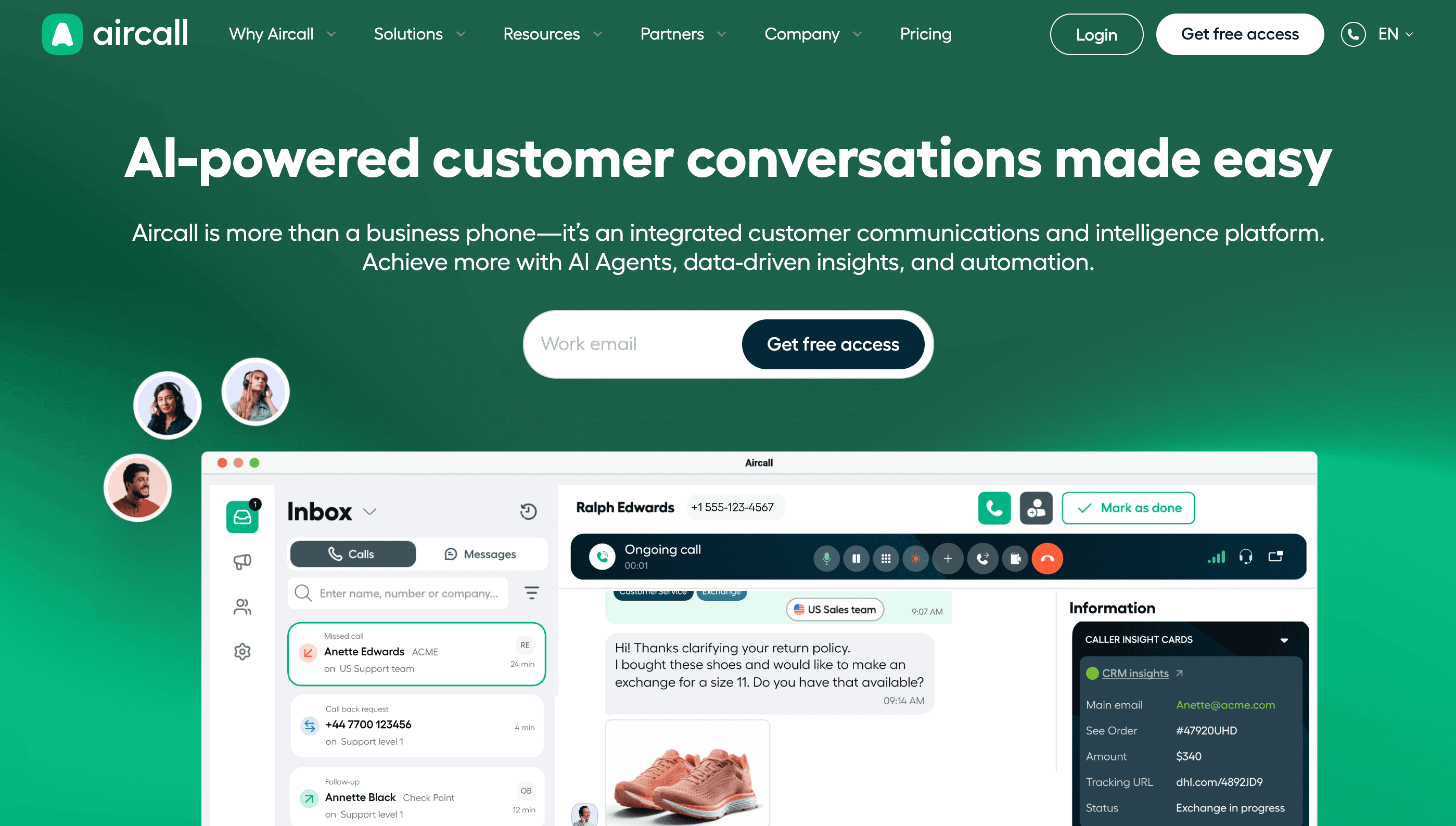
Aircall, by a wide margin. Its pricing page lists Essentials at $30/license/month and Professional at $50/license/month, both billed annually with a three-license minimum, and a Custom tier for larger deployments that starts at 25 licenses. The power dialer and voicemail drop live on Professional, and AI features are partly included with paid add-ons on top, per its pricing page. You can budget Aircall before you ever talk to sales.
Nooks does not publish pricing. Third-party write-ups report roughly $4,000 to $5,000/user/year (demo-gated, annual), but these figures are unverified and Nooks routes buyers through a demo and quote. What is confirmed is momentum: Nooks raised a $43M Series B, and it is often cited as the parallel-dialing category leader. Expect specialist pricing that reflects the connect-rate value, well above a general phone system's per-license cost. For a fuller breakdown of the vendor, see Nooks pricing and reviews.
Which fits your team and stack better?
Match the tool to who is using it. Nooks fits a dedicated outbound function, an SDR or business development representative (BDR) team measured on conversations and meetings booked, ideally with a manager who wants a live salesfloor and coaching layer. It assumes calling is the whole job and that you already have a phone system or CRM that handles everything else.
Aircall fits a company that needs telephony as shared infrastructure, where support and sales both make and take calls and integrations into the CRM and helpdesk matter more than dial volume. Its integration count and unified admin make it the safer default for a mixed org. Put simply, buy Nooks to make a calling team faster, and buy Aircall to give a whole company a phone system. For other options, see the best Aircall alternatives.
Should you choose Nooks or Aircall?
Choose Nooks if you run a high-volume outbound team, live conversations per hour is your core metric, and you want parallel dialing plus a virtual salesfloor and AI coaching in one place. It is the specialist, and specialists win when the job is narrow and the volume is high.
Choose Aircall if you need one cloud phone system for both sales and support, you want transparent per-license pricing, and over 250 integrations matter more than maximum dial throughput. It is the generalist, and generalists win when several teams share the same phones.
There is a third path worth naming. Whichever of these you buy, your reps still run the calling. If you would rather not operate a dedicated dialer at all, Artisan runs calling inside a wider AI-driven outbound motion where its AI employee Ava sources leads, writes and sends messages, and handles replies, with the dialer as one step. For a direct comparison, see Artisan vs. Nooks.
On cost, it offers power and parallel dialing up to three lines with automatic compliance checks, priced on a usage-based model where Ava's work runs on credits and dialer seats and numbers are billed separately, and over 90% of customers run it autonomously. This is a different shape of purchase from either a specialist dialer or a company phone system: you are buying an outcome priced against the work performed, not a tool to staff and configure. For the broader landscape, see the best AI dialers and parallel dialers and how an AI sales agent approaches the whole motion.
Frequently asked questions
Is Nooks or Aircall better for cold calling?
Nooks, for pure cold-calling volume. Its parallel dialer rings several numbers at once and connects reps only to live answers, which multiplies conversations per hour. Aircall's power dialer is single-line and better suited to teams that also handle inbound and want a full phone system. If your reps do nothing but outbound dials, Nooks is built for it. For the wider field, see the best outbound dialer roundup.
How much do Nooks and Aircall cost?
Aircall publishes pricing: $30/license/month for Essentials and $50/license/month for Professional, both annual with a three-license minimum, per its pricing page. Nooks does not publish pricing; third-party estimates put it around $4,000 to $5,000/user/year (annual), unverified, and it requires a demo and quote. Aircall is far easier to budget in advance.
Does Aircall have a parallel dialer?
No. Aircall offers a single-line power dialer on its Professional tier that advances through a list one call at a time, with voicemail drop, per its pricing page. It does not run multiple simultaneous lines with AI answer detection, as Nooks does. If parallel dialing is a requirement, Aircall is not the right tool.
What is a virtual salesfloor?
It is a shared digital space where reps dial together, managers and peers can listen to live calls, and coaching happens in real time. Nooks popularized this alongside its parallel dialer, aiming to recreate the energy and feedback of a physical sales floor for remote and hybrid teams. Aircall does not offer an equivalent salesfloor experience.
Can Nooks or Aircall handle inbound calls?
Aircall is built for inbound and outbound: it has IVR menus, routing, and shared numbers for support and sales, per its pricing page. Nooks is centered on outbound sales development and the calling floor instead of inbound support. If handling inbound is important, Aircall is the natural fit; Nooks assumes another system covers that.
Which integrates with more tools?
Aircall advertises over 250 integrations across CRMs, helpdesks, and productivity tools, per its pricing page, reflecting its role as shared telephony. Nooks integrates with major CRMs and sales tools to support its dialing and coaching workflow but is not positioned as a broad integration hub. For integration breadth, Aircall leads.
Is there an alternative to both Nooks and Aircall?
Yes. A standalone dialer may not be the right category if what you want is pipeline instead of dials. Artisan runs calling as one step inside a wider AI-run outbound motion, alongside lead sourcing, message writing, sending, and reply handling, on usage-based pricing, so it generates qualified pipeline and does not simply place dials. This suits teams that want an outcome priced against the work performed instead of a specialist tool to staff and configure. For a direct comparison, see Artisan vs. Aircall.
Related reading

Artisan Team
Expert insights from the team at Artisan
Our writing team blends direct operational experience, in-house data, and thorough research to bring you the very latest insights and updates about sales and GTM automation.