Orum vs. Aircall: Which should you choose in 2026?
A fair comparison of Orum and Aircall on parallel dialing, global coverage, pricing, and stack fit, with clear buyer scenarios for each.
Key Takeaways
- Orum is a dedicated parallel dialer for outbound sales; Aircall is a general-purpose cloud phone system covering sales and support.
- Orum dials 5 to 10 lines at once with AI answer detection and offers international dialing on its top (Ascend) tier, aimed at enterprise and global calling teams.
- Aircall publishes pricing: Essentials at $30/license/month and Professional at $50/license/month, both annual with a three-license minimum, per its pricing page. Its power dialer is single-line.
- Orum does not publish pricing; it is reported around $250/user/month, gated behind a demo. Orum acquired Scout AI in July 2026 to deepen its AI capabilities.
- Aircall's strength is breadth and transparency; Orum's is raw connect-rate throughput and international reach.
- A third path runs the dialer inside a wider AI-run outbound system on usage-based pricing, for teams that would rather not buy a dedicated dialer.
Orum is an enterprise parallel dialer built to multiply live conversations for high-volume outbound teams, including international ones. Aircall is a cloud business phone system for sales and support with a single-line power dialer. Teams that chase connect rate at scale want Orum. Teams that need a company phone system want Aircall.
How Orum and Aircall compare at a glance
Tool | Best for | Standout capability | Dialing model | Public pricing |
Orum | Enterprise and global high-volume outbound | Parallel dialing at scale with international dialing on the Ascend tier | Parallel, 5 to 10 lines | Not published; reported around $250/user/month (gated) |
Aircall | Sales and support teams that need one phone system | Unified cloud telephony with over 250 integrations | Power dialer, single line (Professional) | From $30/license/month annual (per its pricing page) |
Are Orum and Aircall solving the same problem?
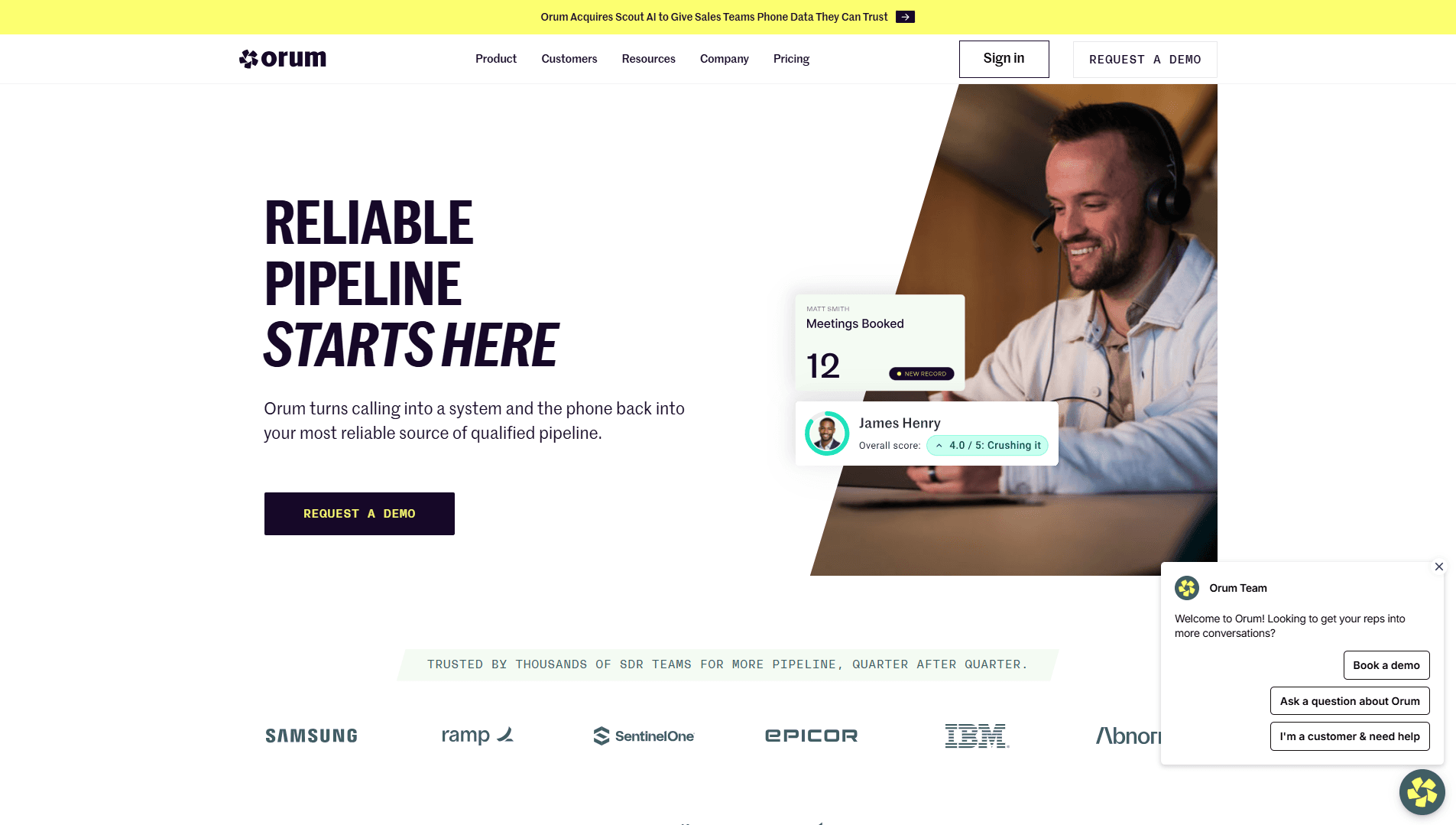
No. Orum is a parallel dialer engineered for one outcome: more live conversations per rep per hour. It dials several numbers simultaneously, uses AI to skip voicemails, busy signals, and dead air, and connects a rep only when a human answers. On its top (Ascend) tier it offers international dialing, which is what pushes it into enterprise and globally distributed teams. It is a volume machine built around the call itself.
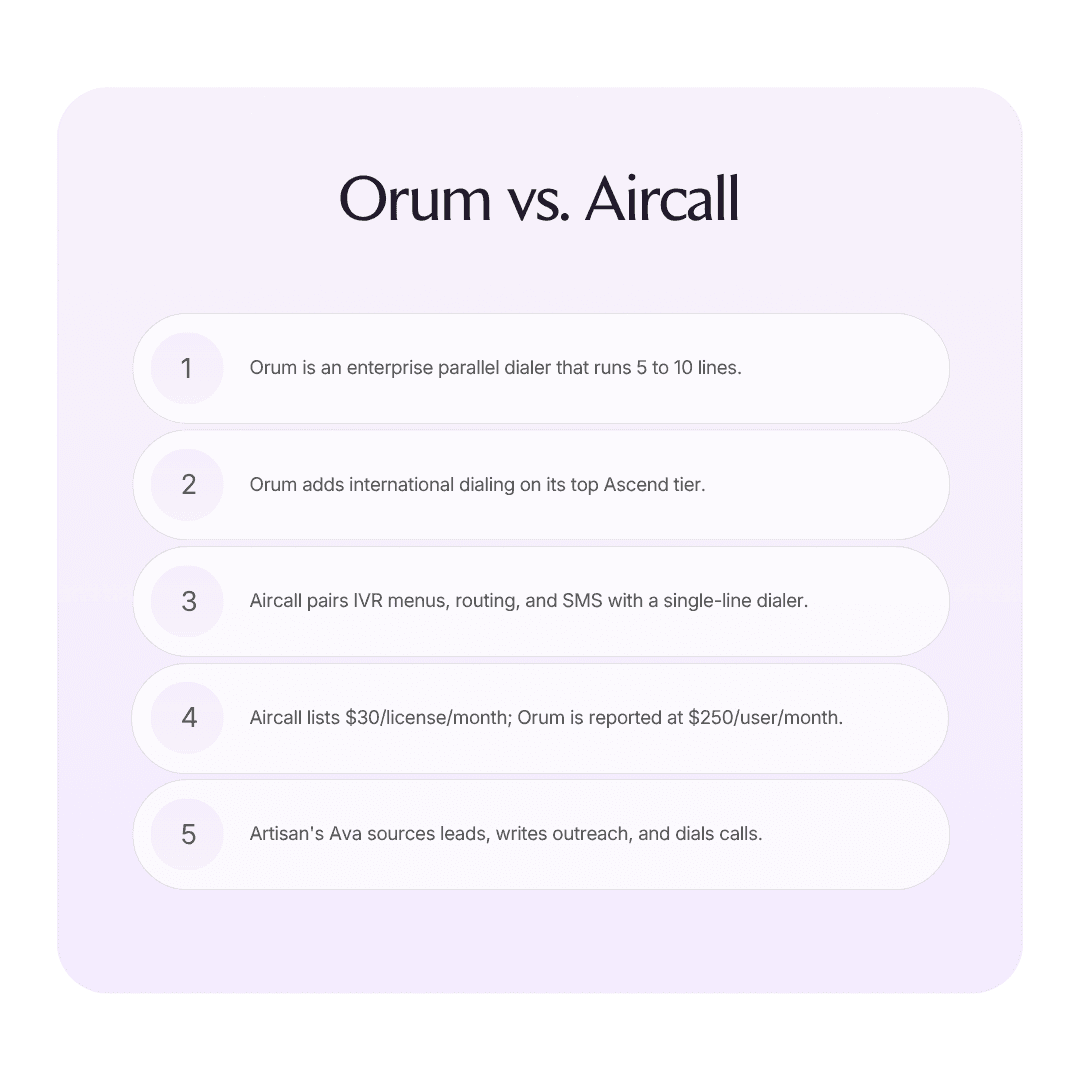
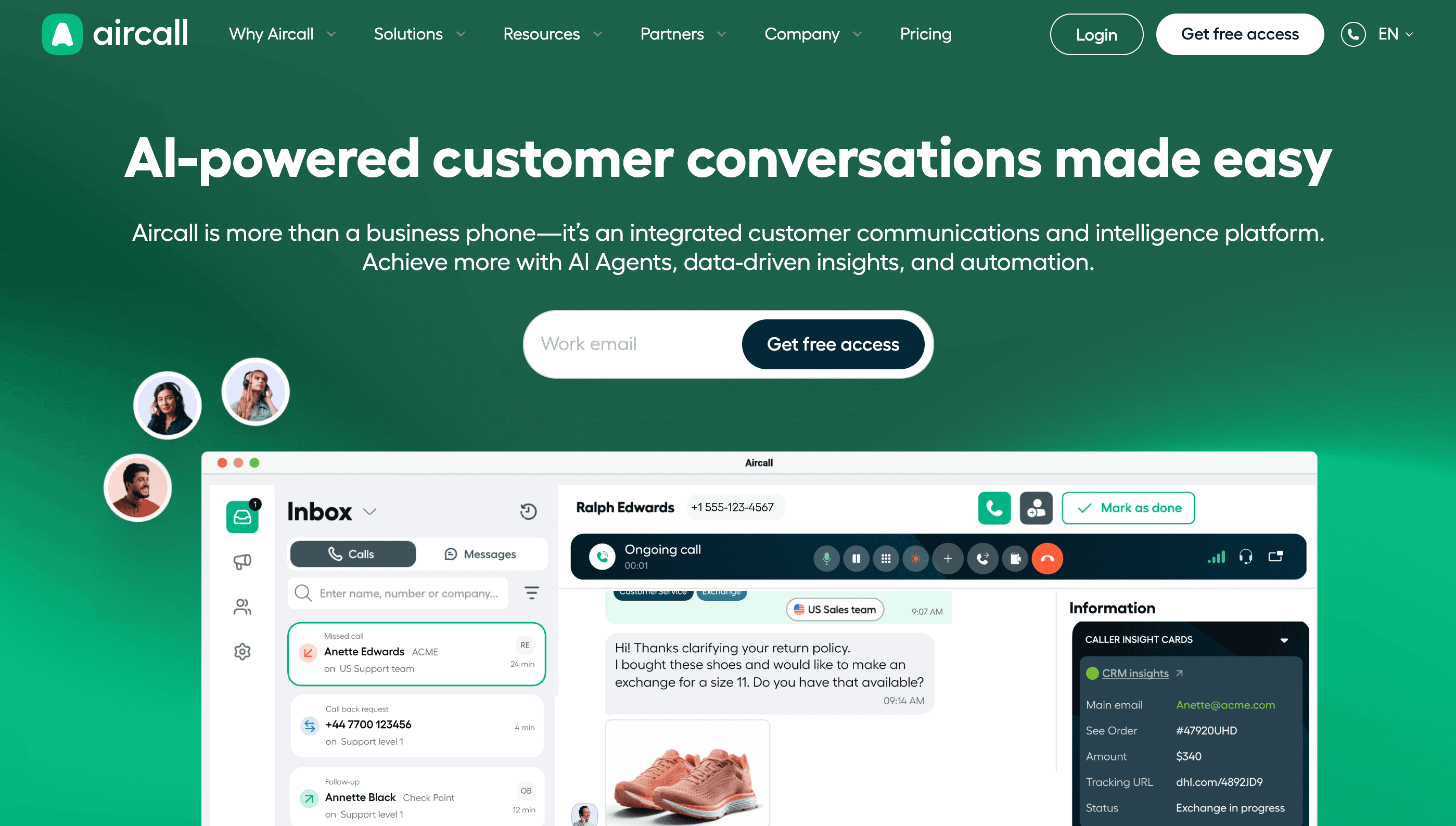
Aircall is the phone system. It handles inbound and outbound calls, interactive voice response (IVR) menus, routing, shared numbers, SMS, and analytics across over 250 integrations, and it serves support desks and sales floors alike. Its power dialer is single-line and auto-advances through a list one call at a time with voicemail drop. So the decision is less about which is better and more about whether you need a global outbound calling engine or a company telephone system.
Which has the stronger dialer for high-volume outbound?
Orum, without much argument, if connected conversations are the metric that matters. Parallel dialing at 5 to 10 lines with AI answer detection is a genuine connect-rate multiplier, and Orum is positioned at the enterprise end of this category, with the country coverage to run the motion across regions. For a large or international outbound org measured on live conversations and pipeline, this is exactly what Orum is built to do, and its July 2026 acquisition of Scout AI signals continued investment in AI-assisted calling.
Aircall's single-line power dialer is not trying to win this contest. It suits teams that also field inbound calls, want clean CRM logging, and value a unified system over maximum dial throughput. A rep who splits time between outbound, inbound, and support is well served by Aircall; a rep whose entire day is cold-calling volume will out-dial a single-line tool fast and should be on a parallel dialer like Orum.
Which has clearer pricing, Orum or Aircall?
Aircall, decisively. Its pricing page lists Essentials at $30/license/month and Professional at $50/license/month, both billed annually with a three-license minimum, plus a Custom tier for larger rollouts from 25 licenses. The power dialer sits on Professional, and AI capabilities come partly included with paid add-ons layered on, per its pricing page. You can model Aircall's cost before contacting sales.
Orum does not publish pricing. It is reported at roughly $250/user/month, but this figure is unverified and Orum routes buyers through a demo and quote. This is typical of dedicated parallel dialers, which price well above general phone systems because the connect-rate lift is the value. Budget accordingly, because Orum is a premium, sales-assisted purchase, while Aircall is transparent and self-serviceable.
Which fits your team and stack better?
It comes down to who is calling and why. Orum fits a dedicated outbound function, especially a large or international one, where reps do little but dial and success is measured in conversations and meetings. It assumes another system already handles your inbound, support, and general telephony, and that maximum outbound throughput justifies specialist pricing.
Aircall fits a company that needs phones as shared infrastructure. Support and sales both make and take calls, integrations into the CRM and helpdesk matter, and admin simplicity across teams outweighs dial volume. With over 250 integrations and predictable per-license pricing, it is the safer default for a mixed org. Buy Orum to make a global calling team faster; buy Aircall to give a whole company a reliable phone system.
Should you choose Orum or Aircall?
Choose Orum if you run a high-volume or international outbound team, live conversations per hour is your core metric, and you want enterprise-grade parallel dialing with wide country coverage. It is the specialist, and it earns its premium when the job is calling at scale across regions.
Choose Aircall if you need one cloud phone system for sales and support, you want transparent per-license pricing, and over 250 integrations matter more than dial throughput. It is the generalist that keeps several teams on the same phones without a procurement negotiation.
There is a third path. Whichever of these you buy, your reps still run the calling. If you would rather not run a dedicated dialer at all, Artisan runs calling inside a wider AI-driven outbound system where its AI employee Ava sources leads, writes and sends outreach, and handles replies, with the dialer as one step.
On cost, it offers power and parallel dialing up to three lines with automatic compliance checks, priced on a usage-based model where Ava's work runs on credits and dialer seats and numbers are billed separately, and over 90% of customers run it autonomously. This is a different purchase from an enterprise parallel dialer or a company phone system: you are buying an outcome priced against the work performed, not a tool to staff and configure. For context on the wider field, see the best AI dialers and parallel dialers and how an AI business development representative (BDR) owns the full motion.
Frequently asked questions
Is Orum or Aircall better for outbound sales calling?
Orum, for high-volume outbound. Its parallel dialer runs 5 to 10 lines with AI answer detection, multiplying live conversations per hour, and it offers international dialing on its top (Ascend) tier for global teams. Aircall's single-line power dialer suits teams that also handle inbound and want a full phone system. For pure cold-calling throughput, Orum is purpose-built.
How much do Orum and Aircall cost?
Aircall publishes pricing: $30/license/month for Essentials and $50/license/month for Professional, both annual with a three-license minimum, per its pricing page. Orum does not publish pricing and is reported around $250/user/month, unverified, gated behind a demo. Aircall is much easier to budget; Orum is a premium, sales-led purchase.
Does Aircall offer parallel dialing?
No. Aircall provides a single-line power dialer on its Professional tier, which advances through a list one call at a time with voicemail drop, per its pricing page. It does not dial multiple lines simultaneously with AI answer detection, as Orum does. If parallel dialing is a hard requirement, Aircall will not meet it.
What did Orum's Scout AI acquisition change?
Orum acquired Scout AI in July 2026 to strengthen its AI capabilities around the dialer. It signals ongoing investment in AI-assisted calling on top of Orum's parallel-dialing core. As with any recent acquisition, evaluate how far the combined capabilities have shipped against what is still being integrated before making it a deciding factor.
Can Orum handle international calling?
Yes, and this is one of its differentiators. Orum offers international dialing on its top (Ascend) tier, which makes it a fit for globally distributed outbound teams. Aircall also provides international numbers as part of its phone system, but for parallel dialing across many countries at high volume, Orum is the more specialized choice.
Which integrates with more tools?
Aircall advertises over 250 integrations across CRMs, helpdesks, and productivity apps, per its pricing page, reflecting its role as shared telephony. Orum integrates with major CRMs and sales engagement tools to support its dialing workflow but is not positioned as a broad integration hub. For sheer integration breadth, Aircall leads.
Is there an alternative to both Orum and Aircall?
Yes. A standalone dialer may be the wrong category if what you want is pipeline instead of dials. Artisan runs calling as one step inside a wider AI-run outbound system, alongside lead sourcing, message writing, sending, and reply handling, on usage-based pricing, so it generates qualified pipeline and does not simply place dials. It suits teams that want an outcome priced against the work performed instead of a specialist tool to staff, configure, and negotiate.
Related reading

Artisan Team
Expert insights from the team at Artisan
Our writing team blends direct operational experience, in-house data, and thorough research to bring you the very latest insights and updates about sales and GTM automation.