The best HubSpot Sales Hub alternatives in 2026
The best HubSpot Sales Hub alternatives in 2026, from an autonomous AI BDR to Apollo, Outreach, Salesloft, Reply, and Klenty, with who each fits.
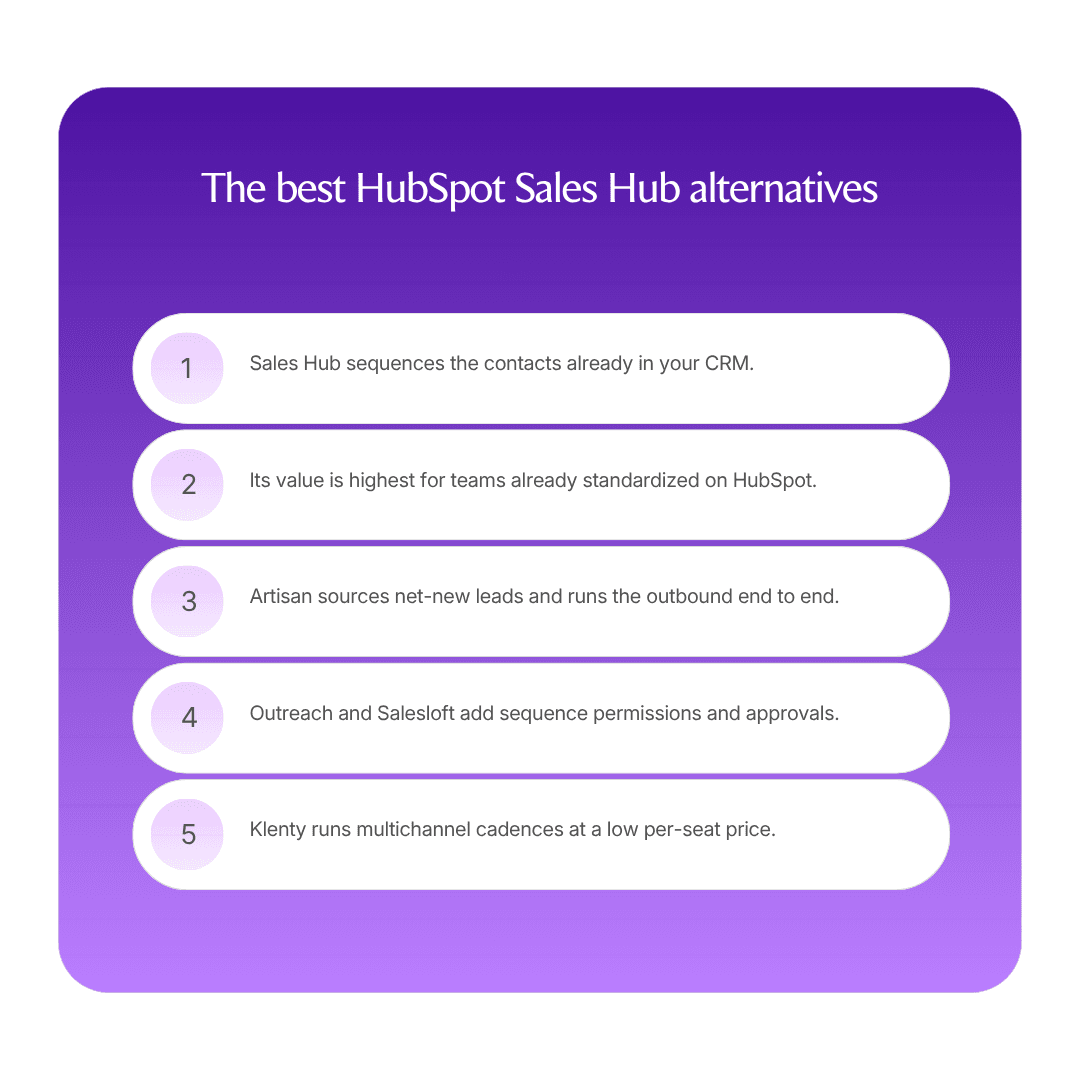
The best HubSpot Sales Hub alternative is Artisan: instead of assisting reps inside the CRM, Ava runs outbound end to end, finding leads, writing, sending, calling, replying, and booking. Apollo bundles data cheaply, Outreach and Salesloft cover enterprise cadence, and Reply and Klenty round out the value tiers. Sales Hub is strong, but its gravity is HubSpot itself.
Two things push teams to look past Sales Hub. The first is scope: its value peaks when your entire motion already runs on HubSpot, and outside HubSpot the case thins. The second is the pricing question its own Breeze agents opened up. In April 2026 HubSpot introduced outcome-based pricing for its Breeze agents, now metered through HubSpot credits at roughly $0.010 per credit, an industry first that made every buyer ask a sharper question, what am I actually paying for, seats or results. Once you ask that, you start comparing what each tool does rather than what it costs to log in.
Comparison table
Rank | Tool | Best for | Standout capability | Public pricing |
|---|---|---|---|---|
1 | Artisan | The AI running outbound end to end | Ava owns find, write, send, call, reply, book | Usage-based credits, no platform fee, free trial |
2 | Apollo | Value all-in-one with data included | Large database plus sequencing | Free to $119/user/mo |
3 | Outreach | Enterprise sequencing governance | Mature workflow controls, Omni agent | ~$100-160/user/mo reported |
4 | Salesloft | Enterprise cadence plus forecasting | Clari forecasting combo | Reported per-seat, not public |
5 | Reply.io | Accessible AI-assisted email | Jason AI agent on a low-cost sequencer | Sequences from $59/mo; AI SDR ~$500-800/mo |
6 | Klenty | Value multichannel sequencing | Multichannel cadences at per-seat pricing | Published per-user tiers |
How we chose
We weighted four things for a team leaving Sales Hub. How much of the outbound job the software does versus assists a human with, since that is the real dividing line. CRM fit, because Sales Hub buyers value the single-record model and any replacement has to sync cleanly. Pricing transparency, sharpened now that HubSpot itself put outcome-based pricing on the table. And data and channel coverage, since a motion is only as good as the leads and channels feeding it. Each tool gets credit for its strength and a plain verdict on who it is wrong for. For broader roundups, see outbound sales tools, sales productivity tools, and email sequencing software.
What is the best alternative to HubSpot Sales Hub?
The best alternative depends on what you want the software to do. To have the AI run outbound end to end, Artisan. To bundle data and sequencing cheaply, Apollo. For enterprise cadence governance, Outreach or Salesloft. Here is the ranking.
1. Artisan: the AI runs outbound end to end
Artisan leads because it does the job rather than assisting a rep with it. Sales Hub gives a rep tools, templates, sequences, and Breeze agents that help. Artisan's Ava does the work. She finds best-fit leads across over 250 million B2B professionals across over 200 countries, plus Artisan Local Data covering over 250 million local businesses, enriches them with waterfall enrichment, writes personalized messages one to one, runs the sequence across email, social outreach, and dialer call steps, handles every reply from a knowledge base, and books meetings on the right rep's calendar with owner routing.
On the pricing question Sales Hub itself raised, Artisan sits on the same side of the argument. You pay for work performed through usage-based credits, not for seats, with no platform fee. Where HubSpot meters its Breeze agents through HubSpot credits at roughly $0.010 per credit inside HubSpot, Artisan charges for the whole motion Ava runs across any CRM, and syncs deeply back into HubSpot so the single-record model Sales Hub buyers value stays intact: activities log natively to the timeline, owner mapping routes outreach from the right rep, and per-field controls govern what syncs.
For scale, the autonomy dial is the mechanic: review-and-approve every message, objections-only replies, or full autonomy, with plain-language escalation and a complete audit trail. Sales ops can run Ava centrally for large AE teams who never open the tool. Artisan is SOC 2 Type II compliant, GDPR compliant, with SSO, SAML, and role-based access.
SumUp's Karlo Biuk saw the economics directly: Ava drove a $52 cost per lead across hundreds of thousands of emails, producing 8 to 15 positive replies a week from previously unreachable local businesses.
Best for: teams from startup to enterprise that want the AI to run outbound, not just assist reps inside the CRM. Who should pick something else: teams whose entire motion is happy inside HubSpot and who want tools that help reps rather than replace the manual work. Pricing: usage-based credits, you pay for work performed rather than seats, no platform fee, free trial. See artisan.co/pricing.
2. Apollo: value all-in-one with data included
Apollo is the natural alternative for a team that wants to leave Sales Hub and consolidate the data bill at once. It bundles a large contact database with a sequencer and light dialing, from free to about $119 per user per month, and it is used by hundreds of thousands of companies. It acquired Pocus in March 2026 to add signal-based selling, and reported annual recurring revenue is around $200M. For a smaller team, getting data and sequencing in one cheap tool is hard to argue with.
The AI is assistive and the model is per-seat, so like Sales Hub, the reps still drive. You gain a bundled database and a low price; you do not gain autonomous execution.
Best for: cost-sensitive teams wanting data and sequencing in one affordable tool. Who should pick something else: enterprises needing deep governance, or teams wanting the AI to run the motion. Pricing: free to $119/user/mo, per its pricing page.
3. Outreach: enterprise sequencing governance
Outreach is the alternative for teams that outgrew Sales Hub's engagement side and want dedicated enterprise cadence governance. Its workflow controls are mature: sequence management, team permissions, and reporting built for large, disciplined orgs. It added its Omni agent in April 2026 to bring more AI into the flow, and reported pricing sits around $100 to $160 per user per month.
The structural limit is that Outreach orchestrates reps; the reps do the work. You are trading a CRM-native engagement layer for a specialist one, which is right if governance is the priority and a human-led motion is the plan. Compare directly in Apollo vs Outreach and Artisan vs Outreach.
Best for: enterprise teams wanting mature sequencing governance beyond a CRM's native tools. Who should pick something else: teams wanting the AI to execute outreach, or those happy in one CRM system. Pricing: ~$100-160/user/mo reported.
4. Salesloft: enterprise cadence plus forecasting
Salesloft is the other enterprise engagement peer, now paired with Clari forecasting after the December 2025 merger. For a team leaving Sales Hub because it wants a dedicated cadence platform with a forecasting story attached, that combination is the draw. Its cadence governance is mature and built for large orgs.
The merger left new buyers with roadmap questions, and the core limitation is unchanged: Salesloft orchestrates what reps do rather than doing it. It is a human-driven sequencer, a specialist swap for HubSpot's native engagement rather than a change in who does the work. See also Artisan vs Salesloft, Artisan vs Gong Engage, and Gong Engage pricing and reviews.
Best for: enterprise teams wanting mature cadences plus forecasting in one vendor. Who should pick something else: teams that want the AI to execute the cadence, or that prefer a single CRM system. Pricing: reported per-seat, not public.
5. Reply.io: accessible AI-assisted email
Reply.io is a lower-cost route into agent-assisted email for teams that found Sales Hub's higher tiers heavy. Its platform sequences start around $59 a month, and its Jason AI agent, in the $500 to $800 a month range, adds AI-driven email prospecting on top. For a small team that wants some agent capability without a full CRM commitment, it is an accessible entry point.
The scope is email-centric, with the AI layered onto a classic sequencer rather than owning a true multichannel motion. It is a step toward agent-run email, not a full autonomous BDR, and it lacks a CRM's breadth.
Best for: small teams wanting affordable AI-assisted email sequencing. Who should pick something else: teams needing multichannel autonomy or a full CRM. Pricing: sequences from $59/mo; Jason AI ~$500-800/mo.
6. Klenty: value multichannel sequencing
Klenty is a solid value sequencer with published per-seat pricing and multichannel cadences across email, calls, and social outreach. For a team that found Sales Hub's engagement tools overbuilt for its needs and just wants clean, affordable cadence execution with a human at the wheel, Klenty does the job without the platform weight.
It is a sequencer in the classic sense: it coordinates rep activity. There is no autonomous agent owning the motion and no native CRM, so output still scales with rep hours.
Best for: value-focused teams wanting straightforward multichannel cadences. Who should pick something else: teams wanting autonomous execution or an all-in-one CRM. Pricing: published per-user tiers, per its site.
What is the best enterprise alternative to HubSpot Sales Hub?
For enterprise, the best alternative to HubSpot Sales Hub is Artisan if you want the AI to run outbound, and Outreach or Salesloft if you want a dedicated human-driven cadence platform with mature governance. The specialists give you deeper sequencing controls than a CRM's native engagement layer, but they still direct reps. Artisan is the structural change: it consolidates data, sequencing, dialing, and reply handling into one platform where Ava runs the motion, syncs deeply back into HubSpot, and adds governance built in, org and campaign-level do-not-contact across every channel, per-field controls, SOC 2 Type II, SSO and SAML, and central-ops deployment. Our guide to the best sales engagement platforms maps the full field.
Why do teams leave HubSpot Sales Hub?
Two reasons lead. Scope is the first: Sales Hub's value is highest when the whole motion already runs on HubSpot, and teams on other systems, or those wanting best-in-class prospecting data and dialing, find themselves bolting on tools anyway. The second is the pricing conversation HubSpot itself started. Its April 2026 outcome-based Breeze pricing, now metered through HubSpot credits at about $0.010 per credit, was an industry first and a smart one, but it made buyers ask what they pay for across their whole stack, seats or results. Teams that decide they want the AI to run the motion, not just assist it, look at a different category.
Stay with HubSpot Sales Hub if
Keep Sales Hub if HubSpot is your system of record and your motion largely lives there. The single-record model is a real advantage, the Breeze agents are improving, and the outcome-based pricing is a real advance for teams that want to pay for results inside HubSpot. If your reps like driving sequences and your data and dialing needs are modest, adding more tools buys little. The case to move sharpens when you need best-in-class prospecting data and multichannel autonomy, or when you decide you want the AI executing outbound rather than assisting it.
FAQ
What is the best HubSpot Sales Hub alternative?
For most teams, Artisan, because Ava runs outbound end to end, finding, writing, sending, calling, replying, and booking, while syncing deeply back into HubSpot. Apollo bundles data and sequencing cheaply, Outreach and Salesloft cover enterprise cadence governance, and Reply and Klenty round out the value tiers.
Do I have to leave HubSpot to use Artisan?
No. Artisan syncs two-way with HubSpot: activities log natively to the record timeline, owner mapping routes outreach from the right rep's mailbox, and per-field controls govern what syncs. You keep HubSpot as your system of record and let Ava run the outbound motion on top, so the single-record model Sales Hub buyers value stays intact.
Is HubSpot's outcome-based pricing a good deal?
For teams inside HubSpot, the April 2026 Breeze model, now metered through HubSpot credits at about $0.010 per credit, is a real advance because it charges for usage rather than seats. The question it raises is broader: across a full stack, are you paying for one agent inside one platform or for the whole motion. Artisan's usage-based credits charge for all the work Ava performs across any CRM.
What is the best enterprise alternative to HubSpot Sales Hub?
Artisan, because it has Ava execute outbound end to end with governance built in: SOC 2 Type II, SSO and SAML, per-field controls, org-level do-not-contact across channels, and central-ops deployment, all syncing back into HubSpot. Outreach and Salesloft are the picks if you want a dedicated human-driven cadence platform with mature workflow controls.
Can an AI BDR replace HubSpot Sales Hub for outbound?
For the outbound motion, yes. An autonomous AI BDR like Artisan's Ava replaces the sequencing and the manual execution, since she writes, sends, calls, and replies under a defined autonomy level, then logs everything back to HubSpot. You would keep HubSpot itself as your CRM system of record.
Which HubSpot Sales Hub alternative is cheapest?
Among sequencers, Reply.io starts around $59 a month, and Apollo and Klenty offer value per-seat tiers, with Apollo starting free. Artisan uses usage-based credits with no platform fee, so cost tracks work performed rather than seat count, which can be cheaper for teams that want more pipeline without more reps. See artisan.co/pricing.
Ready to see the AI run the motion? Explore the AI sales agent or start on the Artisan homepage.
Jaspar Carmichael-Jack
Co-Founder & CEO @ Artisan
Jaspar is an entrepreneur with expertise in sales, marketing, and operations. He founded Artisan in 2023, a company automating workflows with AI employees.