How to build a targeted prospect list with AI
A step-by-step method to build a targeted B2B prospect list with AI: define your ICP, filter, use NLP search, add signals, enrich, and qualify.
Key Takeaways
- A targeted list beats a big list. Reply rates depend on fit, not volume, so precision at the list stage compounds through every later step.
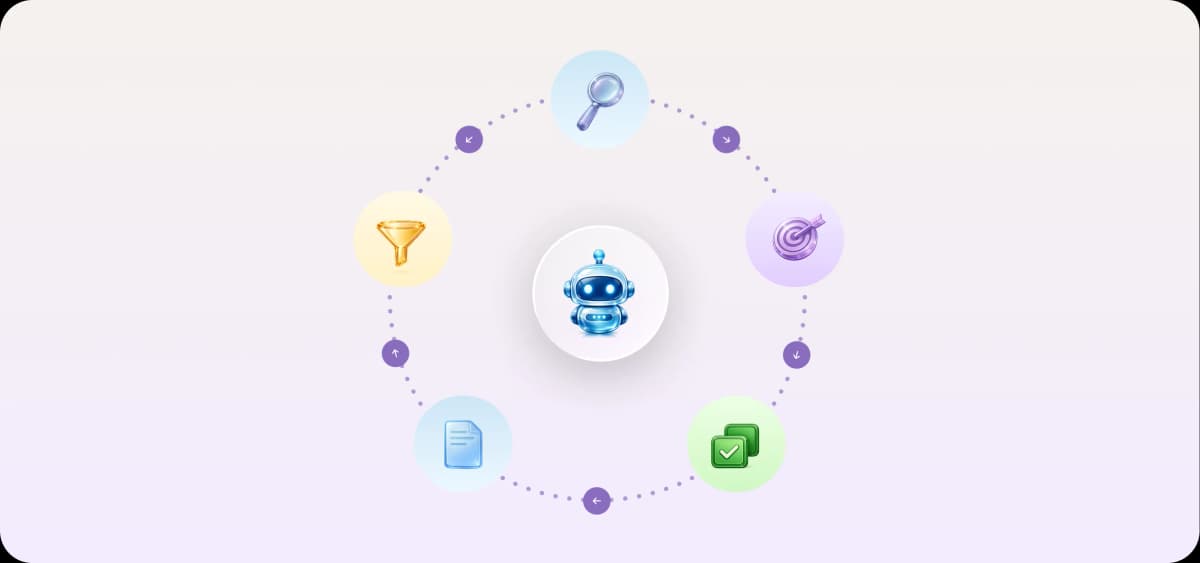
- The method has five moves: define the ICP, filter the database, layer signals, enrich contacts, and qualify with AI before contact.
- The two failure modes that ruin most lists are targeting too broadly and building on stale data, and both are avoidable.
- Verified data decays fast. Roughly a quarter to a third of B2B contact data goes stale each year as people change jobs, so a list built once and reused is a list of bounces.
- Artisan's Find Leads runs this whole loop across a database of over 250 million B2B professionals in over 200 countries, plus Artisan Local Data, which holds over 250 million local businesses, with natural-language search, intent signals, waterfall enrichment, and AI qualification built in.
Building a targeted prospect list with AI means defining a precise ideal customer profile (ICP), then using natural-language search, structured filters, buying signals, and enrichment to assemble verified contacts who match it, with AI qualifying each one before it enters outreach. Done well, this replaces days of manual research with a live, self-refreshing list of people actually worth contacting.
Why does a targeted list matter more than a big one?
Because cold reply rates have collapsed industry-wide, and the collapse is worst for untargeted blasts. Every irrelevant contact you add lowers your average fit, drags your reply rate, and burns sender reputation on people who were never going to buy. A list of 300 well-matched prospects will out-produce a list of 30,000 scraped from a title filter, every time.
There is also a cost argument. Sales development representatives (SDRs) already lose 40% to 60% of their hours to non-selling busywork, and a large share of that is list research: hunting for accounts, finding the right contact, digging up an email, checking whether a company is even a fit. Automating the list stage is the single most valuable place to put AI, because everything downstream inherits the quality of the list you feed it.
Step 1: Define your ICP precisely enough to filter on
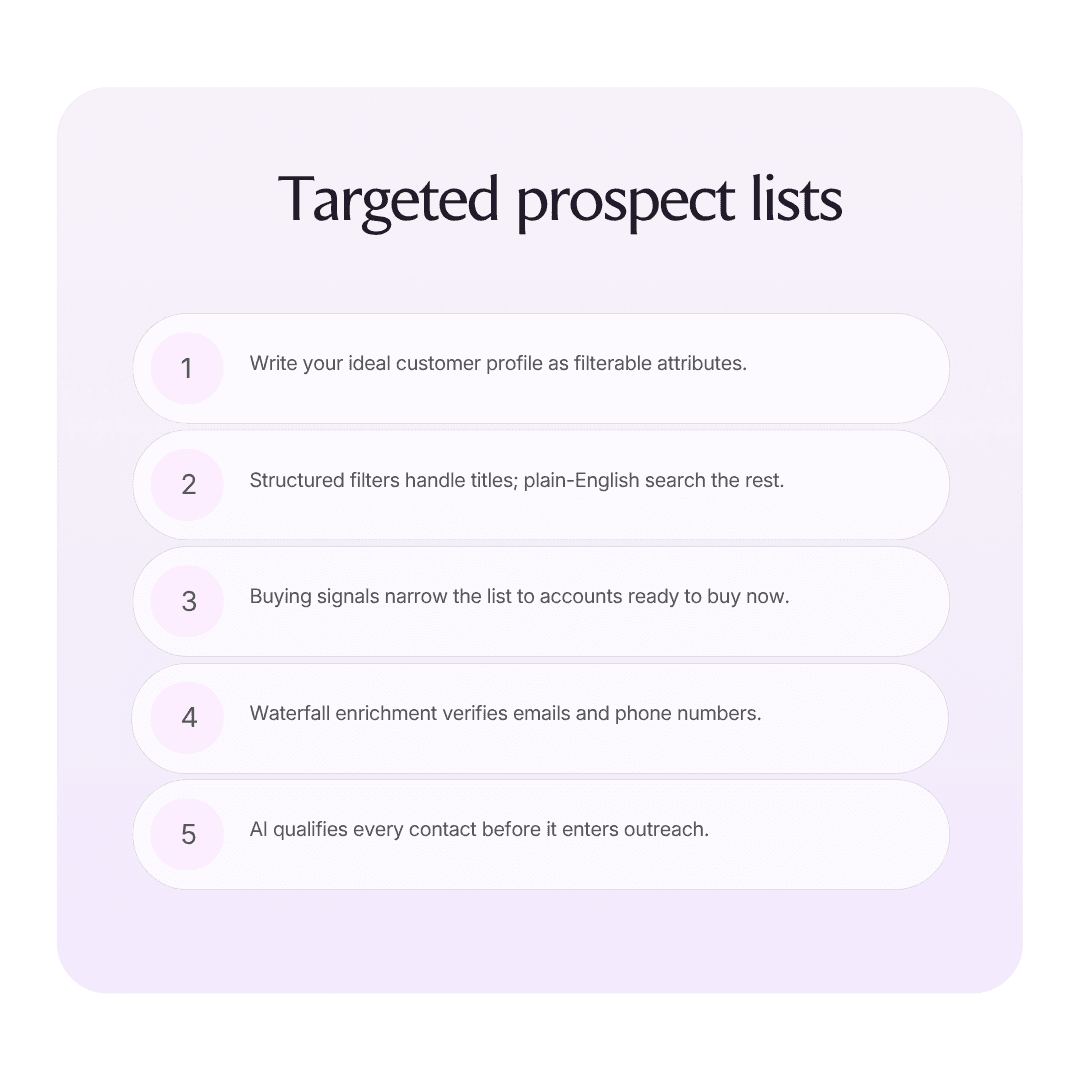
You cannot build a targeted list against a vague target. "Mid-market SaaS companies" is a slogan, not an ICP. Write it as a set of attributes a database can actually filter:
Firmographics: industry, employee count band, revenue band, geography, funding stage
Technographics: tools they run that imply a need for yours (a CRM, a data warehouse, a competing product)
Persona: the exact titles and seniority of your buyer, your champion, and your blocker, specific enough that "decision-maker" never stands in for a job title
Trigger conditions: what has to be true right now for the timing to be good (hiring for a role, just raised, new exec in seat)
The tighter this is, the less filtering and qualifying you have to do later. Most weak lists trace back to a weak ICP, so spend real time here.
Step 2: Filter and search the database
With the ICP written down, you pull matching accounts and contacts from a B2B database. Two search modes matter.
Structured filters handle the firmographic and persona criteria: industry equals X, headcount between 50 and 500, title contains "VP Revenue," region equals North America. This is the workhorse, and it covers most of the ground.
Natural-language search, also called NLP search after the natural language processing behind it, handles the criteria that do not map cleanly to a dropdown. Instead of chaining 12 filters, you describe a prospect in plain English ("heads of demand gen at Series B fintechs that recently expanded into Europe") and the AI translates that into a query across the data. NLP search is where AI earns its place at this step, because it captures fuzzy intent that structured filters miss. For a fuller comparison of the underlying databases, see the best B2B data providers.
Step 3: Layer buying signals onto the list
A filtered list tells you who fits. Signals tell you who fits and is worth calling this week. This is the difference between a static list and a targeted one.
Useful B2B signals include funding rounds, a newly hired executive, the first hire in a department, a company actively hiring for a specific role, tech-stack changes, topic-level intent (the co-op intent data, such as Bombora, that many vendors resell), champion job changes, and website visits. Each one narrows a broad list to the slice with a reason to buy now.
The best systems let you define custom signals in plain language. You describe a trigger ("flag any account that just posted a role for a revenue operations lead"), and the AI watches for it, scores confidence, and attaches the evidence. Signals are also the antidote to the "too broad" failure mode: instead of contacting everyone who fits your firmographics, you contact the subset showing intent.
Step 4: Enrich contacts with verified emails and phone numbers
A name and a company are not a contact. To reach someone you need a verified email and, if you call, a verified phone number, plus enough context to personalize. This is the enrichment step, and it is where lists quietly die if you cut corners.
A reliable approach is waterfall enrichment: instead of trusting one data vendor, the system queries a stack of providers in sequence and takes the first verified result, which lifts match rates and cuts bounces well past what any single source delivers. Good enrichment also charges only when it actually finds a verified record, so you are not paying for misses. Layer AI web research on top for the context no database stores, such as recent company news, a relevant post, or a product launch, and the personalization has something real to work with. For tools that specialize in this step, see the best email and phone number finder tools for sales, B2B data enrichment tools, the best Seamless.ai alternatives, and the best Clearbit alternatives.
Step 5: Qualify each contact with AI before it enters outreach
The final step is the one manual list-building usually skips: checking, contact by contact, that a person actually belongs before you spend outreach on them. AI qualification reads each enriched record against your ICP and disqualifies the mismatches: the "VP of Sales" who is really an individual contributor, a company that looks like a fit but sells into the wrong market, a contact whose record holds too little information to personalize.
This is quality control at the gate. It is cheap to run and it protects everything downstream, because a disqualified contact never wastes a sequence, never bounces, and never dents your reputation.
What are the failure modes when building a list with AI?
Two, mostly, and both are avoidable.
The first is targeting too broadly. AI makes it trivially easy to generate a list of 100,000 contacts, which feels like progress and is usually a trap. A broad list dilutes fit, tanks reply rates, and trains your team to treat outreach as spray-and-pray. The fix is discipline at Steps 1 and 3: a tight ICP and real signals that force the list down to people with a reason to hear from you. If your list is huge, your ICP was probably loose.
The second is stale data. B2B contact data decays fast. A meaningful share, commonly cited around a quarter to a third, goes out of date every year as people change jobs, companies restructure, and emails die. A list built once and reused for months becomes a list of bounces and wrong numbers, which hurts deliverability and sender reputation. The fix is to enrich at send time instead of at build time, and to treat your list as a live query that re-runs, not a spreadsheet you export once and forget.
How Artisan automates the entire list-building loop
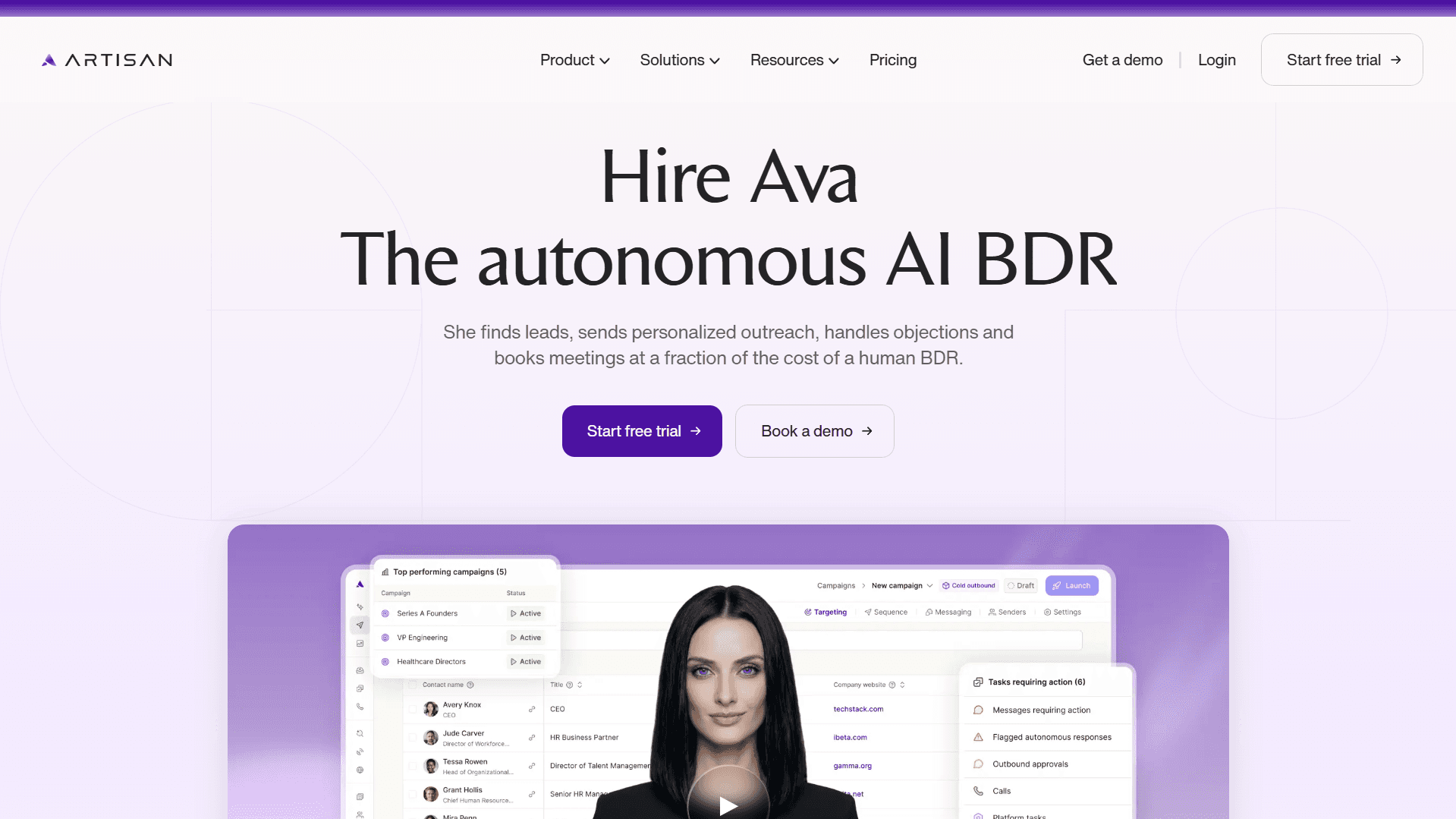
Everything above, the five steps and the two fixes, is what Artisan's Find Leads and its AI business development representative (BDR), Ava, run as one continuous loop. You describe the target; the system builds and maintains the list.
Database depth: over 250 million B2B professionals across over 200 countries, plus Artisan Local Data, which holds over 250 million local businesses (restaurants, gyms, local services). This local coverage matters if your buyers are small and medium-sized businesses (SMBs) a standard B2B provider never sees.
Search: structured ICP filters and natural-language search let you describe a prospect in plain English or filter precisely, whichever fits the criterion.
Signals: Ava watches funding rounds, new executive hires, hiring activity, tech-stack intent, topic intent, champion job changes, and website visitors, plus custom signals you define in plain language with confidence scoring and evidence URLs.
Enrichment: waterfall enrichment runs across roughly a dozen providers for verified emails and phone numbers, adds AI web research, and is charged only on success.
Qualification: AI qualifies every contact against your ICP before it enters a campaign, and disqualified contacts never receive outreach.
Because Ava re-runs this loop continuously, the list stays live instead of aging on a spreadsheet, which is the direct fix for the stale-data failure mode. She also enriches and ranks leads by likelihood of converting, so the strongest fits reach outreach first. And because the same AI sales agent then writes the outreach across email, social media, and dialer call steps, handles replies, and books the meeting, your targeted list flows straight into a working motion instead of being handed off to a separate tool and a separate person. See the full role of the autonomous AI BDR for how the list stage connects to everything after it.
SumUp used this to reach buyers a human team could not economically find. Targeting local businesses that were previously out of reach, the team hit a $52 cost per lead and now receives 8 to 15 positive replies per week.
Frequently asked questions
What is the best tool to build a targeted prospect list?
The best tool depends on whether you want a database to search yourself or a system that builds and maintains the list for you. Standalone data providers like Apollo, ZoomInfo, and Cognism give you contacts to filter and export. Orchestration tools like Clay let a skilled operator enrich and assemble lists programmatically. Artisan runs the full loop, ICP definition, natural-language search, signals, waterfall enrichment, and AI qualification, across over 250 million B2B professionals and over 250 million local businesses, then feeds the result straight into autonomous outreach. For head-to-head data comparisons, see Apollo vs. Lusha, Apollo vs. Outreach, Artisan vs. Apollo, and Artisan vs. Clay.
How do I define an ideal customer profile for a prospect list?
Write your ICP as filterable attributes, not adjectives. Specify firmographics (industry, headcount, revenue, geography, funding stage), technographics (tools that imply a need), the exact buyer and champion titles, and the trigger conditions that make the timing right. The test is whether a database could execute it: "mid-market SaaS" fails that test, while "Series B fintechs, 50 to 500 employees, hiring a revenue operations lead" passes. A precise ICP is what makes every later step accurate.
How often does B2B contact data go stale?
Fast. A commonly cited figure is that roughly a quarter to a third of B2B contact records decay each year as people change jobs, companies restructure, and email addresses are retired. This is why reusing an old exported list produces bounces and wrong numbers. A reliable fix is to enrich contacts at the moment you contact them and to treat your list as a live query that re-runs, instead of a static file you build once.
Can AI find contacts that filters miss?
Yes, and this is the main advantage of natural-language search. Structured filters handle clean criteria like title and headcount, but many real targeting rules are fuzzy ("companies that just expanded into a new region" or "teams that recently adopted a competing tool"). Natural-language search lets you describe a prospect in plain English and translates it into a query across the data. Combined with custom signals defined in plain language, AI captures intent no dropdown filter can express.
What is waterfall enrichment and why does it matter?
Waterfall enrichment queries multiple data providers in sequence instead of trusting one, taking the first verified email or phone number it finds. Because no single vendor has complete or current coverage, a waterfall lifts match rates and cuts bounce rates well beyond any one source. Good implementations charge only when they return a verified record, so you never pay for a miss. This is the difference between a list you can actually reach and a list full of dead addresses.
How big should a targeted prospect list be?
Smaller than you think. There is no universal number, but if your list runs to tens of thousands from a couple of filters, your ICP is almost certainly too loose. A tightly qualified list of a few hundred well-matched contacts showing buying signals will beat a massive untargeted one on reply rate, pipeline, and sender reputation. Let your ICP and signals set the size; do not pad a list to hit a volume target.
Do I still need a data provider if I use an AI prospecting tool?
Usually not as a separate purchase. An AI prospecting platform that includes its own database, search, signals, and enrichment covers what a standalone data provider does and adds the qualification and outreach steps a raw database leaves to you. You would keep a separate provider only for specialized coverage a platform lacks. Compare the underlying databases on the best B2B data providers and weigh the model on Artisan's pricing page.
Want the list built and worked for you? Start at the Artisan homepage.
Related reading
Jaspar Carmichael-Jack
Co-Founder & CEO @ Artisan
Jaspar is an entrepreneur with expertise in sales, marketing, and operations. He founded Artisan in 2023, a company automating workflows with AI employees.