ZoomInfo vs. Clay: Which should you choose in 2026?
ZoomInfo vs. Clay compared on data depth, enrichment, pricing, and fit. An honest 2026 buyer's guide with published prices and real trade-offs.
Key Takeaways
- ZoomInfo is a single, deep first-party database with signals attached; Clay is orchestration infrastructure that aggregates other people's data rather than owning one big source.
- ZoomInfo claims over 321 million profiles (a marketing figure; its investor filings have historically cited over 235 million), plus WebSights visitor identification and Scoops intelligence. It is quote-based and annual, with buyer-reported entry points around $15K per year.
- Clay publishes tiers from a free plan to Launch at $167 per month and Growth at $446 per month, per its pricing page, on a usage-based model. Median contracts run around $30,000 per year once usage scales.
- Clay connects over 150 data providers with waterfall logic and its Claygent research agents. It was valued at $3.1 billion in August 2025.
- ZoomInfo hands you finished data; Clay hands you a workbench that a skilled operator, often a go-to-market (GTM) engineer, turns into finished data.
- Both are data tools. Neither writes, sends, or replies to your outreach, which is a separate category covered below.
ZoomInfo and Clay solve different problems. ZoomInfo is an enterprise data platform with its own deep, US-heavy database and intent signals, sold on annual contracts. Clay is a programmable enrichment layer that waterfalls across over 150 providers and needs an operator to run it. Pick ZoomInfo for verified depth out of the box, Clay for custom data workflows.
ZoomInfo vs. Clay at a glance
ZoomInfo | Clay | |
Category | Enterprise GTM data platform | Programmable enrichment infrastructure |
Best for | Large teams that need deep, verified US data and signals | Custom data workflows run by an operator |
Standout capability | First-party data depth, WebSights, Scoops intent | Waterfall enrichment across over 150 providers plus Claygent |
Native database | Over 321 million profiles claimed (vendor figure) | No first-party database; aggregates providers |
Published pricing | Quote-based, annual (from ~$15K/yr reported) | Free; Launch $167/mo; Growth $446/mo; Enterprise custom |
Who runs it | RevOps and reps, self-serve search | A data-literate operator or GTM engineer |
Pricing above is from each vendor's published pages and reported contract data; re-check before you buy.
How we compared them
We looked at four things a buyer actually feels: how good the data is and where it comes from, how much it costs at real usage rather than the headline tier, how much skill it takes to operate, and how well it fits an enterprise motion. ZoomInfo and Clay both live under "data for outbound," but they sit at opposite ends of buy versus build, so the right answer depends heavily on your team rather than a feature count.
What is the core difference between ZoomInfo and Clay?
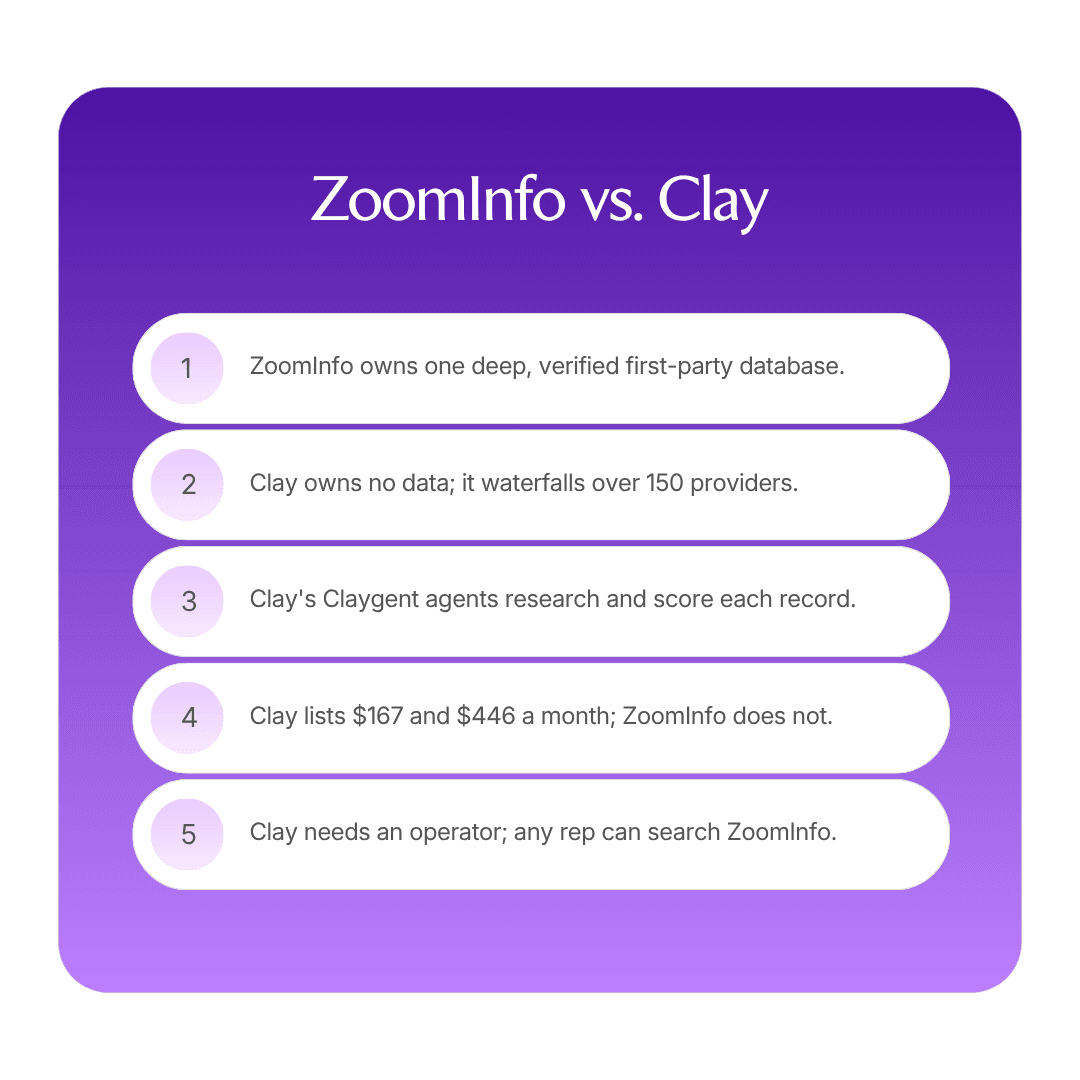
One owns the data; the other orchestrates it. ZoomInfo is a destination you search; Clay is a layer you configure.
ZoomInfo built its reputation on a large, verified first-party database, strongest in US enterprise coverage, wrapped in signals most rivals cannot match: WebSights for website visitor identification and Scoops for human-sourced sales intelligence. It repositioned around a broader go-to-market intelligence story and now trades publicly under the ticker $GTM. You log in, search, and export. The data is already there. For more ZoomInfo matchups, see ZoomInfo vs. Cognism and ZoomInfo vs. LinkedIn Sales Navigator.
Clay is the opposite shape. It holds no first-party database. Instead it connects to over 150 data providers, runs them in a waterfall so you only pay when one source fills a field the last one missed, and lets you enrich, score, and format records with spreadsheet-style logic and its Claygent research agents. Then it pushes the result into your sequencer or CRM. ZoomInfo gives you the store. Clay gives you the workbench. For more Clay matchups, see Clay vs. Apollo, Clay vs. Clearbit, and Clay vs. Common Room.
Which has better data, ZoomInfo or Clay?
It depends on what "better" means to you. For verified depth in North American enterprise accounts out of the box, ZoomInfo leads. For breadth of sources and hard-to-find records, a well-built Clay table wins.
ZoomInfo's advantage is one large, heavily verified database plus its Scoops and intent layers. Enterprises pay a premium precisely because the data holds up under scrutiny in the segments ZoomInfo covers best, and any rep can search it without setup.
Clay's advantage is that it is not one source but many. Because it waterfalls across over 150 providers, it can find records and fill fields no single database holds, and it lets you verify one provider against another. For niche personas, thin international coverage, or hard-to-find phone numbers, a well-built Clay table usually beats any single vendor, including ZoomInfo. The catch is that someone has to build and maintain this table. For a wider view of the field, see our guide to the best B2B data providers. For more head-to-heads, see Clay vs. ZoomInfo, ZoomInfo vs. RocketReach, and ZoomInfo vs. UpLead.
How do ZoomInfo and Clay pricing compare in 2026?
Clay is transparent and starts cheap; ZoomInfo is opaque, annual, and enterprise-priced. This contrast is one of the clearest reasons buyers pick one over the other.
Clay publishes its tiers openly: a free plan, Launch at $167 per month, and Growth at $446 per month, per its pricing page, with an Enterprise tier that is custom. The model is usage-based, so enrichment credits are consumed fast at scale, and reported median contracts land around $30,000 per year once serious usage kicks in. You also pay implicitly for operator time to build workflows.
ZoomInfo is quote-based and sold on annual contracts, with buyer-reported entry points around $15K per year that climb steeply with seats, data volume, and add-ons like WebSights and intent. Its contract terms, including auto-renewal and negotiation dynamics, have a reputation buyers should go in aware of. For a small team, the price and transparency gap often decides this; for an enterprise where data quality drives real revenue, ZoomInfo's cost can be justified.
Which is easier for a team without a data engineer?
ZoomInfo, clearly. It is built so a rep or revenue operations (RevOps) analyst can search, filter, and export on day one. Clay is powerful precisely because it is programmable, and this is also its cost.
Extracting real value from Clay usually assumes someone who thinks in data, whether that is a dedicated go-to-market (GTM) engineer, a role that can run north of $160,000 fully loaded, or an ops-minded rep who enjoys building. Teams that buy Clay expecting a turnkey list tool tend to underuse it. Teams that staff it properly obtain outputs a single database cannot match. ZoomInfo asks far less of the operator; you are buying finished depth, not a system to assemble.
Which is better for enterprise teams?
ZoomInfo, in most cases, if the job is a verified data foundation. Clay earns its place in the enterprise stack too, but as a precision enrichment layer rather than the backbone.
ZoomInfo is built for an enterprise motion: deep data, mature admin and governance, and signals that feed large RevOps operations. If your competitive edge comes from knowing more about accounts than rivals do, and you have the budget, it is the safer foundation. Many enterprises then run Clay alongside it to enrich specific high-value segments, waterfall multiple sources, and fill the gaps a single vendor leaves. They are not really rivals at this tier so much as different jobs. The question is which job is actually yours.
What is the shared limitation of both ZoomInfo and Clay?
Neither one runs your outreach. Both are data-first, and this is the honest limit they share.
ZoomInfo gives you verified records and signals, but a person still writes the messages, sends them, and works the replies. Clay produces beautifully enriched rows, then hands them off to whatever sequencer a person still operates. Both improve the inputs to outbound. Neither runs it. If your real bottleneck is not the quality of the data but the humans required to act on it, adding either tool sharpens the input without touching that constraint.
Is there a third option beyond ZoomInfo and Clay?
Yes, and it is a different kind of purchase. If what you actually want is for the sourcing, enrichment, and outreach to run without a person babysitting them, you need an autonomous platform rather than a data tool.
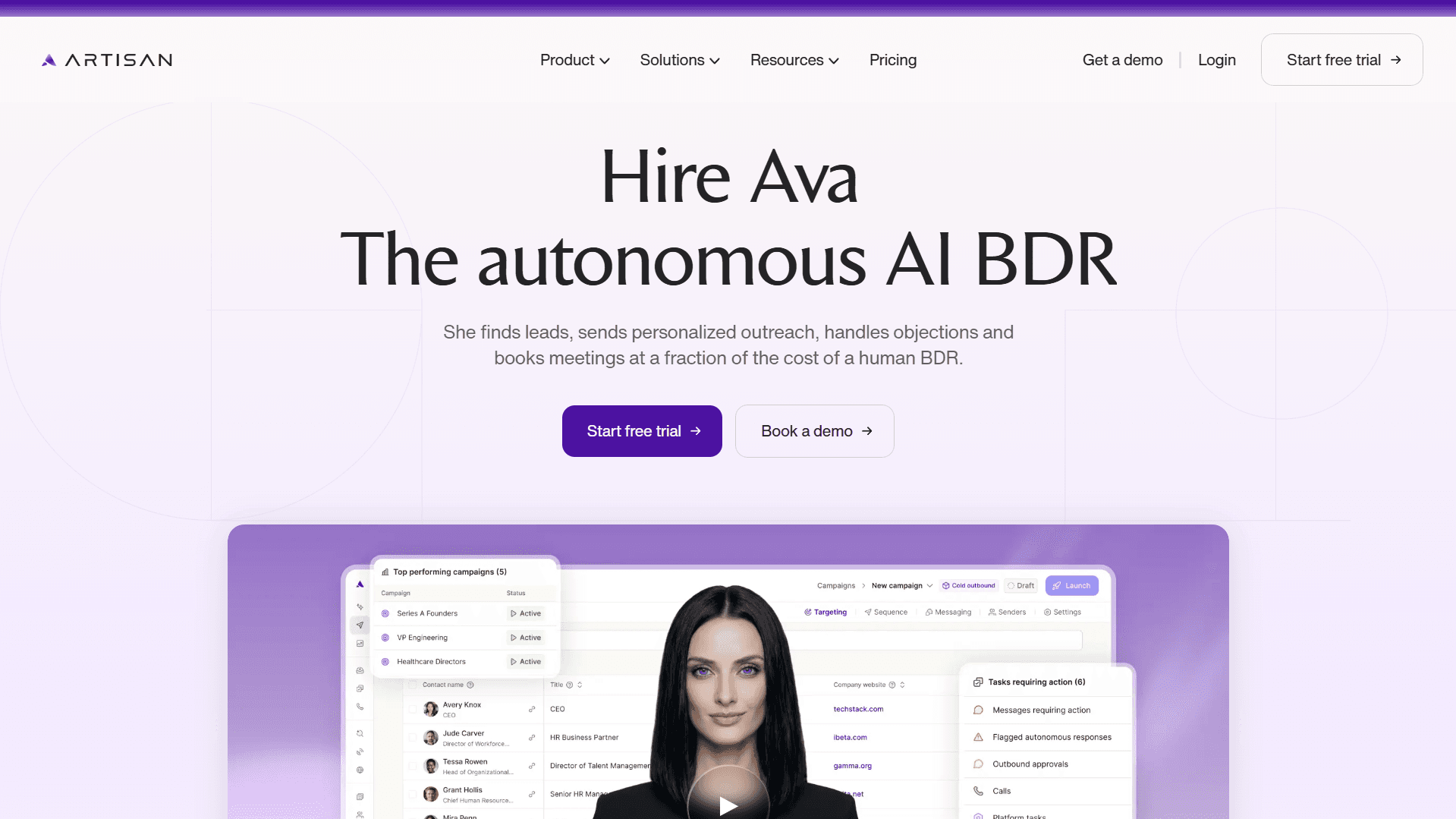
Artisan pairs its own contact database and waterfall enrichment with an AI employee, Ava, who finds best-fit leads, runs multichannel outreach, handles replies, and books meetings. The data and the activation live in one system instead of a data platform plus the humans working it, or a workbench plus the operator building it. You set the targeting and the guardrails; Ava runs the motion, as hands-off or as review-and-approve as you want.
Pricing is usage-based: Ava's work runs on credits, so you pay for the work she actually performs. See how the model works on the AI sales agent page. This is the third path when the real question is who runs the motion, not which data source to license. If you specifically need an enterprise data backbone or a programmable enrichment layer, ZoomInfo versus Clay is still the right comparison. See how Artisan vs. ZoomInfo and Artisan vs. Clay compare directly.
Choose ZoomInfo if...
You are an enterprise or upper-mid-market team where verified data depth drives revenue.
You need US enterprise coverage plus intent signals (Scoops) and visitor identification (WebSights).
You want any rep to search and export without building pipelines.
You have budget for an annual, quote-based contract and mature RevOps to use it.
Choose Clay if...
You have, or will hire, someone data-literate to build and maintain enrichment workflows.
Your targeting is specific enough that no single database covers it and you need to waterfall many sources.
You want transparent, usage-based pricing and are comfortable managing credit consumption.
You already own a data foundation or sequencer and want better, custom-enriched data flowing into it.
Frequently asked questions
Is ZoomInfo or Clay better for a startup?
Clay, for many startups, if you have someone data-literate to run it, because you can start on a free or $167-per-month plan and pay for what you use. ZoomInfo's enterprise depth is real but comes with an annual, quote-based contract that usually outsizes an early team's needs and budget. A startup without an operator, though, may gain more from a self-serve database than from a workbench it cannot staff.
Which has more accurate data, ZoomInfo or Clay?
For verified US enterprise coverage out of the box, ZoomInfo is widely regarded as the stronger single source, which is what its premium pricing buys. Clay can beat any one vendor for specific, hard-to-find records because it waterfalls over 150 providers and lets you cross-check them, but this quality depends on how well the table is built. Test both on your real target list before deciding.
How much do ZoomInfo and Clay cost?
Clay publishes tiers from a free plan to Launch at $167 per month and Growth at $446 per month, per its pricing page, on a usage-based model, with reported median contracts around $30,000 per year at scale. ZoomInfo is quote-based and annual, with buyer-reported entry points around $15K per year that climb with seats, data volume, and add-ons. The transparency gap is one of the clearest differences between them.
Does Clay replace ZoomInfo?
Not exactly. Clay has no first-party database; it orchestrates other providers, so it can substitute for ZoomInfo only if the sources you plug in cover your targets well. Many teams run both: ZoomInfo as the verified backbone, Clay as the precision layer that waterfalls extra sources and fills gaps. Whether you need both depends on how specialized your targeting is.
Do ZoomInfo or Clay run outreach for you?
No. ZoomInfo is data-first with execution as an add-on; Clay enriches data and hands it to a sequencer someone else operates. Neither writes messages, sends them, or works replies on its own. An autonomous model, where an AI employee runs the full workflow, is a separate category covered in our guide to the AI business development representative (BDR).
Is there an alternative to both ZoomInfo and Clay?
Yes, if your goal is booked meetings rather than better data. Artisan is an autonomous platform where an AI employee, Ava, sources leads from its own database, enriches them with waterfall logic, runs the outreach across email, social media, and dialer call steps, handles replies, and books meetings. Instead of buying a data source or an enrichment workbench and staffing the work around it, you buy the outcome. Compare the model on the Artisan pricing page.
What changed with ZoomInfo recently?
ZoomInfo repositioned around a go-to-market intelligence platform story and now trades publicly under the ticker $GTM. The change is positioning and ticker, not a legal rename, and the core business remains its enterprise data and signals (WebSights, Scoops, and intent). For buyers, the practical evaluation is unchanged: deep, verified, US-heavy data sold on annual, quote-based contracts.
The bottom line
ZoomInfo and Clay are both data tools, but they answer different questions. ZoomInfo is the enterprise data platform: deep, verified, signal-rich, and priced accordingly on annual contracts. Clay is the programmable enrichment layer: transparent, usage-based, unmatched for custom waterfalls, and dependent on a skilled operator. Choose ZoomInfo when you need finished depth out of the box; choose Clay when you need to build data no single vendor sells. And if the goal is to automate the outreach rather than just source the data, you need a different tool. Start from the Artisan homepage to see what running the whole motion looks like.

Artisan Team
Expert insights from the team at Artisan
Our writing team blends direct operational experience, in-house data, and thorough research to bring you the very latest insights and updates about sales and GTM automation.