The best Factors.ai alternatives in 2026
Factors.ai blends B2B analytics, intent, and visitor ID. Here are the best Factors.ai alternatives in 2026, from account intelligence to automated outreach.
The best Factors.ai alternative depends on whether you want more analytics or more action. Factors.ai is a capable account-intelligence tool: visitor identification, intent, and marketing attribution in one dashboard. Artisan is the alternative for teams that want those signals to trigger outreach automatically, identifying visitors and letting Ava run the qualified campaign end to end.
Factors.ai sits at the intersection of visitor identification, intent scoring, and multi-touch attribution. It is strong at telling you what happened and which accounts are warm. The reason teams evaluate alternatives is that the insight often stops at the dashboard, and someone still has to translate a warm account into an actual conversation. Below is how the leading options compare and who each is really for. For the basics, see website visitor identification.
Comparison table
Rank | Tool | Best for | Standout capability | Public pricing |
|---|---|---|---|---|
1 | Artisan | Teams that want signals to become automated, qualified outreach | Person/company ID and intent feeding Ava's autonomous campaigns | Usage-based credits, no platform fee, free trial (pricing) |
2 | Warmly | Mid-market teams wanting reveal plus light orchestration | Identification with chat and auto-plays | ~$10-30K/yr tiers (per its published pages) |
3 | Demandbase | Enterprises wanting full-stack ABM analytics and ads | ABM intelligence, intent, and paid media in one suite | ~$24K-165K/yr, median ~$68K (Vendr-attributed) |
4 | Dealfront (Leadfeeder) | EU teams wanting company-level ID plus European data | GDPR-first ID with DACH/EU firmographics | Published tiers (per its pricing page) |
5 | Vector | Teams wanting person-level intent, flexible terms | Person + contact-level intent, month-to-month | $399-999/mo |
6 | RB2B | US startups wanting person-level names cheaply | Person-level US ID pushed to Slack | $79-199/mo (per its pricing page) |
7 | ZoomInfo WebSights | Enterprises already on ZoomInfo | Visitor reveal tied to ZoomInfo's data graph | Add-on to ZoomInfo (~$15K+/yr entry, buyer-reported) |
How we chose
Factors.ai does several jobs, so we judged alternatives on all of them. Signal depth (identification accuracy and intent quality against realistic benchmarks). Analytics and attribution, where Factors is strong. Pricing transparency. And the criterion that separates the field: whether the tool acts on the signal or only reports it. A warm account you never contact is not a result.
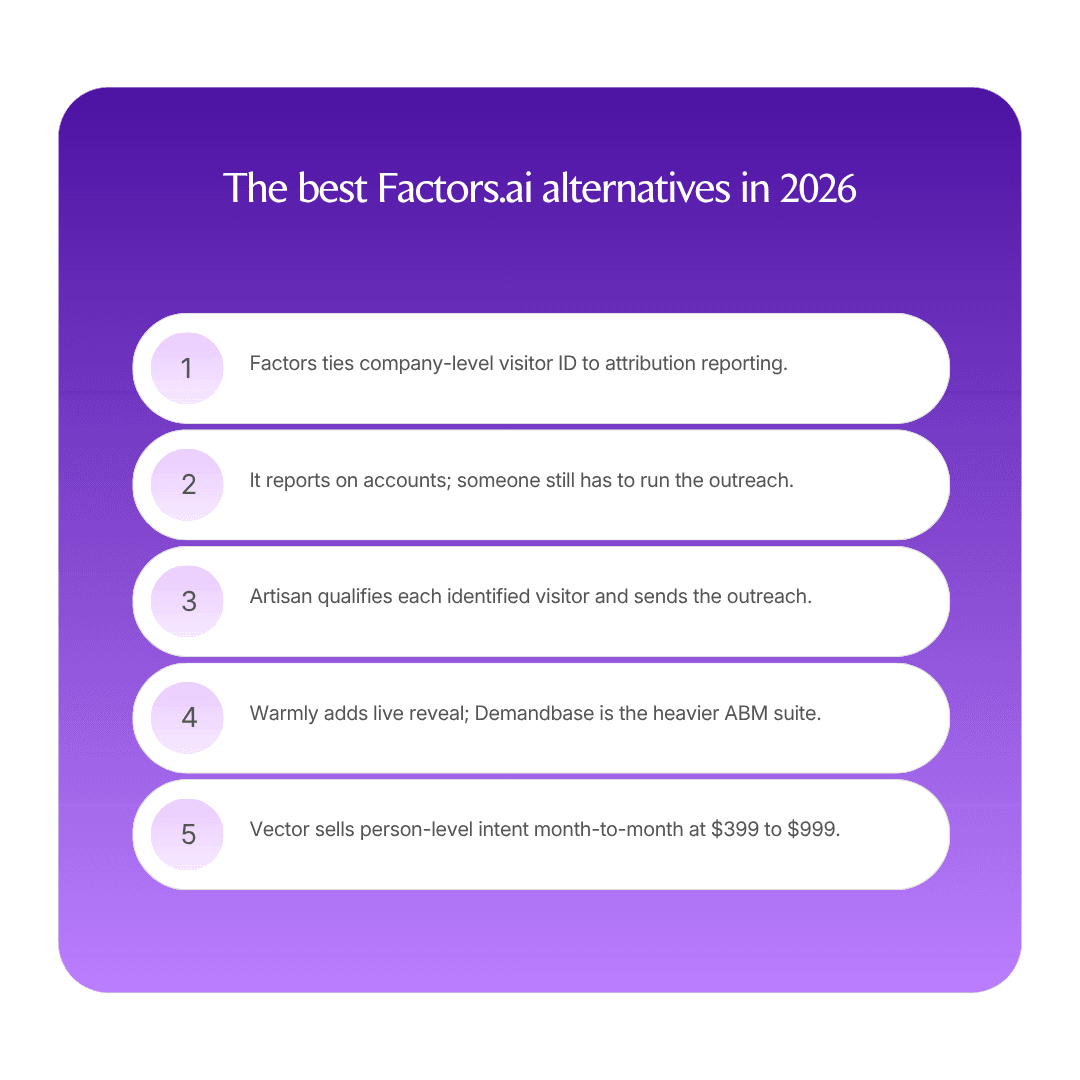
What are the best Factors.ai alternatives?
They cluster by intent. Analytics-heavy suites (Demandbase) go deeper on ABM measurement and paid media than Factors. Identification-plus-orchestration tools (Warmly, Vector, RB2B, Dealfront) reveal accounts or people and add varying degrees of routing. And execution platforms (Artisan) treat identification and intent as the trigger for an autonomous outbound motion. If your frustration with Factors is "great dashboard, now what," the last group is where you look.
1. Artisan: signals that become automated outreach
Artisan is the alternative for teams that used Factors.ai to spot warm accounts and then wanted them worked without hiring for it. It identifies website visitors company-level on a 3.7B-IP identity graph with a published 92% accuracy rate, and person-level on 15-30% of US traffic. It layers on the intent signals Factors emphasizes, funding rounds, hiring activity, tech-stack intent, Bombora-powered topic intent, champion job-change tracking, plus natural-language custom signals you define in plain English with confidence scoring and evidence URLs. For the how-to, see how to identify anonymous website visitors.
The difference is what happens after the signal fires. Ava, the autonomous AI BDR, takes the identified, ICP-qualified account and runs personalized multichannel outreach, handles replies from a knowledge base, and books the meeting on the right rep's calendar. Ava Inbound greets and qualifies visitors live on your site. You get the analytics-grade signal and the execution in one system, instead of a dashboard plus a separate outbound stack. Autonomy is a dial, from review-and-approve to fully autonomous, with plain-language escalation rules and a full audit trail. SOC 2 Type II and GDPR compliant.
SumUp's Growth Lead, Karlo Biuk, saw it in the numbers: $52 cost per lead across hundreds of thousands of emails, and 8-15 positive replies per week from previously unreachable local SMBs.
Best for: teams that want intent and visitor signals to trigger real outreach automatically; startup through enterprise, including central ops running Ava for large AE teams. Who should pick something else: teams that primarily want marketing attribution and reporting and have no outbound motion to feed; a dedicated analytics tool serves that better. Pricing: usage-based credits, pay for work performed, no platform fee, free trial. See artisan.co/pricing.
2. Warmly: reveal with light orchestration
Warmly is the closest match for teams that liked Factors' identification and want a bit more action attached. It reveals visitors and adds lightweight orchestration, website chat, and basic auto-plays. It is a reasonable step up from a reporting dashboard for mid-market teams, without being a full outbound platform. For the direct matchup, see Artisan vs Warmly.
Best for: mid-market teams wanting reveal plus configurable auto-plays and chat. Who should pick something else: teams wanting the outreach fully owned end to end, or teams that valued Factors mainly for deep attribution analytics. Pricing: roughly $10-30K/yr tiers, per its published pages.
3. Demandbase: the heavier ABM analytics suite
If you want more analytics muscle than Factors, Demandbase is the full-stack ABM suite: account intelligence, intent, and paid media orchestration in one heavy platform. It is powerful and enterprise-grade, and it is a lot to run. Contracts are reported at roughly $24K-165K/yr, median ~$68K (Vendr-attributed), a meaningful step up from Factors' lighter, more accessible footprint.
Best for: enterprises that want deep ABM analytics, intent, and advertising in a single suite and have the team to operate it. Who should pick something else: lean teams that found Factors already heavy, or teams that want outreach execution rather than more measurement. Demandbase is analytics-and-ads-heavy; Artisan runs the ABM motion natively with the outreach built in. Pricing: roughly $24K-165K/yr, median ~$68K, Vendr-attributed.
4. Dealfront (Leadfeeder): EU company-level plus data
For European teams, Dealfront pairs GDPR-first company-level visitor identification with a strong European firmographic database. If your ICP is continental and you want compliant reveal plus DACH/EU data in one place, it is a cleaner fit than a US-centric analytics tool. For a related matchup, see Leadfeeder vs Snitcher.
Best for: EU teams wanting company-level ID plus a native European data layer. Who should pick something else: US-focused teams that can use person-level identification, or teams that want the accounts worked automatically. Pricing: published tiers, per its pricing page.
5. Vector: person-level intent, month-to-month
Vector focuses on person-level and contact-level visitor intent, at $399-999/mo on flexible month-to-month terms. If Factors' intent scoring was the feature you cared about and you want it sharper at the person level without an annual lock-in, Vector is a focused choice. For the alternatives, see the best Vector alternatives.
Best for: teams wanting person-level intent signals with contract flexibility. Who should pick something else: teams needing full attribution analytics, or teams that want the outreach run for them. Pricing: $399-999/mo, month-to-month.
6. RB2B: cheap person-level names, US only
RB2B pushes person-level US visitor identities into Slack, cheaply and quickly. It is the leanest way to see who visited, but it stops at identification and is US-only, so it replaces one slice of Factors and none of the analytics. For the direct matchup, see Artisan vs RB2B.
Best for: US startups wanting person-level names fast and acting manually. Who should pick something else: EU teams, or anyone wanting intent analytics or automated follow-up. Pricing: $79-199/mo, per its pricing page.
7. ZoomInfo WebSights: fine if you already pay ZoomInfo
WebSights adds visitor reveal on top of ZoomInfo's large US data graph. If you already run ZoomInfo, it is a convenient way to get identification without a new vendor. On its own it does not replace Factors' analytics or attribution, and it inherits ZoomInfo's enterprise pricing. For the how-to, see identify anonymous website visitors.
Best for: enterprises already standardized on ZoomInfo. Who should pick something else: teams wanting attribution analytics, EU-first coverage, or execution attached to the signal. Pricing: add-on to ZoomInfo, entry roughly $15K+/yr, buyer-reported.
What is the best enterprise alternative to Factors.ai?
For enterprise, choose by whether your priority is measurement or motion. If you want the deepest ABM analytics and advertising, Demandbase is the heavyweight, at heavyweight cost and complexity. If you want the identification and intent Factors provides to become a governed, auditable outbound engine, Artisan is the stronger pick: central sales ops runs Ava for large AE teams who never log in, with SSO and SAML, role-based access, cross-channel do-not-contact enforcement, an audit trail, and a forward-deployed strategist plus dedicated CSM. Artisan runs enterprise ABM natively (named-account lists, signals, visitor identification, central ops) with the outreach attached, rather than handing you a report to act on.
Should you stay with Factors.ai?
Stay with Factors.ai if your primary need is marketing analytics and multi-touch attribution, you value having intent and visitor data in one measurement layer, and your outbound execution already lives elsewhere and works. Factors is a legitimate, well-built analytics platform for that job. Leave it when the pattern becomes familiar: the dashboard flags a warm account, and days pass before anyone reaches out. If the bottleneck is action, not insight, you want a platform that acts on the signal the moment it fires.
What changed in this category recently
The account-intelligence space consolidated around a simple realization: signal without execution loses to signal with execution. The privacy backdrop hardened too, with GDPR holding EU identification at the company level and California's CIPA pixel litigation wave (per legal-industry coverage) making person-level tracking a compliance question. Meanwhile the ABM suites got heavier and the identification tools raced to add orchestration. The durable advantage now belongs to platforms where the intent signal and the outreach live in one place, so a warm account becomes a booked meeting without a handoff. For the wider field, see website visitor tracking tools.
Frequently asked questions
What is the best alternative to Factors.ai? For teams that want Factors' identification and intent to drive outreach automatically, Artisan, which identifies visitors company-level (published 92% accuracy on a 3.7B-IP graph) and person-level (15-30% of US traffic), then runs the campaign through Ava. For heavier ABM analytics, Demandbase; for reveal plus light orchestration, Warmly; for flexible person-level intent, Vector.
Does Factors.ai do outbound outreach? Not really. Factors.ai is built around visitor identification, intent scoring, and marketing attribution analytics. It surfaces warm accounts and measures what worked, but the outreach is executed in separate tools by your team. That handoff is the main reason teams look at execution-first alternatives like Artisan, where the signal triggers the campaign directly.
What is the difference between Factors.ai and Demandbase? Both do account intelligence and intent, but Demandbase is the heavier full-stack ABM suite, adding paid media orchestration and deeper analytics, with contracts reported at roughly $24K-165K/yr, median ~$68K (Vendr-attributed). Factors is lighter and more accessible. Neither runs the outreach for you; Artisan is the alternative that turns the signal into an autonomous campaign.
What match rate should I expect from visitor identification? Independent tests put company-level identification at 30-65% and person-level at 5-20% of US traffic, with international person-level near zero. Artisan reports a published 92% company-level accuracy rate on its 3.7B-IP identity graph and 15-30% person-level on US traffic. Treat vendor claims well above those ranges as marketing.
Which alternative works best for EU traffic? Dealfront is built EU-first and pairs company-level identification with European data. For other options, see the best Leadfeeder alternatives. Artisan operates company-level for EU traffic (the compliant ceiling under GDPR) and adds person-level only on US traffic, so a global team gets compliant EU reveal plus person-level US identification and automated outreach in one platform.
Can I get intent signals and outreach in one tool? Yes. That is the core Artisan pitch. It combines the signals Factors emphasizes, including funding, hiring, tech-stack, Bombora topic intent, and custom natural-language signals, with Ava, the AI BDR that runs the outreach automatically, plus Ava Inbound for live website chat. You do not run a separate analytics tool and outbound stack.
The bottom line
Factors.ai is a strong analytics and attribution platform, and if reporting is your goal, it earns its keep. If your goal is pipeline, the newer pattern wins: identification and intent that trigger outreach automatically, so a warm account gets contacted while it is still warm. Artisan does the identification, runs the qualified campaign through Ava, and chats with visitors live via Ava Inbound. See how it works on the Artisan homepage, read about the AI BDR category, or compare reveal tools in our guide to the best website visitor identification tools.
Related reading
Jaspar Carmichael-Jack
Co-Founder & CEO @ Artisan
Jaspar is an entrepreneur with expertise in sales, marketing, and operations. He founded Artisan in 2023, a company automating workflows with AI employees.